Wednesday, September 13, 2017

I Literally Walked into Sacred Geometry


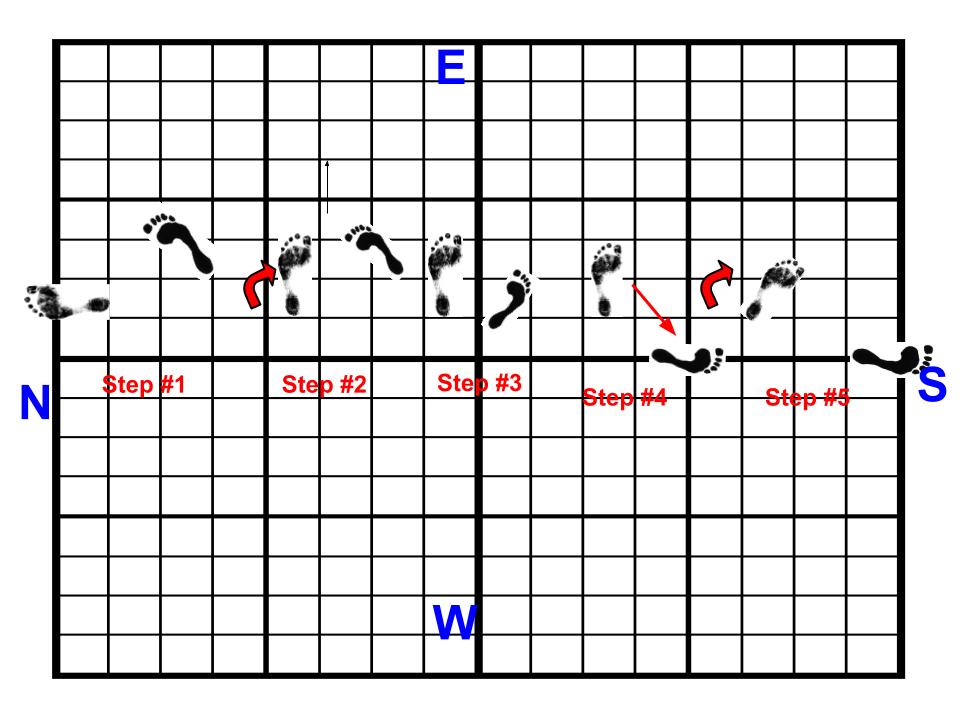
In teaching Tai Chi to older adults it is best to combine teaching the internal principles along with the form, which means you are basically reteaching people how to walk and move. After warm-ups, I have everyone pick a linoleum tile and place the feet heel to heel in a right angle on a corner on a tile. We stand like that for a moment and I have them take a step forward with their right foot, and about 4" over with their left foot, leaving their right on the square but turned at a 45 degree angle. As you are reading this you might be trying to visualize a bunch of older adults assembled in rows standing on a grid-like pattern.
taichi-wisdom.ppt (2).jpg

I have been teaching Tai Chi to older adults since 2001 and it took me awhile to catch on how to difficult it is for older adults to get into a bow stance and especially when turning 180 degrees with clear aligned movement. After so many students having difficulty I started using the tiles on the floor along with a cardinal directional sign on each of the four walls. As I started to create these methods of teaching people to do Tai Chi I realized that there was a geometric logic to how we align ourselves to the earth. When looking at the illustration (above) you can see one possible way sacred geometry developed. If you stay in one place facing north and turn around in a complete circle it will be 360 degrees. Then going back to basic geometry you can divide that up an infinite amount of ways but typically we divide it up first in quarters and then in eighths, hence the origin of the bagua (Pictured below).
Related image
That inspired me to seek out geometric relationships in Tai Chi, moreover, when I was exploring Tai Chi I became aware of Feng Shui and their usage of the bagua.  I also knew that the original 13 postures of Tai Chi are patterned off of the very same bagua symbol; eight main postures and five secondary ones (pictured below). These connections made me appreciate Tai Chi even more because the whole Taoist system worked in concordance with one another. There was not too many contradictions, although there are smaller discrepancies with certain assignments of what fits into which area, for instance, an animal and an emotion and actually everything in existence is prescribed to each cardinal direction.   


As the caption states in the 13 postures of Tai Chi, there are 8 energies and directions, which are also added to the elemental directions of the 5 elements, north, south, east, west, and center.


The early Chinese people created a compass (pictured below) that linked up the waxing and the waning of the moon with the 8 directions and this was used to predict floods and then more was added on to it. The I Ching or Book of Transformation was also created from there. The early Chinese people figured that significant events occur during the seasonal changes, i.e. floods, winter, harvest season etc. The idea is that by understanding the natural forces one could prepare ahead of time and avoid more acute emergencies.
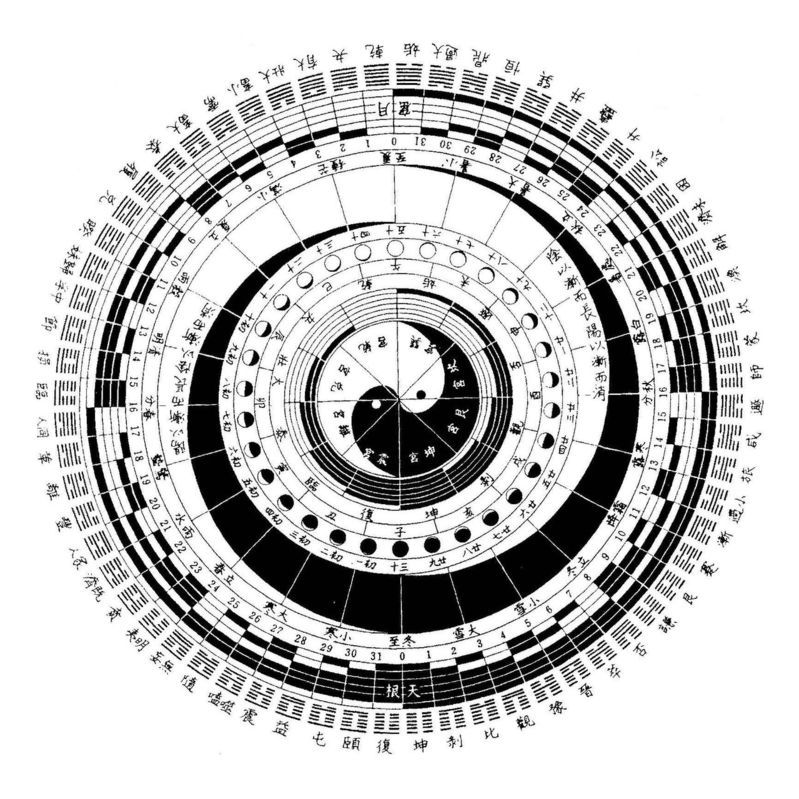

Other cultures have discovered many of the same ideas; stonehenge follows the same circular formations as does the Kabbalah with its numerical structure. The phases of the moon are based in reality but the socially constructed aspect of attributing certain emotions, elements, animals to each phase is where there is not cross cultural corroboration. This doesn’t mean it is not worth studying. I view it more as an art form that deserves respect and consideration. An interesting fact is how deeply our psychology and physiology is tied to night and day. Circadian rhythms and seasonal patterns are strong determinants of hormonal secretions and


they play a major role in our psychological functioning as well of the well being of our vital organs.   


As you can see there are many connections with codified symbols found in Taoism that connect the heavens to man and to the earth. Another example of this intense connection is  the 64 hexagrams, 32 yin and 32 yang found in the I Ching, and their exact match with the 64 codons found in DNA.
Here is the conclusion of a paper on the connection between DNA and the I Ching:


“ —We defragged three I Ching representations of the genetic code while emphasizing Nirenberg's historical finding. The synthetic genetic code chromosomes obtained reflect the protective strategy of enzymes with a similar function, having both humans and mammals a biased G-C dominance of three H-bonds in the third nucleotide of their most used codons per amino acid, as seen in one chromosome of the i, M and M' genetic codes, while a two H-bond A-T dominance was found in their complementary chromosome, as seen in invertebrates and plants. The reverse engineering of chromosome I' into 2D rotating circles and squares was undertaken, yielding a 100% symmetrical 3D geometry which was coupled to a previously obtained genetic code tetrahedron in order to differentiate the start methionine from the methionine that is acting as a codifying non-start codon”


The depth of early Chinese people is astounding, even today this at least 4000 year old symbol still influences and explains phenomena in our lives. I think the reason why is that these early Taoist masters discovered a spiral network of energy vectors that determine all growth on this planet. They called these energy vectors “Chi” or “Qi.” Admittedly, the word Qi did not arrive until later years after the I Ching was created, nonetheless is it currently used in this manner to describe these energetic vectors and hence the 8 energies of the Tai Chi movement. So from a simple joint lock, to the structure of DNA to the Milky way solar system we are constrained by a spiral force that connects all life and all inanimate objects to the earth rotation and its evolution around the sun. Just to be clear, I am not a proponent of divination. I know this kind of thinking has led to over use to put it mildly. I am speaking from a physical science perspective. That said, this movement has an affect on us and it is hard to figure out just how much because there is no counterfactual ideal. We do not have another galaxy to measure its effect on the beings there. You may think I am starting to go off the deep end. There are people who I have run into who love sacred geometry but end up tying the origin of it to aliens. Believe me it gets even weirder with when the illuminati conspiracies start piling up.


As with many of the phenomena I write about, I am able to parse out the wheat from the chaff and where there is unknown I simply leave it at that. I don’t need to believe in aliens or a personal god either to substantiate the physical reality of certain things. I also don’t need to deny it all and be an atheist either.
Image result for flower of life


Another thing that happened when I was teaching the 180 degree turns was I saw how the foot positions fit within a box grid and if you draw diagonal lines and add circles it can become a flower of life. The flower of life (pictured above)is something in many cultures together, even Leonardo Da Vinci drew this in his Codex. Of course explaining the relationship between Davinci, stonehenge, the Kabbalah, and the I Ching could be an endless exploration that is not suited to the purpose of this blog post. If you are interested there are hundreds of videos and books on this topic but be forewarned that you will be hearing some crazy theories.


Anyway back to Tai Chi
I have always wondered why all the Tai Chi forms don't sync up with the bagua (8 directions), wu xing (5 elements) (pictured below) and ultimately the I Ching. Fortunately, I found Tai Chi According to the I Ching by Stuart Alve Olson who brilliantly tackled my dilemma. Per usual for Olson, he breaks everything down and backs it up with the ancient texts to support his reasoning. I have been searching for a truly symmetrical form for years and thanks to Mr. Olson I finally have that..   
Image result for wu xing


Conclusion
One of the reason why I love Tai Chi is because there is this internal logic that starts really small like with a step and then expands outwards to encompass the whole universe, the Chinese call it the microcosm and the macrocosm. Is it scientifically sound? I  am not sure but I think it is worth investigating. Moreover, humans love symmetry we seek it out whenever we can and I find discovering the underlying symmetry in Tai Chi increases my love of it and enhances my personal practice.

Tuesday, August 22, 2017

Every Time I Hear “Opioid Crisis” It Makes Me Angry!

I have been teaching Tai Chi part-time in Oxford, Mississippi on and off since 2001. I love teaching and recently, I had to reluctantly send an email to my Tai Chi class saying that I had to cancel because of a backache. I was laid out in pain for 5 days. I did go to work but I was in unbearable pain. I called my chiropractor, John Gianini and my massage therapist, Shireen Mullink, and set up a bunch of appointments. After two weeks and over $400 out-of-pocket, I was much better.

While I was laying in bed, I got a chance to catch up on current events. One of the stories that struck a chord was The Opioid Crisis! It seems like there were all of a sudden hundreds of articles on this one issue. It appears that people are worried about chronic pain only when people are overdosing. Obviously, my back pain drove home all the components of this issue for me such as, cost of treatments, time off from work, pain, pain and more pain. It sucks to be in pain.

So the Opioid Crisis is an important issue without a doubt, one person dies every day from an opioid overdose in the US and many more have misused them and some even resort to heroin after they are no longer able to get their prescribed drugs. Government agencies are taking this serious and arresting doctors for selling them illegally and suing pharmaceutical companies for not disclosing risk levels and recommending that doctors prescribe them for diagnoses beyond their proven effectiveness.

So why does hearing about the opioid crisis make me angry?

All the aforementioned activities are great but what you are not hearing about the Opioid Crisis is that it is about pain, real pain people are feeling and zero promotion of nonaddictive alternative treatments for their pain. In one 2006 study that sampled a total of almost 8,000 people, 262 of which were opioid users, of which 59.3% of those had chronic lower back pain, and 89.6% of those 262 people also suffered from multiple pain issues. So for the most part the opioid crisis is affecting two groups, older adults in pain, and younger adults who are abusing opioids to get high or experiment. It looks like we need to separate out target populations and address substance abuse in younger adults, while addressing chronic pain in people over 40.

In this story by Vox entitled, How to Stop The Deadliest Drug Overdose Crisis In American History, there is not even a sentence regarding alternative non-addictive, non-drug treatments, like chiropractic, acupuncture, massage, Tai Chi and yoga.

From drugabuse.gov’s website, “The bulk of American patients who need relief from persistent, moderate-to-severe non-cancer pain have back pain conditions (approximately 38 million) or osteoarthritis (approximately 17 million.) “ It mentions nothing about alternative treatments for chronic back pain.

The real issue at the heart of this crisis is that the conventional medical world promotes pain pills and surgery for many problems when they are not needed and they scoff at chiropractors, acupuncturists and anything outside their area of expertise. There has been a battle in this country since the advent of conventional medicine. I am not going to go into the whole issue here but complementary and alternative treatments for back pain have been researched and much of it looks promising, for acupuncture , Chiropractic, massage, yoga and Tai Chi. I say the research looks promising but some of it is older and it is not as rigorous as other medical interventions because frankly the funding for research is not there for these treatments. In other words, they do not rake in huge profits for the power elite of the medical world. Another part of the problem is that many of these alternative treatments are part of the anti-vaccine crowd, which irresponsibly encourages the public to stop vaccinating their children and they promote of unverifiable theories regarding how the body works, i.e chi, prana and meridians. These types of issues make it hard for medical professionals to promote alternative treatments. However, it is possible to separate out what is effective and what is not, just like what we have to do with many medical practices.

In the first paragraph in this article I said I had been teaching Tai Chi since 2001, and that was also when I started my first healthcare job in an elderly facility as an activities assistant. After a few years of working with older adults, most of whom had some kind of disability, I noticed that many disabilities were totally preventable and had they done some kind of alternative treatment might never have needed to enter an assisted living facility. I started to formulate a larger mission to my classes and was soon teaching at the local community center. There were difficulties in funding which curtailed the growth of the class and I was against creating a business because I wanted to reach all older adults, most of whom are on a very tight budget. That vision prompted me return to university and get my BA in psychology, and on to graduate school to complete a master in public health. I chose public health because I wanted to prevent these easily preventable disabilities with Tai Chi and other alternative treatments. I enjoyed my time in academia and published a few papers. Unfortunately, I was so naive to think that Tai Chi would be accepted as a credible intervention. I even did my master’s project on Tai Chi as a prevention for cardiovascular disease. I found that the evidence required to prove the effectiveness of Tai Chi is hard to acquire because there are only a few good studies out there. Basically, it all comes down to funding. Recognizing this I shifted my focus on nutrition and worked with some nutrition researchers documenting dietary behaviors and their association with indicators for cardiovascular disease. It was a great learning experience but it was also a departure from my life's vision, which is the use of Tai Chi and alternative healing for the prevention of chronic disease and disabilities.

One of the things I attribute to my success as a teacher, an activities person and as a researcher was that I also suffer from a chronic pain problem. As I have written many times before, when I was 19 and working my way through college I fell off a ladder while painting a giant boiler in an office building. It resulted in a broken scaphoid bone, which is a small bone in the wrist. The problem with that kind for break is that it “heals” quickly and is often misdiagnosed as a slight sprain. Once the sprain "heals" many, myself included don't go to the doctor,. The real problem starts as one ages because the hand becomes weak and then pain increases. Then you go to the doctor and it is often misdiagnosed as carpal tunnel syndrome. So years later when I finally went to see a doctor for the pain in my wrist, I was given a carpal tunnel syndrome diagnosis and he only wanted to give me pain meds. I was 30 years old at that time and I thought that was weird; surely there was something else? I didn’t see how pain meds would cure my pain.

That off putting experience with a conventional medical doctor prompted me to seek out an alternative doctor; I soon found a naturopath. He suggested I find a Tai Chi class and he also offered acupuncture in his practice. I tried those treatments and they have been successful in managing pain and maintaining my range of motion. I am 52 now and have been working with these healing treatments consistently for the past 22 years. My wrist is not healed in the sense of a normal injury. Scaphoid injuries never truly heal for a number of reasons, so I suffer from avascular necrosis and feel pain daily. I do take pain meds every so often when it flairs up. Since I have been living with this for a very long time I know myself and my body and have come to realize that massage works the best because the pain builds up from being used when other parts of my body are tight and exacerbate the pain in my wrist. A massage works out the stress in my forearms, shoulders and hands, which reduces the wrist pain. Unfortunately, the problem is massage costs anywhere from $70 to $100 dollars for an hour visit. And I do not always have that kind of money to spend. I feel if I were able to get at least one massage and a few chiropractic adjustments per month I would much better manage my chronic musculoskeletal pain. 

Unfortunately, alternative treatments are not promoted by the professionals who are on the front lines of this pain epidemic. When someone sees a doctor, few if any doctors are going to offer an alternative treatment. Moreover, even if doctors did recommend an alternative treatment it would have to be paid for out-of-pocket as few insurers reimburse for them. I believe that if our health system integrated and reimbursed for alternative treatments for pain we would see less people becoming addicted to opioids.

Thursday, June 22, 2017

Martial Arts Restored My Self Respect

As I have mentioned in a few blog posts already, my parents were hippies from Brooklyn and moved to a working class town where there were no hippies, while I was in elementary school In the early 70s. I already discussed my first steps on the martial path but in this post I am going briefly review what I went through and then detail how I went about restoring of my own self-respect.

During that 5 to 6 year period of being bullied, I truly felt horrible about myself. I dreamed of killing my classmates often. I wanted nothing out of life but revenge and I thought of little else, my grades plummeted and I was put into Special Education, after the football players in honors class kept punching me when the teacher turned his back. People laughed at me daily; teachers were of little help; and girls stayed far away from me. To this day, I remember those kids surrounding me in the bathroom, while the head football player peed on my sneakers. They all just sat there laughing but that was the moment I said enough is enough!

Then I saw Bruce Lee's movie, Game of Death, and I instantly knew what I had to do, I enrolled in a karate class. Even though it sounds a lot like the movie Karate Kid, this happened 5 years before the movie came out in 1984. I got into weapons right away. I was also in shop class and I started making my own weapons, like wooden swords, a kai, which is a Japanese oar used in traditional karate, tonfas and many others. Even though, I didn’t see it at the time, it was an exciting period because  I was unifying my creativity, my physicality and my mind, as I began doing my own research. I started going to the library and bookstores finding the information I needed to solve my bully problem. School had a little value to me, no one there either cared or tried to uncover what was going on with me. I may have put up a wall I am not sure. Regardless, for the first time in my life I had a plan, it was plain and simple...fight back.

At 14 years old, I was the youngest person in my karate class, most of the people were in their 20s and 30s. When we sparred they knocked me on my ass. This was not a kid's class. I started training regularly and I would find peace of mind for the first time in my life, when I was doing the numerous katas I had to memorize in my backyard. I loved karate weapons but my teacher would not teach them to anyone until they were older. So I had to find access to weapons on my own. I made a lot in shop class or when my family went to Chinatown in Manhattan every now and again, I would go to the kung fu shops and buy Bruce Lee posters, nunchaku, throwing stars, etc etc.  I loved everything about karate and kung fu. It gave me a purpose and things really started looking up for me for the first time in my life.

Then one day after school, as we were all chaotically heading to the buses, one of the bigger football players, also wrestler, confronted me in the parking lot. I don't recall the details as I was pretty nervous, but I do remember that he made a move to grab me and I let go a round house kick to his head. All the students stopped motionless, and he hesitated and backed off. This was no small feat, no pun intended, because a few months ago, I was this kid who didn't do anything when a group of kids peed on his new sneakers, and now that little cry baby just kicked him in the head in front of everyone in the school. Luckily for me it shocked him so much that he left me alone that day. I really got lucky because a few weeks earlier he had beat up one of the larger hippie freaks, yes this was the era of the freaks and the jocks. Not only did this football player beat that kid up but he had hit him so hard that the hippie went into convulsions while he was unconscious on his back. I did not witness it but it was the talk all over the school for weeks and here I am kicking this guy in the head. Well, my luck did not last long, I soon became labelled as a fighter and being 130 pounds soaking wet, people were eager to test me and the football players smelled blood. So the stakes increased and on top of that my karate school closed down. My father also said we couldn't afford it. I cried and cried I still feel the pain of that closure. I did not have the luxury of withdrawing in my shell, I had to adapt to the new circumstances.

One of the very few positive moves my father made was to buy a home with a wood burning fireplace in it and he made me chop all the wood for it. I should mention that I was diagnosed with dyslexia and there wasn't much being done for people like myself in the 70s. If it had been today I would most definitely have been given Prozac because in my later years I was diagnosed with ADHD. So my father knew I was a handful and this "prescription" of chopping wood was perfect for me. My strength and power increased tremendously but I no longer had a teacher. I searched and searched, remember this wasn't the day when there was a karate school on every block. That school was the only school in town.

The karate school closure coincided with the rise in popularity of boxing, between Rocky movies, and Martin Scorsese's The Raging Bull, and famous fighters like Sugar Ray Leonard, Roberto Duran and Thomas Hearns people were really into boxing in those days. Being Italian-American those movies of Italian boxers really spoke to me and one of my friend's brother was a boxer in the Marines.  He taught me a few moves informally. I began to train. I sold my karate and kung fu weapons for boxing equipment, a heavy bag, a speed bag and a jump rope. I began running and training daily. I developed a routine, I would come home from school and instead of practicing my katas, I began running, and training hard by shadow boxing, hitting the heavy bag, jumping rope and doing push-ups. I did this routine right up until dinner time. I knew that the football team trained hard and even had their own weight-training coach. So if I was going to fight them I would have to work as hard as them. As I started to train word got out, people saw me running around town throwing punches in the air. Since boxing was popular many people got into it. People began asking me to spar with them. I had my own informal sparring ring in my basement, instead of rope it had brick walls. I began sparring and sparring and sparring. I sparred as much as I could. I even had to promise my friends, who wouldn't spar with me otherwise, that I wouldn't throw any punches and they could try to hit me. We did that often and I got good at dodging punches, and I have the scars on my left eyebrow when I let them hit me as hard as they could until I bled-I had to imitate that scene when Jake LaMotta told his brother to hit him in the face in the movie the Raging Bull. I was Italian-American after all.

As my skills were improving and I started turning the tables on those bastard football players, I decided to enter the Golden Gloves tournament in NYC. Without any coach or anyone but my uncle and my dad in at my corner, I entered the ring against a seasoned fighter from Fort Apache Bronx Boxing Gym. They put out top professional fighters.  As soon as I stepped out when they called my name to fight, I was bombarded by lights and TV cameras. The ref made us touch gloves and bam bam, this guy was all over me and the ref stopped the fight within two minutes of the first round. I did not get knocked down but I was totally outclassed and overwhelmed.  

After that experience, word must have spread about me in my little town, and some old Irish guy, named Pat Finneran showed up at my house asking if I wanted to learn how to box. He was 72 years old and worked as a boxing coach in the Bronx. He was the first person to actually genuinely express interest in my well-being. He was the first person to show me why discipline is so important. He made me shuffle with my left leg leading up and down my driveway over and over again. We didn’t do all kinds of crazy drills, or 20 different punches. He simply made me shuffle in and out, with a left jab over and over again. He eventually added a right cross and a left hook and that was all we worked on for 6 months. After those six months no one was able to hit me or to last long with me. I totally outclassed everyone. I fought most of the football team members and beat them bad. The only one who I could not beat was the one guy who peed on my shoes. He was 6' 3" or 4" and around 200 pounds. He was captain of the football team and an all-star baseball player. I fought him 7 times and one time he busted a blood vessel in my eye but I kept fighting him. After those fights no one ever messed with me again. I was liberated and could say and do what I wanted and no one called me names or tried to bully me again.

After accomplishing that I felt like my self respect had been restored and with my new coach I signed up for the next golden gloves tournament but then I met a girl. It was my first girlfriend ever and I was about to graduate high school. I was on top of the world and I went to Pat Finneran and told him I didn’t want to fight anymore. Looking back at myself at that moment I feel terrible because here was a person who really helped me and I left him without so much as a thank you. I hope he knew how much he helped me in my life. When my second son was born I named his middle name Finneran.

Tuesday, June 13, 2017

The A.B.M.S. Mindest

IMG_2143.JPG

  • Always
  • Be
  • Making
  • Stuff

As I have mentioned in other posts, my parents were hippies that made hand-sewn leather goods and sheepskin coats for people in the 70's. As a young child to young parents I would play with the scraps while they were working-I have the scars to prove it. I specifically remember gluing together a leather bag with those scraps. My parents were very creative people and set me off on the road towards making stuff.

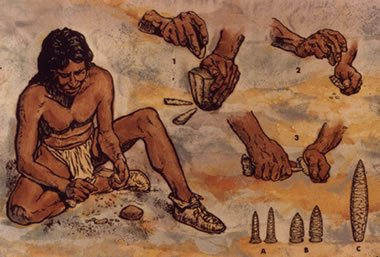
When I graduated high school I wanted to be an artist and began taking classes at a community college. I started in drawing and painting but soon found myself in sculpture. I started carving wood and researching primitive carvings and carving across cultures. I loved anthropology and incorporated many styles in my work. I have carved totem poles and small work alike.

Then my wife and I decided to move to Mississippi, where she was born. Whenever we visit her parent’s land I head off to the woods. They live in a small rural town that doesn’t even have a police station. I call my jaunts in nature, a bushcraft walk because when I go I always do some bushcrafty activities like, build a shelter, identify wild plants or make cordage from plants. I also gather materials and spot and identify them. It is a like a mini-adventure. When I was a kid I loved those shows about a jungle expedition where someone always got stuck in quicksand. Anyway, this is my little way of having an adventure. I have been doing that for over a decade and haven’t gotten caught in quicksand yet.

After doing some research I purchased VHS tapes from Ron Hood’s Woodmaster series. In them, he demonstrated all kinds of projects to make with wood and other natural and found materials. Watching those videos I realized that I could make that stuff while I was in the woods. What really grabbed my attention was the innovative, out of the box thinking, which I think is the hallmark of bushcrafting Ron displayed. In one, he magnetizes a small thin piece of metal and places it on a leaf in a cup of water to determine north, and in another, he sharpens both ends of two 12” long sticks and interlocks them to make a primitive weapon. There were tons of ideas that you can make from everyday items around you.  From that moment on I was hooked and it became a life long hobby. It also paired well with my background in the arts and it made me feel more confident in nature.

To me ABMS is a daily mindset, I am always looking for a resource and seeing what I can make from it. I also try to make something everyday, even if it is a little feather stick and a small fire. Now these things are not pieces to sell at a crafts fair but they keep the juices flowing. The ABMS mindset puts me in creative mode, it builds body heat (during cold days), teaches me about the properties of different materials and finally it keeps my mind occupied. I don’t know if you are like me but my mind is constantly racing around, so this activity keeps me positive and focused.

Friday, May 26, 2017

Five Reasons Why Martial Arts Forms Don’t Suck!

“Those who are enlightened never stop forging themselves. The realizations of such masters cannot be expressed well in words or theories. The most perfect actions echo the patterns found in nature. “ ~ Morihei Ueshiba


The martial arts forms suck argument has been going around the martial arts world for a long time. It states that traditional martial arts are rigid and spend too much time mindlessly following the choreographed forms passed down from antiquity, while a fight in real life is dynamic, unpredictable and spontaneous. The purpose in me writing this is not to totally lay to rest that argument because there are valid points to both.

That said, I do believe that there are good reasons to continue to practice forms. For starters, forms have combat tested moves within them BUT it is up to the motivation of the practitioner to unlock them. It is hard to balance keeping the knowledge alive for future generations, and then letting that commitment go to follow the current trends in fighting. Whether or not the two sides of the argument are right or wrong depends on the context in which we are living. So if you were a police officer I would recommend focusing more on the dynamic fighting part and less on forms. On the other hand, if you are looking for a healthy alternative to gym exercise and want a just little understanding of martial arts then forms are perfect for you. I think the problem comes in when you get confused as to what are your main objectives.
Currently, at this point in the US, violent crime has been decreasing since the 70’s. Sure, there are places where it is bad and it is up to you to understand that in your environment.  Moreover, your context can change for a number of reasons and if it does we have adapt our training accordingly. Currently, chronic disease and accidents top the list of causes of death, with murder not even making the top 10.  When I assess my environment I look at national trends and local ones. In my context, I just don’t see a danger by other humans. Does that mean I turn a blind eye and go on my merry way? Absolutely not, I think it is important to prepare for a possible violent encounter. I just do not think it is necessary to focus everything I do on it. So this is where forms come into play. Like I mentioned previously, the moves are there. So why not practice them to develop your body as a weapon, and in the age of steep cuts to Medicaid, use it to prevent chronic disease?  

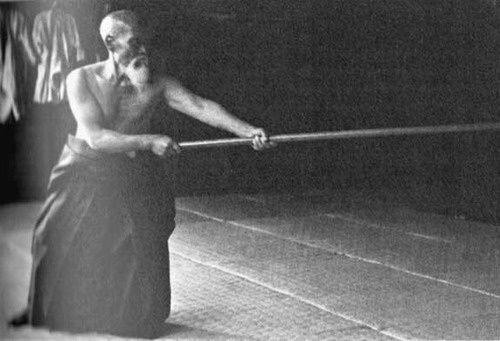
Without a doubt, one of my favorite forms is the Aikido 31 Jo Kata. A “jo” is a Japanese term for a 55” long wooden staff. O’Sensei, who is pictured above holding a jo, created Aikido, a Japanese martial art that uses the flow of spiral energy and joint locks to redirect an opponent’s momentum. O’Sensei used the jo often and created some small sets, consisting of a few moves together. It is said that he developed his love of the jo from bayonet training he did during his service in the Russo-Japanese war.  He continued using the jo until he was a very healthy elderly man. His student Morihiro Saito created the 31 Jo Kata from the different sets O’Sensei passed to him. Here is a video of Morihio Saito performing the 31 Jo Kata.
 
I did Aikido intensely for two years starting 1995 until I got a wrist injury that interfered with my progress in Aikido. I moved to Tai Chi because of the healing benefits, but I really missed Aikido and kept the form in my practice. Despite my love of the 31 Jo Kata, I eventually forgot the moves after a few years. I always wanted to bring it back. I did keep a smaller set memorized and then one day I decided to study Morihiro Saito’s video and regain the form for my training. Now it is a major part of my practice.

I wanted to bring it back because I find that the jo form is beneficial in 5 ways: 
  1. Power 
  2. Fitness
  3. Riai 
  4. Self defense
  5. Fun

Power Doing forms, especially weapons forms, helps you develop proper body mechanics to build power. When you repeatedly strike and move from one posture to another you can work on your body mechanics, which helps you understand the rhythm of releasing power. A great example is let's say you had to break a down a door with a stick or shovel. There are postures in the jo form that follow the same kinetic chain needed to muster the power to accomplish that action. It is not the form that teaches you how to apply the moves, it is your imagination. I figured that one out and now when I practice the form my intent is totally different. Can you practice that move without the form? Absolutely, yes, but the question I would ask is will you. Hell, you might even forget it. The form keeps the postures alive for as long as people practice them, even if they are taught by someone who doesn’t understand them and is a terrible teacher.

Fitness Doing the form over and over again for an hour is a great workout and gets my heart rate beating really hard. I haven’t measured the VO2 Max of it but but I would say that is definitely qualifies as a high intensity cardiovascular exercise, which the CDC recommends you do 75 minutes per week, along with some whole body muscle strengthening exercise. Since the staff weighs about 1-2 lbs and you are swinging it at pretty good speeds, you are definitely strengthening your muscles. Just take a good long look at that picture of O’Sensei (above). He is around 80 years old in that picture. Additionally, there was a study done comparing middle-aged martial arts practitioners with sedentary people of the same age, and it found that the martial artists were healthier on a wide variety of measures.

Riai is a Japanese martial art term that means understanding of the core principles behind the mechanics of punching, joint locks, and throws in relation to weapons training. For example, if you practice yokomenuchi, an overhead strike to the side of an opponent's head, you can see that the mechanics of that strike can be done without a weapon, such as using a hammer fist strike. That same motion can be used in grappling and in a forearm block. The idea of forms is to use your imagination and partner practice to unlock these relationships and innovate other uses. To me this is the main reason to keep forms alive. The danger comes when we mindlessly practice these forms and then think mindless practice alone will help us overcome an attack, or worse when we think we are invincible simply because we practice them. This is why I think the argument against forms is important. It keeps us honest.


Self defense
chris-kid-martialarts_0009.jpg
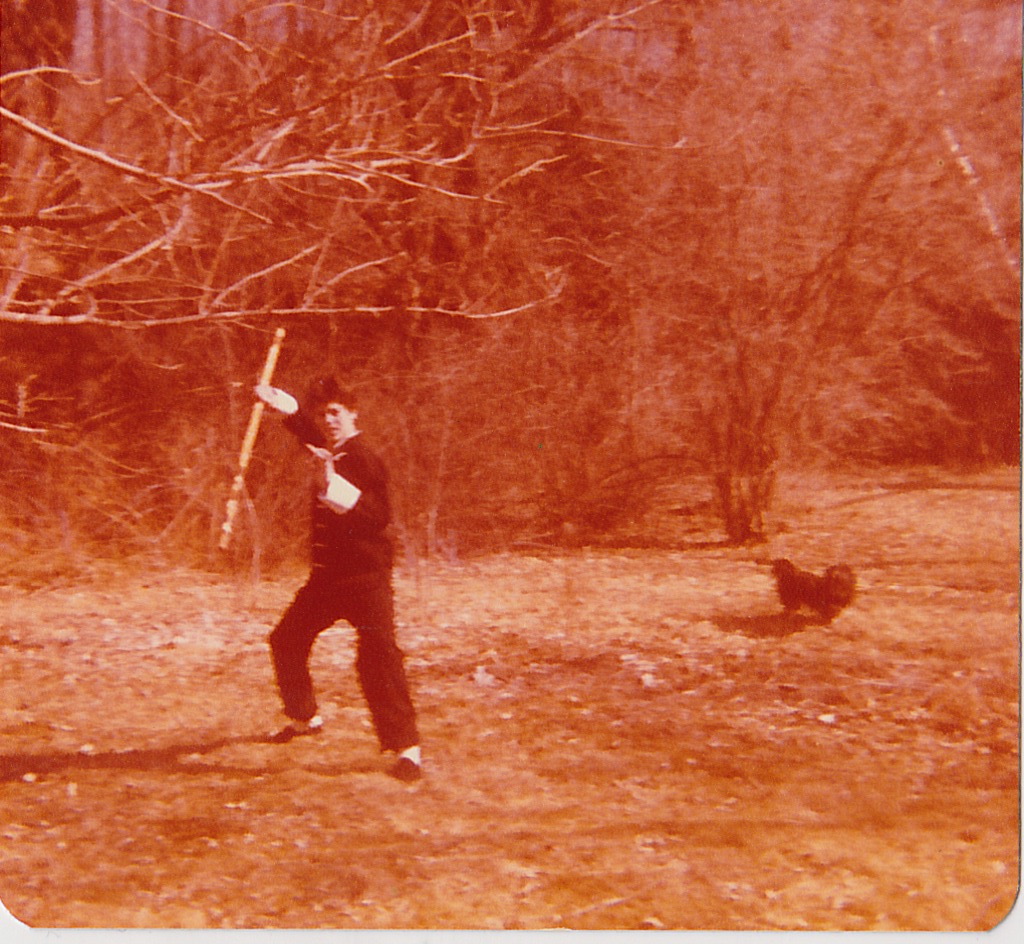
The author in his teens
First, check out this news story. It depicts a woman, who most likely had little to no self defense training, and probably less training with a weapon, fending off an attacker with a baseball bat. She got in some good hits, but she could have used some training to increase her effectiveness. The fact is a little training goes a long way. One could do forms with a little self defense application and in a dire situation be effective in deploying a weapon similar to the training weapon. There is no way that someone with little to no combative training can pick up a baseball bat and beat a competitive stick fighter, but if you have been working out with a staff for a while and a dog attacks you you would definitely have a better chance than someone with no training. I have been working out with weapons since the early 80s, and I can tell you honestly that I would not be able to compete in a stick fighting competition. But in the very rare possibility that I had to wield my staff to defend my family, I believe I am confident enough to dissuade any would-be assailant from continuing. In addition, a jo is first and foremost a common stick, which is ubiquitous in many environments from urban to rural. Sticks, pipes, and baseball bats can be readily found throughout the world, from India to Southern California. A stick is a feature of most environments.

Fun
Lastly, it is fun to move with a stick and develop your body at the same time. O’Sensei saw his jo practice as a sacred connection to the universe. I feel that same connection--it is kind of like a pantheistic dance partner! We all know that the more you see an activity as fun, the more likely you are to continue it. So I am counting on my love of the jo to increase my health, to decrease my health bills, and, if need be, to protect me in a dire situation.
chris-n-chewy.jpg
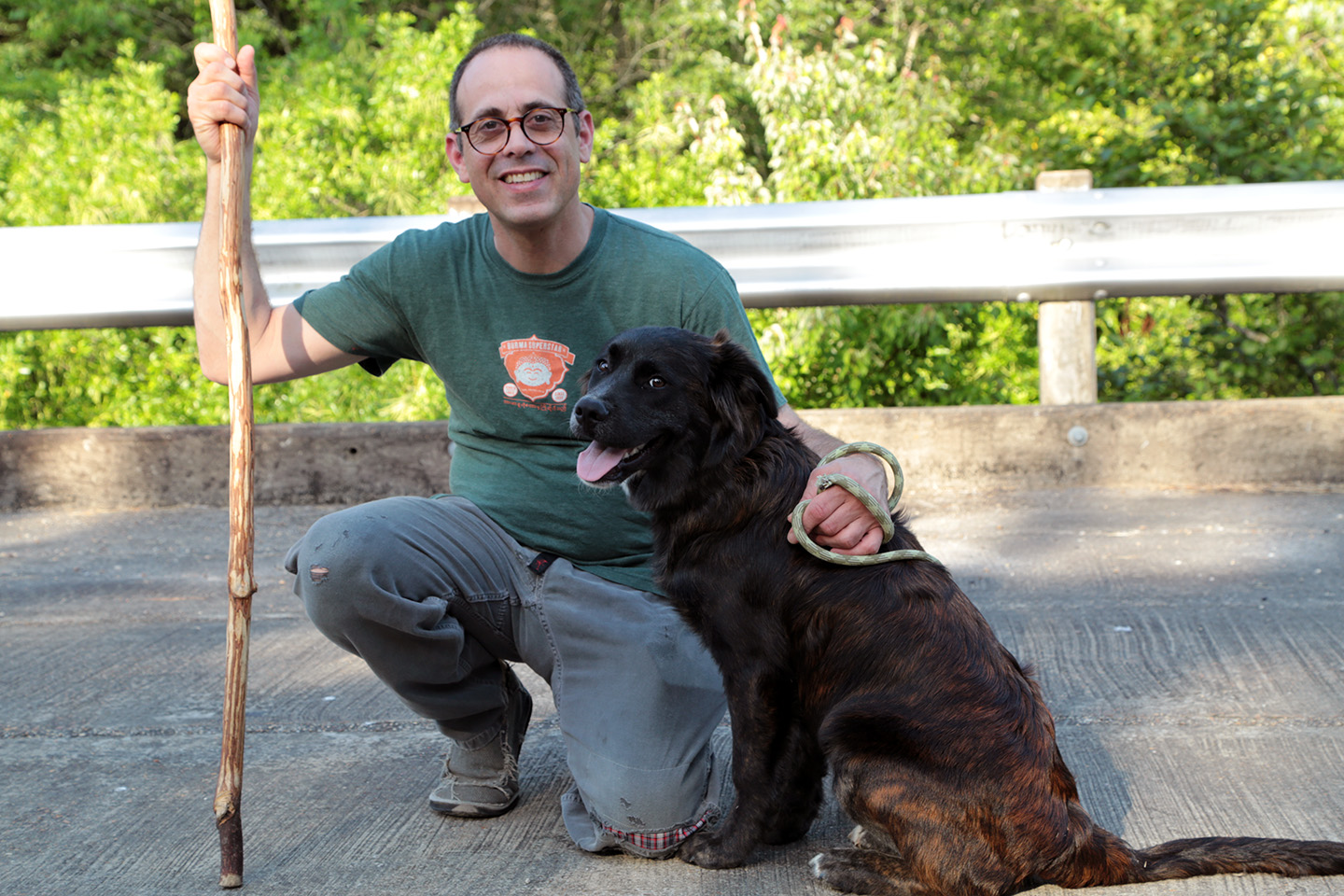
The author pictured with his dog and walking stick

As the quote at the beginning of this post says, the most perfect actions echo patterns found in nature, and I believe that the moves collected in the 31 Jo Kata do just that. They echo patterns that are found in nature, while intrinsically embedding them inside you. You are learning how to develop power and when to release power. These are not the only parts of the equation if you want to learn to become a skilled fighter. But in my context, where self defense is not a high priority, practicing these forms helps in the pursuit of health and provides a small amount of security. But most of all, I do it because it is fun. It genuinely brings a smile to my face when I practice.


Friday, May 19, 2017

Bushcraft, a Hobby With Benefits


When I was a kid we often went out into the woods and wandered with no specific purpose. Eventually, someone would come up with an idea that a few of us would become involved in. One day it was digging into China, and another was digging an underground fort; next, it was a tree fort. We explored, roamed, and challenged ourselves. Movies and stories about people like Daniel Boone, Robin Hood, and Native Americans really inspired me to get into nature and be comfortable there.
Of course, as we enter our teens and early 20s, these kinds of adventures mixed with testosterone morph into camping, partying, and risk-taking. This often lethal combination leads directly to a life-threatening situation, which wakes us up to the realities of life; our life is fragile; hubris can get you killed quickly, and that nature still has the upper hand.  


When you realize that nature still has the upper hand, you either shelter yourself in the comfort of civilization or you decide to step up your game and learn how to work within the dominant force of nature. That is when you research wilderness survival and bushcrafting, and you come across names like Mors Kochanski and Ray Mears. You might watch some reality survival shows, and you might even buy a knife. Then you will find yourself practicing how to make fire, build shelters, hunt, and other skills.


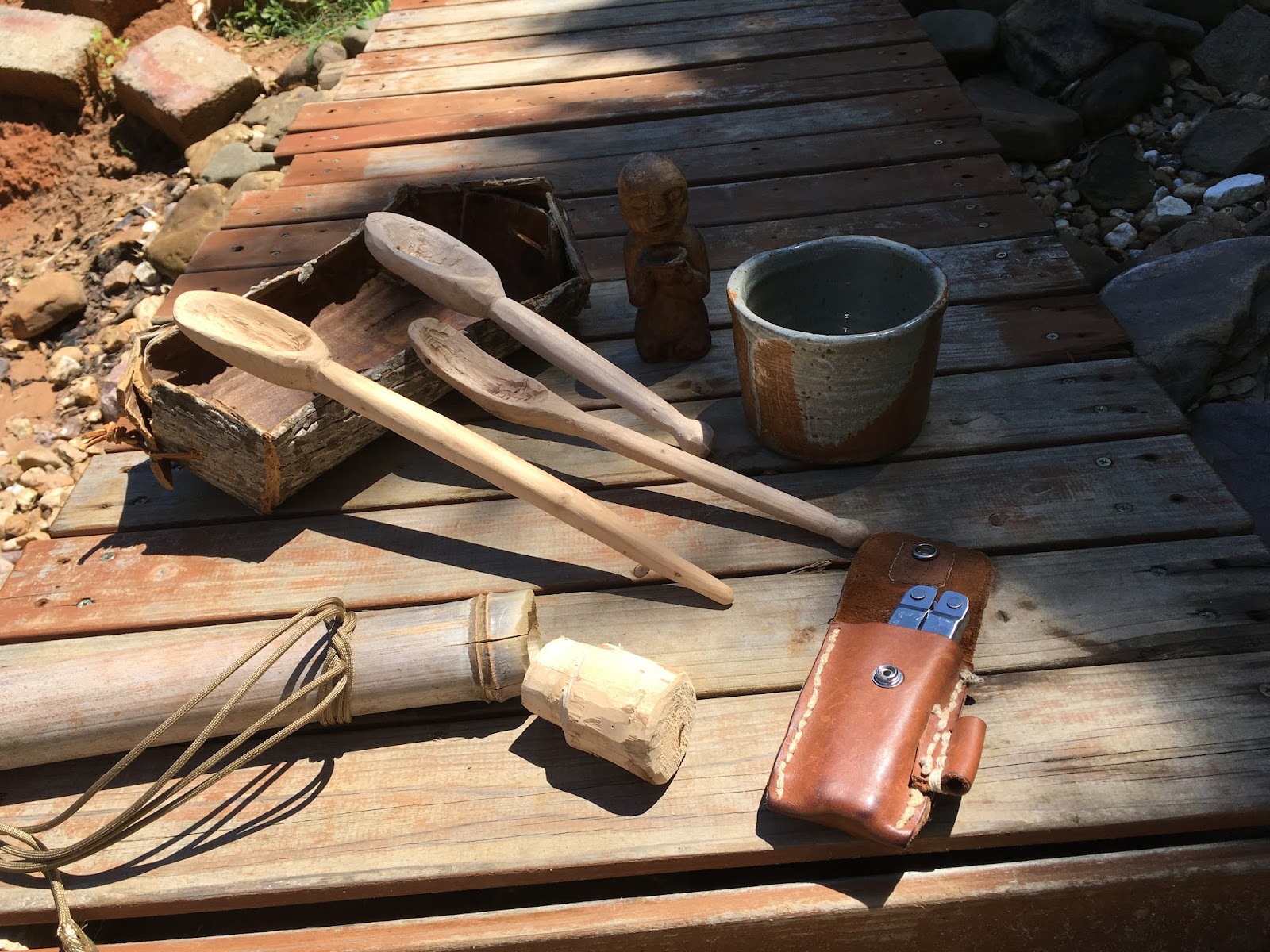
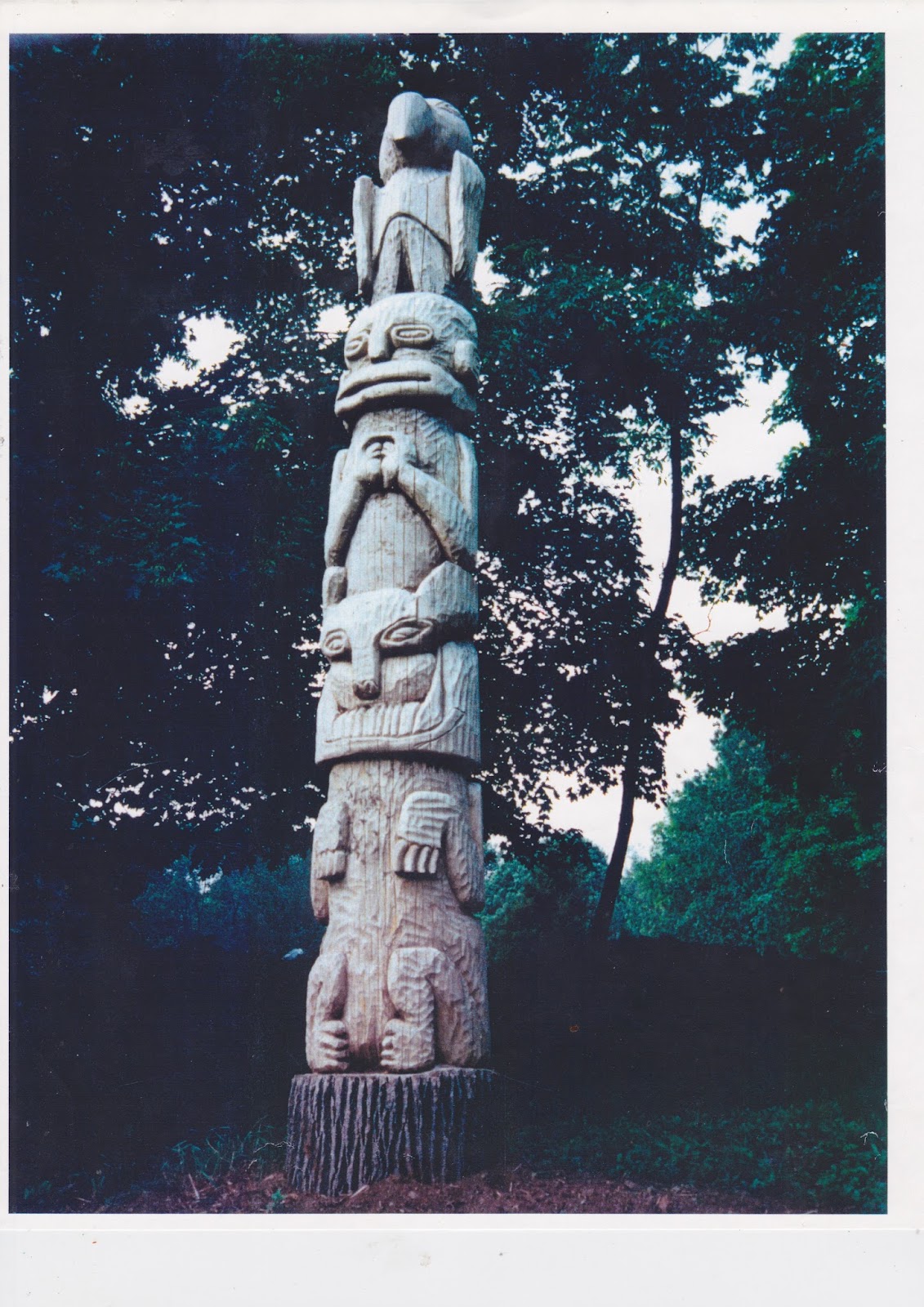
Scan.jpegDuring the decade of my 20s,  I had a more than a few run-ins with that dominant force, and towards the end of my 20s, still alive, I realized that I needed to step up my game and learn the basics. Having gone to art school and taking art history helped me understand how primitive cultures used natural materials to make things. I started carving wood. Also, my parents were hippies and made hand-sewn leather and sheepskin jackets for us. They sold some too! My father also made these possible bags for your belt, but his were for pot and pot paraphernalia (during the 60s and early 70s). After dropping out of art school, I started carving wood because it was accessible. This path grew to carving a few very large totem poles (the one pictured on the right I carved sometime in 1990), which helped me develop a lifelong admiration for primitive cultures and how they lived. It was a natural progression to tie together art and wilderness survival skills, otherwise known as bushcrafting.


Many people will argue about the meaning of bushcrafting, but to me, it means the constellation of skills one needs to live in the woods without electricity or gas-powered machines. So many of us will make spoons, cut wood, build fires, study plants, and their uses. Bushcrafters don’t necessarily want to live in the woods, even though they dream about it daily and they don’t have disdain for modern conveniences but they/we see value in keeping the skills alive for a few reasons. Keeping these pre-industrial skills alive is empowering because you can live and thrive in the “real” world. I say this because modern technology and our society is dependent upon a steady stream of oil and other means of harvesting energy all dependent upon very complex technology.  Take, for instance, heating your house; most houses are not equipped with a fireplace. So you are left with propane, electric, or solar. Solar is dependent on batteries. At some point, these technologies will need to be replaced, and most individuals cannot do that themselves they rely on the vast and complex means of production that is our society. If you juxtapose that previous sentence with the simplicity of wood-fired homes and products made from wood, you can see my point. Just to be clear, I am not advocating that we all become Luddites. I know wood supplies would quickly dwindle. My point here is that most of us live near resources or in places where primitive people survived and thrived with the very same resources we take for granted or even despise. Common weeds, which many of us pour expensive chemicals over, were used to make life-saving cordage, medicines, and literally thousands of other things. I can’t tell you the pain I feel every time I see a development going up and that ubiquitous massive pile of wood resources being hauled to the city dump, often to be burned off.


So the bushcrafter learns and appreciates the skills and knowledge of the people from before the industrial revolution. They don’t expect to live off the land and shun the use of modern technology. They simply want to become more in tune and closer to the environment in which we live, and what better way to do that than by using the materials found nearby.


Now that I spent the first few paragraphs explaining bushcrafting, I will try to explain some of the benefits I get from doing bushcraft.


The main benefit I get is, ironically enough, because bushcraft is mostly physical activity, a cognitive one. Ask yourself how many tulip poplars you passed by in your life, and have you ever once imagined that you could make a knife sheath or a basket to carry water in with its bark and consider that there are infinite items like this to be made from natural materials all around us in everyday life. So from my point of view, this part of us humans is dialed into innovation and outside-the-box thinking, which is an integral part of bushcraft. Taking the raw materials from nature and making useful items that have aided in human survival is what bushcraft is all about.

The real underlying benefit of bushcraft is tapping directly into human creativity at its earliest stages by connecting with our ancient side. I believe that humans feel better about themselves when they are participating in activities in which we need to survive on the African savanna. We needed to make tools, so we looked at nature in its raw form and figured out how to manipulate those materials to bring about better chances for survival. Just look where we ended up? We put a guy on the moon!! Impressive, but many of us have lost track of the baby steps it took to get us there, and those are the very same baby steps that lead us back to mother nature.


I have written many posts on Tai Chi and how it connects us to mother nature, and when we are disconnected, we feel depressed, disempowered, and alienated. Tai Chi and bushcraft do similar things; they are both connected because they originated long before the modern era when we had to acknowledge the power of nature and work within that hierarchy of power and not against it. Since this connection with nature is deep within our DNA, we need to be as close as possible to it, or we risk becoming alienated from it and really a large part of ourselves.


Another benefit is that if we are ever without power or get lost in nature, we have the ability to make it through unscathed. I also think it is important to teach these skills to my sons because they can get lost or who knows what the future will bring with climate change lurking on the horizon. It is a simple fact that humans can find themselves in short supply of technological resources and may once again need to make some of their items from the materials around them.

Bushcraft is a great hobby that has multiple benefits for your well-being and your survival. Plus, practicing these skills keeps them alive because it was developed by people who lived before the advent of technological advances. While technology is amazing, it creates a consumeristic type of dependency that dissuades one from taking the initiative and making their own stuff. So go out and make your own stuff and see how rich you truly are with the resources around you.   

Thursday, April 27, 2017

Principal Vs Pinciple

Most religious people believe you must believe in an omnipotent "Principal" to get into heaven, or at the very least, it is a prerequisite to be saved from eternal suffering.


According to Online Etymology.com, principal as a noun originally meant  a  "ruler” or  “governor." It also meant  a “person in charge of a public school." On the other hand, since the 14th century, principles have been seen as a rule or basic set of truths. Said more simply, a principal is a high-level authority figure who administers laws or principles, while a principle is a basic set of fundamental truths.


You probably see where I am going with this, but it is something that I have not seen discussed much. Within religious groups there is clearly a desire to differentiate one group from another by claiming allegiance to a specific set of deities and rituals, while also showing that the other group is less than holy and even that they are evil. This is classic, “in-group, out-group” stuff, which many humans are trying to get beyond. Yet we keep bumping into it.

Regardless of the basic instinct to continue excluding others I see no spiritual reason to continue it. In my own spiritual exploration I have been trying to understand where to place my faith, or hang my hat and this line of inquiry has led to me try to lay my faith on principles thus obviating the need to “out-group” someone based solely on the name they have chosen as their ruler. I would argue what is the point of the name of the leader at all, except beyond in-group/out-group. I see no value in it at all. I know the second commandment in the Judeo-Christian bible there is a rule which states that “Thou shalt have no other gods before me.” While there are two others that also place great value on the name of god. However, those commandments hold little spiritual value to me.


Regardless of how much value I place on it or someone else does, why is it important to acknowledge name of the principal? If god is almighty and omnipotent, then why would they care for such trifles in a name? Wouldn't the person/god you worship love you even more if you studied the principles that he/she/it has established?


Taking this line of thinking further, there are literally hundreds of names of God, and add to that the many different cultural pronunciations, along with metaphors and such. Taking all this into account it is quite a foolish activity, trying to exclude people from heaven because they do not use the same 900 codes words that your group does.


Now if someone, does not heed a principle that you have established as important to you or your belief system, for instance, I follow many Taoist principles, and one I find particularly important is that the human body is a microcosm of the universe, the macrocosm. Thus harmonizing your body with nature is a legitimate path to harmonizing with the greater procreative life force or the creator of the universe. So it follows, if someone shows no value for their own body then they would not be abiding by the principles I believe are deeply important to being a spiritual person. Taking another angle on this line of thinking, lets us say there is a group of people who call their practice Yoga, and follow their own energetic system. Does this mean they are wrong because they use a different set of names? Since we have established that they follow the same principle, health of the body. Should I, following a Taoist approach condemn them?


I remember having a conversation about religion with a Christian fundamentalist and he said if you don’t follow Jesus, and his specific denomination you will go to hell. I questioned him further, first I asked him to listen to a story I had heard a long time ago about a Methodist preacher, who witnessed the freeing of concentration camp detainees. It goes, the preacher said that many of the ex-detainees were beating up the guards but a lone women was not participating in the melee. He went to her and asked her why she was not taking vengeance on her tormentors. She said, it would make her like them. So I asked my fundamentalist friend, is she going to hell because she is Jewish? He said without hesitation, yes. I was floored. To this day that story tears me up because I am not so sure I could be like her. I know that I might not be able to control myself if the tables were turned on my tormentors. I know if I were in her situation, I would be counting the days and looking for any possible opportunity for revenge. Hell, I do it when someone cuts me off on the road. But yet, in some perverse world, she will be in hell suffering all because she didn’t proclaim one of the correct names of god as her savior. Puzzling. I told my friend if the god in his head would think that woman was not a saint than I would have nothing to with said god. That conversation with the fundamentalist was formative in my own thinking about god, worship and religion.  But honestly it has taken me a long time to reconcile these thoughts that lead to the proverbial fork in the road.


Pascal's Wager and the “Live a Good Life” Quote


Then I came upon a fork in the road with Pascal pointing in one direction and the “Live a good life” quote heading in another. Pascal’s wager asserts that the loss of not believing, eternal damnation, greatly outweighs the very limited earthly pleasure you could gain. The "Live a Good Life" path states that if you live a good moral life and if there is/are a god/gods and they abide by moral principles they will not care about your devotion to them. If they do not have principles than what kind of god are they and you shouldn’t want to believe in them, and if there is no god, you still win because you have spread that morality to your community.


At 51 years old, I have worn out many shoes walking on the “live a good life path" and I know it is good for me on every level I can imagine, and deep, deep down in me I can’t believe that the most omnipotent entity in the universe would condemn me, knowing how hard I work on principles and yet somehow mispronounced one of his/her/it’s 900 or so names.