Showing posts with label martial arts forms. Show all posts

Thursday, June 22, 2017

Martial Arts Restored My Self Respect

As I have mentioned in a few blog posts already, my parents were hippies from Brooklyn and moved to a working class town where there were no hippies, while I was in elementary school In the early 70s. I already discussed my first steps on the martial path but in this post I am going briefly review what I went through and then detail how I went about restoring of my own self-respect.

During that 5 to 6 year period of being bullied, I truly felt horrible about myself. I dreamed of killing my classmates often. I wanted nothing out of life but revenge and I thought of little else, my grades plummeted and I was put into Special Education, after the football players in honors class kept punching me when the teacher turned his back. People laughed at me daily; teachers were of little help; and girls stayed far away from me. To this day, I remember those kids surrounding me in the bathroom, while the head football player peed on my sneakers. They all just sat there laughing but that was the moment I said enough is enough!

Then I saw Bruce Lee's movie, Game of Death, and I instantly knew what I had to do, I enrolled in a karate class. Even though it sounds a lot like the movie Karate Kid, this happened 5 years before the movie came out in 1984. I got into weapons right away. I was also in shop class and I started making my own weapons, like wooden swords, a kai, which is a Japanese oar used in traditional karate, tonfas and many others. Even though, I didn’t see it at the time, it was an exciting period because  I was unifying my creativity, my physicality and my mind, as I began doing my own research. I started going to the library and bookstores finding the information I needed to solve my bully problem. School had a little value to me, no one there either cared or tried to uncover what was going on with me. I may have put up a wall I am not sure. Regardless, for the first time in my life I had a plan, it was plain and simple...fight back.

At 14 years old, I was the youngest person in my karate class, most of the people were in their 20s and 30s. When we sparred they knocked me on my ass. This was not a kid's class. I started training regularly and I would find peace of mind for the first time in my life, when I was doing the numerous katas I had to memorize in my backyard. I loved karate weapons but my teacher would not teach them to anyone until they were older. So I had to find access to weapons on my own. I made a lot in shop class or when my family went to Chinatown in Manhattan every now and again, I would go to the kung fu shops and buy Bruce Lee posters, nunchaku, throwing stars, etc etc.  I loved everything about karate and kung fu. It gave me a purpose and things really started looking up for me for the first time in my life.

Then one day after school, as we were all chaotically heading to the buses, one of the bigger football players, also wrestler, confronted me in the parking lot. I don't recall the details as I was pretty nervous, but I do remember that he made a move to grab me and I let go a round house kick to his head. All the students stopped motionless, and he hesitated and backed off. This was no small feat, no pun intended, because a few months ago, I was this kid who didn't do anything when a group of kids peed on his new sneakers, and now that little cry baby just kicked him in the head in front of everyone in the school. Luckily for me it shocked him so much that he left me alone that day. I really got lucky because a few weeks earlier he had beat up one of the larger hippie freaks, yes this was the era of the freaks and the jocks. Not only did this football player beat that kid up but he had hit him so hard that the hippie went into convulsions while he was unconscious on his back. I did not witness it but it was the talk all over the school for weeks and here I am kicking this guy in the head. Well, my luck did not last long, I soon became labelled as a fighter and being 130 pounds soaking wet, people were eager to test me and the football players smelled blood. So the stakes increased and on top of that my karate school closed down. My father also said we couldn't afford it. I cried and cried I still feel the pain of that closure. I did not have the luxury of withdrawing in my shell, I had to adapt to the new circumstances.

One of the very few positive moves my father made was to buy a home with a wood burning fireplace in it and he made me chop all the wood for it. I should mention that I was diagnosed with dyslexia and there wasn't much being done for people like myself in the 70s. If it had been today I would most definitely have been given Prozac because in my later years I was diagnosed with ADHD. So my father knew I was a handful and this "prescription" of chopping wood was perfect for me. My strength and power increased tremendously but I no longer had a teacher. I searched and searched, remember this wasn't the day when there was a karate school on every block. That school was the only school in town.

The karate school closure coincided with the rise in popularity of boxing, between Rocky movies, and Martin Scorsese's The Raging Bull, and famous fighters like Sugar Ray Leonard, Roberto Duran and Thomas Hearns people were really into boxing in those days. Being Italian-American those movies of Italian boxers really spoke to me and one of my friend's brother was a boxer in the Marines.  He taught me a few moves informally. I began to train. I sold my karate and kung fu weapons for boxing equipment, a heavy bag, a speed bag and a jump rope. I began running and training daily. I developed a routine, I would come home from school and instead of practicing my katas, I began running, and training hard by shadow boxing, hitting the heavy bag, jumping rope and doing push-ups. I did this routine right up until dinner time. I knew that the football team trained hard and even had their own weight-training coach. So if I was going to fight them I would have to work as hard as them. As I started to train word got out, people saw me running around town throwing punches in the air. Since boxing was popular many people got into it. People began asking me to spar with them. I had my own informal sparring ring in my basement, instead of rope it had brick walls. I began sparring and sparring and sparring. I sparred as much as I could. I even had to promise my friends, who wouldn't spar with me otherwise, that I wouldn't throw any punches and they could try to hit me. We did that often and I got good at dodging punches, and I have the scars on my left eyebrow when I let them hit me as hard as they could until I bled-I had to imitate that scene when Jake LaMotta told his brother to hit him in the face in the movie the Raging Bull. I was Italian-American after all.

As my skills were improving and I started turning the tables on those bastard football players, I decided to enter the Golden Gloves tournament in NYC. Without any coach or anyone but my uncle and my dad in at my corner, I entered the ring against a seasoned fighter from Fort Apache Bronx Boxing Gym. They put out top professional fighters.  As soon as I stepped out when they called my name to fight, I was bombarded by lights and TV cameras. The ref made us touch gloves and bam bam, this guy was all over me and the ref stopped the fight within two minutes of the first round. I did not get knocked down but I was totally outclassed and overwhelmed.  

After that experience, word must have spread about me in my little town, and some old Irish guy, named Pat Finneran showed up at my house asking if I wanted to learn how to box. He was 72 years old and worked as a boxing coach in the Bronx. He was the first person to actually genuinely express interest in my well-being. He was the first person to show me why discipline is so important. He made me shuffle with my left leg leading up and down my driveway over and over again. We didn’t do all kinds of crazy drills, or 20 different punches. He simply made me shuffle in and out, with a left jab over and over again. He eventually added a right cross and a left hook and that was all we worked on for 6 months. After those six months no one was able to hit me or to last long with me. I totally outclassed everyone. I fought most of the football team members and beat them bad. The only one who I could not beat was the one guy who peed on my shoes. He was 6' 3" or 4" and around 200 pounds. He was captain of the football team and an all-star baseball player. I fought him 7 times and one time he busted a blood vessel in my eye but I kept fighting him. After those fights no one ever messed with me again. I was liberated and could say and do what I wanted and no one called me names or tried to bully me again.

After accomplishing that I felt like my self respect had been restored and with my new coach I signed up for the next golden gloves tournament but then I met a girl. It was my first girlfriend ever and I was about to graduate high school. I was on top of the world and I went to Pat Finneran and told him I didn’t want to fight anymore. Looking back at myself at that moment I feel terrible because here was a person who really helped me and I left him without so much as a thank you. I hope he knew how much he helped me in my life. When my second son was born I named his middle name Finneran.

Friday, May 26, 2017

Five Reasons Why Martial Arts Forms Don’t Suck!

“Those who are enlightened never stop forging themselves. The realizations of such masters cannot be expressed well in words or theories. The most perfect actions echo the patterns found in nature. “ ~ Morihei Ueshiba


The martial arts forms suck argument has been going around the martial arts world for a long time. It states that traditional martial arts are rigid and spend too much time mindlessly following the choreographed forms passed down from antiquity, while a fight in real life is dynamic, unpredictable and spontaneous. The purpose in me writing this is not to totally lay to rest that argument because there are valid points to both.

That said, I do believe that there are good reasons to continue to practice forms. For starters, forms have combat tested moves within them BUT it is up to the motivation of the practitioner to unlock them. It is hard to balance keeping the knowledge alive for future generations, and then letting that commitment go to follow the current trends in fighting. Whether or not the two sides of the argument are right or wrong depends on the context in which we are living. So if you were a police officer I would recommend focusing more on the dynamic fighting part and less on forms. On the other hand, if you are looking for a healthy alternative to gym exercise and want a just little understanding of martial arts then forms are perfect for you. I think the problem comes in when you get confused as to what are your main objectives.
Currently, at this point in the US, violent crime has been decreasing since the 70’s. Sure, there are places where it is bad and it is up to you to understand that in your environment.  Moreover, your context can change for a number of reasons and if it does we have adapt our training accordingly. Currently, chronic disease and accidents top the list of causes of death, with murder not even making the top 10.  When I assess my environment I look at national trends and local ones. In my context, I just don’t see a danger by other humans. Does that mean I turn a blind eye and go on my merry way? Absolutely not, I think it is important to prepare for a possible violent encounter. I just do not think it is necessary to focus everything I do on it. So this is where forms come into play. Like I mentioned previously, the moves are there. So why not practice them to develop your body as a weapon, and in the age of steep cuts to Medicaid, use it to prevent chronic disease?  

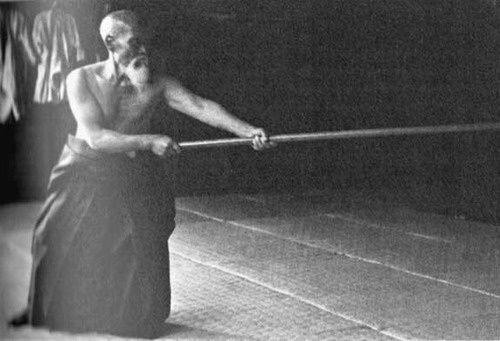
Without a doubt, one of my favorite forms is the Aikido 31 Jo Kata. A “jo” is a Japanese term for a 55” long wooden staff. O’Sensei, who is pictured above holding a jo, created Aikido, a Japanese martial art that uses the flow of spiral energy and joint locks to redirect an opponent’s momentum. O’Sensei used the jo often and created some small sets, consisting of a few moves together. It is said that he developed his love of the jo from bayonet training he did during his service in the Russo-Japanese war.  He continued using the jo until he was a very healthy elderly man. His student Morihiro Saito created the 31 Jo Kata from the different sets O’Sensei passed to him. Here is a video of Morihio Saito performing the 31 Jo Kata.
 
I did Aikido intensely for two years starting 1995 until I got a wrist injury that interfered with my progress in Aikido. I moved to Tai Chi because of the healing benefits, but I really missed Aikido and kept the form in my practice. Despite my love of the 31 Jo Kata, I eventually forgot the moves after a few years. I always wanted to bring it back. I did keep a smaller set memorized and then one day I decided to study Morihiro Saito’s video and regain the form for my training. Now it is a major part of my practice.

I wanted to bring it back because I find that the jo form is beneficial in 5 ways: 
  1. Power 
  2. Fitness
  3. Riai 
  4. Self defense
  5. Fun

Power Doing forms, especially weapons forms, helps you develop proper body mechanics to build power. When you repeatedly strike and move from one posture to another you can work on your body mechanics, which helps you understand the rhythm of releasing power. A great example is let's say you had to break a down a door with a stick or shovel. There are postures in the jo form that follow the same kinetic chain needed to muster the power to accomplish that action. It is not the form that teaches you how to apply the moves, it is your imagination. I figured that one out and now when I practice the form my intent is totally different. Can you practice that move without the form? Absolutely, yes, but the question I would ask is will you. Hell, you might even forget it. The form keeps the postures alive for as long as people practice them, even if they are taught by someone who doesn’t understand them and is a terrible teacher.

Fitness Doing the form over and over again for an hour is a great workout and gets my heart rate beating really hard. I haven’t measured the VO2 Max of it but but I would say that is definitely qualifies as a high intensity cardiovascular exercise, which the CDC recommends you do 75 minutes per week, along with some whole body muscle strengthening exercise. Since the staff weighs about 1-2 lbs and you are swinging it at pretty good speeds, you are definitely strengthening your muscles. Just take a good long look at that picture of O’Sensei (above). He is around 80 years old in that picture. Additionally, there was a study done comparing middle-aged martial arts practitioners with sedentary people of the same age, and it found that the martial artists were healthier on a wide variety of measures.

Riai is a Japanese martial art term that means understanding of the core principles behind the mechanics of punching, joint locks, and throws in relation to weapons training. For example, if you practice yokomenuchi, an overhead strike to the side of an opponent's head, you can see that the mechanics of that strike can be done without a weapon, such as using a hammer fist strike. That same motion can be used in grappling and in a forearm block. The idea of forms is to use your imagination and partner practice to unlock these relationships and innovate other uses. To me this is the main reason to keep forms alive. The danger comes when we mindlessly practice these forms and then think mindless practice alone will help us overcome an attack, or worse when we think we are invincible simply because we practice them. This is why I think the argument against forms is important. It keeps us honest.


Self defense
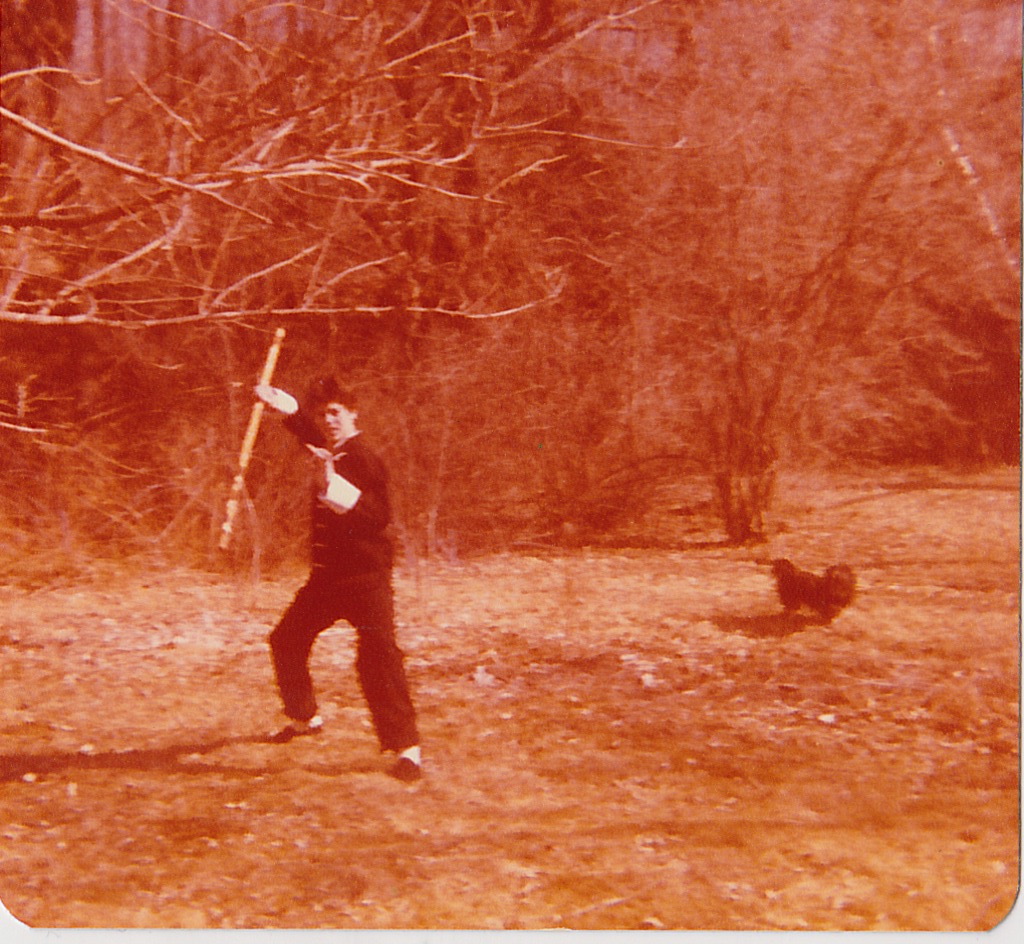
chris-kid-martialarts_0009.jpg
The author in his teens
First, check out this news story. It depicts a woman, who most likely had little to no self defense training, and probably less training with a weapon, fending off an attacker with a baseball bat. She got in some good hits, but she could have used some training to increase her effectiveness. The fact is a little training goes a long way. One could do forms with a little self defense application and in a dire situation be effective in deploying a weapon similar to the training weapon. There is no way that someone with little to no combative training can pick up a baseball bat and beat a competitive stick fighter, but if you have been working out with a staff for a while and a dog attacks you you would definitely have a better chance than someone with no training. I have been working out with weapons since the early 80s, and I can tell you honestly that I would not be able to compete in a stick fighting competition. But in the very rare possibility that I had to wield my staff to defend my family, I believe I am confident enough to dissuade any would-be assailant from continuing. In addition, a jo is first and foremost a common stick, which is ubiquitous in many environments from urban to rural. Sticks, pipes, and baseball bats can be readily found throughout the world, from India to Southern California. A stick is a feature of most environments.

Fun
Lastly, it is fun to move with a stick and develop your body at the same time. O’Sensei saw his jo practice as a sacred connection to the universe. I feel that same connection--it is kind of like a pantheistic dance partner! We all know that the more you see an activity as fun, the more likely you are to continue it. So I am counting on my love of the jo to increase my health, to decrease my health bills, and, if need be, to protect me in a dire situation.
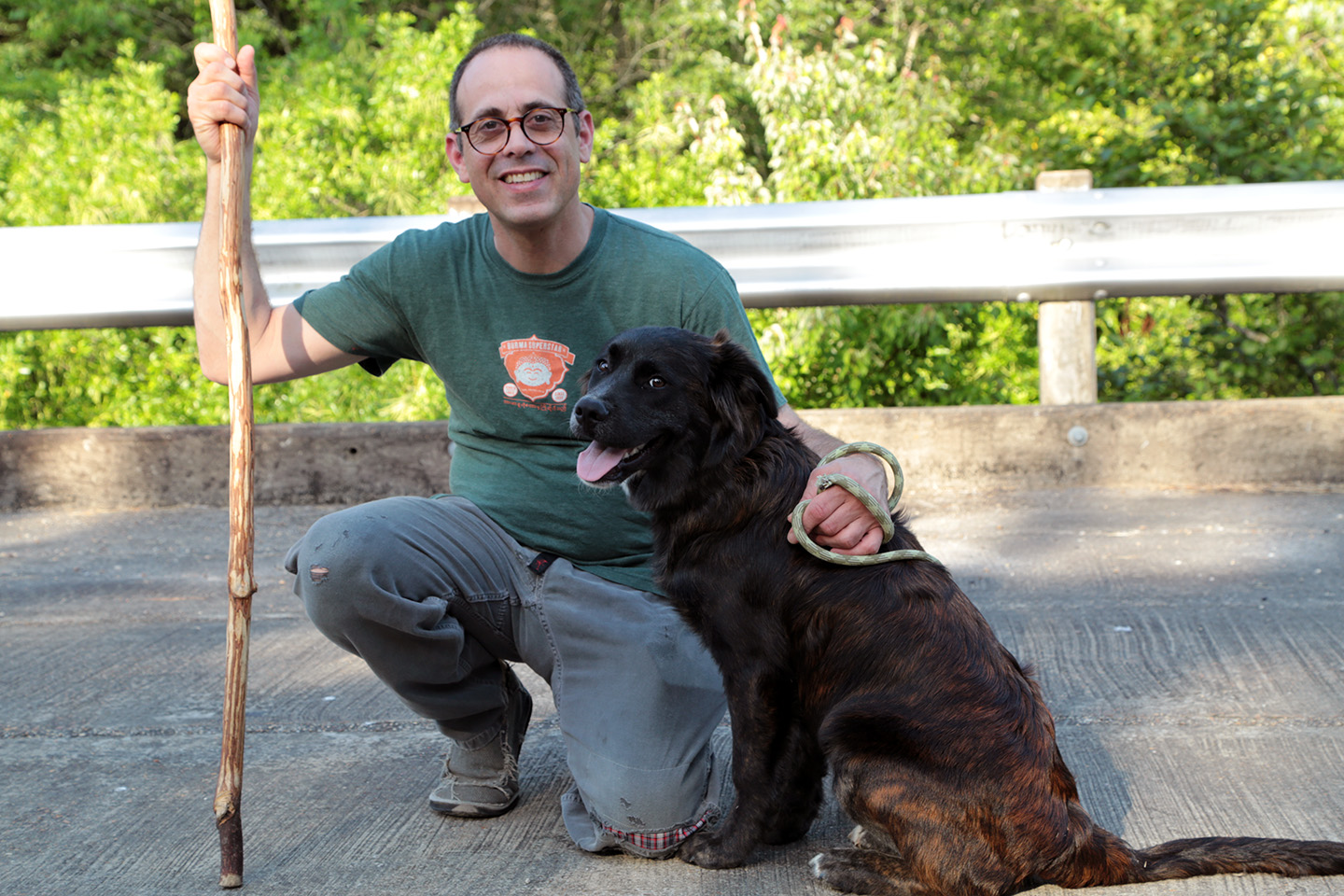
chris-n-chewy.jpg
The author pictured with his dog and walking stick

As the quote at the beginning of this post says, the most perfect actions echo patterns found in nature, and I believe that the moves collected in the 31 Jo Kata do just that. They echo patterns that are found in nature, while intrinsically embedding them inside you. You are learning how to develop power and when to release power. These are not the only parts of the equation if you want to learn to become a skilled fighter. But in my context, where self defense is not a high priority, practicing these forms helps in the pursuit of health and provides a small amount of security. But most of all, I do it because it is fun. It genuinely brings a smile to my face when I practice.