An Italian-American, born in Brooklyn, NY, living in Taos, NM, who writes about Tai Chi, health, wellness, and occasionally about outdoor recreation. Chris Aloia has a BA in Psychology and a Master of Public Health. He is a father of two boys and works in Diabetes prevention.
Bill Waugh spent his life operating in environments where impatience got people killed. Behind enemy lines, in surveillance, in tracking targets over months, he learned something most people miss.
Tactics are not about aggression. They are about timing, listening, and restraint.
Waugh famously said:
“Heroes are men who have a plan, and who understand the plan is ever-changing and dependent on enemy action.”
That single line could be written on the wall of any Tai Chi school and still be correct.
Tai Chi, at its core, trains the same discipline. You enter a form with structure, but you never cling to it. The moment you force a movement, balance is lost. The moment you refuse to adjust, you’re already behind.
Waugh’s approach to tactics wasn’t speed or dominance. It was presence. He spent weeks watching before acting. He waited for patterns to reveal themselves. Listening came before movement.
Tai Chi calls this listening energy, but stripped of mysticism, it simply means this: You don’t impose your will until the situation gives you information.
Another lesson from Waugh’s life is patience as an active state. He wasn’t waiting in a lazy way. He was constantly observing, calibrating, refining his understanding of terrain, behavior, and timing. That same patience shows up in Tai Chi when you settle your weight, regulate your breath, and feel for alignment instead of rushing to the next posture.
In both cases, stillness is not hesitation. It is preparation.
Waugh adjusted constantly. Small shifts in position. Slight changes in routine. Nothing dramatic. Those micro-adjustments over time created survival.
Tai Chi does the same thing to the body and nervous system. Tiny corrections in posture and movement prevent collapse. Large, forced corrections create instability.
The overlap is simple and practical:
• Have a plan, but don’t worship it • Listen longer than feels comfortable • Move only when movement improves position • Conserve energy • Adjust early and quietly
Tai Chi doesn’t teach tactics in a military sense. What it teaches is something more durable.
How to stay engaged without rushing. How to act without panic. How to wait without freezing.
Those are not philosophical ideas. They are survival skills.
And they’re the same ones Bill Waugh trusted with his life.
Outdoor skills are usually framed around the same familiar categories: navigation, fire building, first aid, layering, risk management, and physical conditioning. We talk endlessly about gear, preparation, and the right tools to carry into the backcountry. But there is a missing category that rarely makes it into the conversation, even though it directly shapes how we move, think, and make decisions when the terrain changes or the unexpected happens. It has nothing to do with equipment and everything to do with the person carrying it.
That missing category is our internal skill set—our ability to regulate stress, stay composed under uncertainty, perceive subtle environmental cues, and move with stability even when tired or cold. These qualities often determine whether a situation remains manageable or begins sliding toward trouble. And one of the best ways to train them, though almost no one in the outdoor world talks about it, is Tai Chi.
Most people think of Tai Chi as a gentle meditative practice, something done slowly in a park or community center. But Tai Chi is also practical conditioning for the nervous system and the body’s mechanics. It teaches you to interrupt panic before it snowballs. It teaches your breath to stay long when adrenaline wants to shorten it. It teaches smooth, efficient movement that reduces unnecessary strain and lowers the risk of slips or missteps. And it sharpens awareness so that details in the landscape become clearer instead of fading under stress.
I was reminded of all this on a recent winter hike in the Rio Grande Gorge. It’s a trail I’ve done many times, a descent into the canyon and a climb out along a steep and rugged slope. But with a fresh layer of snow, the trail vanished. The familiar markers were gone, and the terrain suddenly felt foreign. Even though I had the right gear, water, a knife, fire starter, and layers, there was still a moment where my stomach tightened and that subtle, disorienting whisper crept in: “You might be lost.” It wasn’t a dangerous situation yet, but it was enough to trigger the early stages of poor decision-making—the very thing most survival incidents are built on.
Instead of pushing forward blindly, I stopped. I found a patch of sunlight, took a moment to warm my hands, and settled my breath. Then, almost instinctively, I began moving through a few Tai Chi patterns. Slow rotations. Shifting weight. Feeling the ground beneath me instead of fighting it. The more I moved, the more the anxiety dissolved. The land stopped feeling like an adversary. My senses widened. I began noticing small landmarks I had overlooked a few minutes earlier—the way a cluster of rocks opened in one direction, the faint rise of a ridge I recognized, the subtle indentation of the path beneath the snow. Within minutes, the terrain reorganized itself in my mind and the trail appeared again, almost effortlessly.
It struck me afterward how natural that sequence felt. Tai Chi wasn’t something extra I added to the hike; it was a built-in reset button. It prevented me from compounding a small problem into a real one. The practice didn’t “save me”—the situation wasn’t extreme enough for that—but it absolutely corrected the direction of my thinking before it slid into unnecessary risk. And that is the essence of internal survival skill.
When adrenaline hits outdoors, people tend to move faster, breathe shallower, and narrow their awareness. Tai Chi trains the opposite pattern. It teaches you to slow down just enough to see clearly again. It reminds the body how to generate warmth without burning energy, using rotation and breath to bring circulation back into your hands and feet. It keeps your joints soft instead of rigid, which dramatically reduces the likelihood of small but consequential injuries. And it cultivates a wide, open form of attention that lets you read terrain instead of fight it.
None of this requires mystical thinking. These are practical, testable qualities. They translate directly onto icy trails, steep scrambles, loose scree, snow-covered switchbacks, and long climbs. Anyone who spends time outdoors knows that panic, rushing, and missteps cause far more emergencies than rare dramatic events. Tai Chi is one of the few practices that directly conditions the internal mechanics behind those mistakes.
And perhaps most importantly, it’s accessible. You don’t need to be flexible or athletic. You don’t need equipment. You don’t need decades of training. A handful of simple motions can help you breathe deeper, move smarter, and reset your nervous system when the environment becomes challenging. You can practice it at a trailhead, during a rest break, or in the middle of a canyon when the snow makes the world look unfamiliar.
Outdoor participation is higher than ever, and so are preventable incidents caused by panic, poor footing, cold, and decision fatigue. At the same time, athletes across disciplines are embracing breathwork, somatic awareness, and mobility training. Tai Chi exists right at the intersection of these trends, yet it’s rarely discussed in the outdoor community.
It should be. Because ultimately, survival is not just about what you carry in your pack. It’s about the clarity, stability, and awareness you bring to the moment things don’t go as planned. Tai Chi strengthens those qualities. It makes the outdoors feel not just safer, but more alive. It changes how you read the land, how you move through it, and how you respond when the unexpected happens.
It’s not simply a practice—it’s a skill. And for anyone who spends time in wild places, it’s one worth learning.
I believe Tai Chi is an essential element for the Bushcraft and wilderness survival community.
Most conversations around survival skills focus on physical conditioning, endurance, and toughness. And yes, it is true that the fitter and stronger your body, the better your chances of surviving a difficult situation. A body that can climb, hike, and carry under pressure clearly performs better in the wild.
But what often gets overlooked is the other side of that equation, relaxation, awareness, and injury prevention.
Relaxation as a Survival Skill
Bushcraft is not just about endurance or fighting the elements. It is also about sitting by a fire, carving a spoon, cooking, or making something with your hands. These moments of calm are psychologically grounding because they connect us to how humans have lived for thousands of years, working with nature, not against it.
The typical Bushcraft demographic tends to be men over forty. We love the outdoors, the gear, and the process. But at that age, we are also dealing with knee pain, tight backs, and shoulder stiffness. This is where Tai Chi becomes a perfect companion.
Injury Prevention and Healing
Tai Chi is not just slow movement; it is functional movement. It retrains the body to move with balance and coordination. For people with decades of habitual movement patterns, that is huge. The practice helps loosen old injuries, restore range of motion, and strengthen connective tissues gently.
When I am out in the field or camping, Tai Chi keeps me loose and mobile. At sixty, after thirty years of Tai Chi and twenty years of Bushcraft, I can say this with certainty: my recovery is faster, my movements are smoother, and I can camp and hike longer without pain.
Heightened Awareness and Perception
The second major benefit is awareness. Tai Chi opens up your senses. When you move with focus and controlled breathing, your vision and hearing expand rather than tunnel in. You shift from narrow task focused awareness to peripheral environmental awareness.
That is survival gold. When I am practicing Tai Chi in the wilderness, I notice birds, wind shifts, and subtle patterns I would usually miss. If I ever lose an item in camp, I will do a few minutes of Tai Chi before searching. It calms me down and helps me see what is actually there, not what I am panicking about.
Trail runners and hikers often miss this. They are moving fast, chasing performance. Tai Chi slows you down enough to truly connect with the environment.
Breaking Old Patterns
Most people do not realize how deeply their movement patterns are shaped by decades of habit. Tai Chi breaks those unhealthy loops. It teaches you to move with fluidity, not tension, and that translates directly into how you carry a pack, swing an axe, or gather wood.
Yes, the learning curve is slow. You will struggle with balance and coordination at first. But that struggle is the point. You are rewiring your nervous system to move the way humans were meant to move, efficiently, quietly, and with awareness.
Final Thought
Bushcraft is about more than surviving. It is about living well in nature. Tai Chi completes that circle. It builds a strong, supple, and relaxed body, a mind that is calm under pressure, and an awareness that tunes into the natural world.
For me, Tai Chi is not just a martial art. It is the missing link in wilderness living.
On a plane heading to some islands off the Western coast of Canada, I met some guys who worked for a moving company. They had a large office move contract and offered me some work. I agreed, and when the job was completed, they asked me to come work with them in Vancouver, BC. I ended up working for them for 6 months. After a few months of working with them, I did not meet many people, so I was excited when my boss at the moving company asked me to go hunting with him and a few of his friends.
We drove many hours to a place called “Hundred Mile House.” During the drive, we were drinking beer and listening to Metallica's Black Album and being rowdy. On our drive, we were pulled over by a policeman. As the policeman approached our vehicle, the driver (my boss), who had previously rolled his large pickup truck over a few months ago, totally cracking the windshield, greeted the police officer. I distinctly remember the policeman telling him that it was illegal to drive with a windshield that had a crack longer than 12.” My boss, said, “sir, I don’t think there is one crack longer than 12” on the whole windshield.” We all burst out laughing. The whole windshield was like a spiderweb of tiny cracks. He let us go with a warning to fix the windshield. We began drinking beer again. Someone in the car said they left their flask in the back bed. I volunteered to climb out of the moving vehicle and retrieve it. Driving at night in the woods, I climbed out of the window and jumped into the back bed, grabbed the flask in his bag, and climbed back in. We finally and uneventfully pulled up to our motel. We were all pretty drunk. Next thing, I remember we were up at 4 am getting dressed and heading out into the woods.
It was a very cold, rainy November morning. My boss gave me a shotgun, pointed in a particular direction, and told me go out there and if I see a deer, shoot it. I had never been hunting before. I had been walking for a hour or so when I heard a shot. I walked over and my boss had just killed a deer. As I approached, I could tell the deer was still moving so I took out my knife and stabbed it in the throat. He was so impressed by that, he cut the deer open and removed its heart, and said I had to take a bite because it was my first kill. I balked, but he was insistent, so I reluctantly bit a chunk of the warm muscle. I immediately felt an adrenaline rush deep in my body. I now wanted to get my own true kill. Like a bloodhound in search of a fugitive, I charged off following deer tracks without taking my eye off the ground. I really do not remember how long I was searching, but when I looked up, the sun was just about to set.
An eerie chill went through my spine as the trees looked black and gnarled against the smoky pink sky. I simply didn’t notice where I was or what was happening weather-wise. My cotton jacket had a shell of ice from the rain, and the snow turned to sleet. The winds picked up, and I started screaming for help. Realizing I was totally screwed, I frantically yelled, but no one could hear me. I yelled till my voice was hoarse, and then I cried hard. The winds were so loud that it was useless even trying.
After a good bit of crying, A great fear hit me, I realized that wolves and bears could be out there stalking me. I searched for a clearing in the dark, and I took a long hard look around and realized I needed some protection from the elements. I started to get cold, really cold, and I remembered I had some power bars on me. I knew if I ate them, it would generate some body heat. I think I ate three. I felt around in the dark for a tree and cut off some cedar boughs with my Cold Steel SRK knife. It had a 6” blade and barely enough to cut through the boughs. I really had to use force. I remember the impact of those cuts on my wrist. As I started to make a crude shelter from the freezing rain, I found a piece of corrugated metal that was just lying a few feet away, and I surrounded myself by it and the boughs. I was still cold, so I would periodically get up and do some jumping jacks, and martial arts strikes. Those martial arts strikes really felt empowering in that dark, icy forest.
The thought of making a fire never entered my head. I think back then, I knew so little that the fact it was raining, with snow everywhere, meant it was impossible to make a fire. I am not even sure I had matches on me. I seriously doubt I would have made it through the night without becoming hypothermic. Luckily, after 6 hours or so, the winds died down, and I figured it would be a good time to fire the shotgun into the air as a signal device. After a short pause, I heard a shot. We continued to communicate with each other through gunshots, and I was finally able to find my way to them in the pitch dark. It was about 11 p.m., and they said they were just about to leave and notify someone. I can’t express how happy I was when I finally burst through that dense icy forest into an opening where my boss and his friends were.
Lessons Learned
Obviously, an experience like this is life-changing. I couldn’t help but think of how naive I was going into the woods and all the thoughtless decisions I made that led me into a life-threatening situation. There was a temptation to beat myself up; there was also a temptation to eschew ever going into the wilderness again. But as I thought it through, I realized who I was, and I used it as a way to improve myself.
So I set out to take my outdoor skills to a deeper level. After much reflection, three major areas can get you into and out of a survival situation: Decisions, Knowledge and Skills, and Tools.
Decisions
After being a father of two young boys, I realized just how stupid it was to get into a car that was already damaged from a previous drinking and driving accident. There was also the fact that I chose to walk out into a very unfamiliar forest in poor weather conditions without any training whatsoever. I am not beating myself up here, but I am examining some of the decisions I made leading up to my survival situation. Prior to that experience, I hadn’t spent too much time in the woods. Being a city boy, I didn’t grow up learning how to survive in the woods. This is why we can’t always make the right decision. I had always desired to go hunting but never knew anyone that did it. So I overlooked the bad cues because I really wanted to get out there and hunt. Still today, many people go for a hike and don’t even bring a water bottle or even carry a swiss army knife.
Knowledge and Skills
In short, I had none of either. Although I had never heard of hypothermia, I did know enough to keep my wits about me. I was fit; my martial arts background had given me a way to keep my body heated up. Eating something really helped me with increasing body heat, comfort, and keeping a positive outlook. Also, I intuitively knew I should cut some cedar boughs down to protect me from the icy rain. I had zero knowledge of shelter building, but somehow, I made a crude shelter in the night without a flashlight. I also didn’t know anything about navigation, and I lost contact with my hunting party. I am not sure I would have survived the night. I have not dressed appropriately for the weather. Back then, I knew nothing about gore-tex and the difference between waterproofing and water resistance. Most wilderness survival sites and instructors will tell you that knowledge and training are the two most important things to keep you from becoming a tragic news story, and I also endorse that thinking here. There is a wise saying in the survival world, “the more you know, the less you carry.“
Tools
If you search "survival situation preparedness”, you will find a ton of survival kits that talk about the gear you need. There is certainly a bunch of things I lacked in that situation. However, I did get four things right: I had a shotgun and shells, a decent-sized fixed-blade knife, really good boots, and those power bars. I lacked a proper jacket, a fire-starting kit, a whistle, a flashlight, and an emergency blanket. If I had all of those, I could have easily spent the night out there in the woods. I neglected to include a cell phone since this occurred way before the days' cell phones were carried regularly. If I had one, I would have called my boss, and we would have found each other in probably 20 or so minutes. But it is important to remember that a cell phone doesn’t not obviate the need for solid skills and training; batteries run out, and signals can be hard to come by in remote areas.
Going Forward
I should also mention that my experience was, typical of most survival experiences, a lost hunter, which is similar to getting lost hiking or fishing. It is important to acknowledge that while my experience was very challenging, it wasn’t as hardcore as Robinson Crusoe or plain crash survivors in the Andes. So I never would equate my 6-hour or so experience with people who were lost for days on end. But it does bring modest insights into the harshness of nature and what it takes to survive. I hope reading about my experience, you learn from my mistake and get inspired to learn a few skills and ensure that you have at least a few items in your bag to prevent you from getting into a survival situation. And if you are an experienced outdoorsman, look to my experience as a person who did not have many opportunities to get out in the woods and jumped at the first opportunity to get out there way too early and reflect on possibilities to share your skills with people who do not have opportunities to get out there.
Once in awhile when I am resting on the weekends I will watch a reality TV show. Unlike many people I find of them interesting to see how people behave in certain stressful situations. Last week, I got caught up in the Naked and Afraid XL season. This latest offering featured 12 people who had already survived for 21 days in the wilderness with a single partner totally naked. So these 12 naked veterans were tasked with surviving in the wilds of the Orinoco river basin in Colombia with two other veterans, who were chosen by the producers. They were only given a knife, a bag, and each person got to chose one survival item: either a water container, a net, a fishing kit, or a fire making kit. So no one person had everything they needed to make it the whole 40 days. They were not given food, or water, or clothes.
There were four groups of three. The only group I am going to analyze is the one with a male, who described himself as, “The Alpha Male” and specifically said that he is not “an” alpha male but “The” alpha male. He was matched with two women, one of whom was a vegetarian. Literally within minutes of arriving the alpha male started cutting large trees down and building a massive shelter. The one item he chose to bring along was a bow and arrow. He tried hunting for food but was unsuccessful. In the first few days he expended lots of precious energy doing many tasks. He derided the women for being lazy and hurled other abusive insults at them. The women stood their ground and cautioned him against expending too much energy. At one point he moved into a separate camp, which he had to build himself. After he had completed that and expended even more energy, he realized he had no means of making fire, as the women had the fire starter. So he went back to them asking for the fire starter. He tried to make amends but he was not clear in his intention and could not resolve the conflict he instigated. This decision left him without the means to start a fire, a necessary part of surviving. Needless to say, the women chose a better survival strategy and they made it the full forty days by having a wise understanding of resource conservation and “the” alpha male tapped out early and was sent home.
The reason why I took the time to explain that show is because this is a clear cut example of how Taoist principles can work and how toxic masculinity can lead to one’s downfall. I say Taoist principles, but clearly the women in the show did not say what their philosophy was so I am kind of using their survival strategy as an example of Taoist principles in action. Come to think of it, these woman gave a better demonstration of Taoist principles than some old dude with a man bun posting his lecture on YouTube.
The alpha male in the show was the poster boy for toxic masculinity, with his need to be right, to not listen to “weak” women, and a vegetarian no less. He ignored numerous cautions, at his own peril. As a Tai Chi instructor who has been teaching older adults since 2001, I have seen this play out time and time again. In fact, most older males do not chose Tai Chi as their exercise and would rather drop their wives off to their “dance-like” exercise. Those women being dropped off have taught me many lessons about checking my own masculinity. I have learned that women are more likely to go to the doctor’s and older men who live with their wives go to the doctor more and live longer. Women are open to feedback and listen to others more and they live six and a half years longer than men in the U.S.. Whether by script or by personal choice the women in the show clearly demonstrated the qualities Taoists would characterize as Yin, or soft.
Taoist models of gender account for the fact that feminine qualities are important and even superior to male qualities. Before we go any further, it must be stated that Chinese culture did not bring about a gender revolution by any means and there are numerous accounts of women that have been persecuted. However, it must also be acknowledged that Taoism is unique in that it gave a highly significant placement of women and feminine qualities in its value system, especially when comparing it to other systems of that era like Christianity, and Buddhism etc..
The main symbol for Taoism is the Yin-Yang symbol, or Tai Chi doh, with a Yin half, that is soft, dark, and feminine, and Yang half that is hard, bright, and male. Yes, it is a binary view of the universe but it is important to note that each half has a bit of its other within it. That significant dot means that each has the other within them, meaning there is always a little masculinity in a female, and a little femininity in a male. The most important part of the symbol is that both aspects are intertwined and equal in the creation of the universe.
In chapter 6 of the Taoist classic by Lao Tzu, as translated by Gia Fu-feng and Jane English, he mentions the valley spirit,
Tao Te Ching - Lao Tzu - chapter 6
The valley spirit never dies;
It is the woman, primal mother.
Her gateway is the root of heaven and earth.
It is like a veil barely seen.
Use it; it will never fail.
Stand by the door of any Tai Chi class in the world and you will hear talk about using hard force as opposed to soft force. Hard force is usually characterized as a male trait, which is in juxtaposition to the female trait of yielding, that is considered to be the highest level of internalizing the Tao.
The ultimate expression of Yin energy is in Wu-Wei, or non-action. I was always thrown off by that, and many Americans have difficulties grasping it, instead they see it as Jesus-take-the wheel, kind of non-action; totally letting go without any “human” help. I confess it took me a while to understand, but now I have come to understand it as “strategic” or thoughtful non-action. So the women in the alpha male’s group definitely exhibited Wu-Wei. They did it so well that the alpha male called them lazy but they were not lazy at all. Instead of cutting massive trees down they used a sparce shelter, even though they used the shelter the alpha male built, remember they did not ask him to build it, they would have made a simplier shelter. Additionally, while he was out hunting and climbing trees, they wove a fish trap and foraged for fruits and nuts. The vegetarian was practicularly smart in her awareness of her nutrient intake. She rationed her foraged food to make it until the 40 days. They also met up with another group which created a larger team effort. The women were able to work with in another group and therefore increase their chances of surviving.
The Yin, feminine trait of yielding allows clarity and opens up the opportunity of using the force of the earth. So in Tai Chi we relax so that we can use the force of the earth (gravity and leverage) more effectively. If we relax (let go) and don't force it, we can increase our impact. If we move with fear and tension Yang or male qualities, then we have to use even more non-Wu Wei force. Thus creating a non-harmonious trajectory. Often Wu-Wei is poo pooed by martial artists and fighters as weakness or fantasy. More on that in a few paragraphs but first I have to address the binary approach.
I can see that feminists might object to this binary approach because Taoism assigns traits to gender. But this is where the Yin-Yang comes into play, a female can have male traits, and a male can have female traits. So in Tai Chi, I consciously cultivate Yin- female traits to temper my Yang- male traits. Sometimes in everyday life, I get frustrated and become aggressive, which leads to as my wife says, me manhandling things. Tai Chi, helps me temper that Yang aggression and bring about a clarity of action and peace of mind. Just because we say that there are male traits and female traits doesn’t mean that gender assignment is rigidly in one group, the Yin-Yang symbolizes fluidity between gender and the transformation of energy from one group to the other.
All this talk of Yin energy does get dicey though, especially when it comes to martial arts, In combative situations things happen fast and there is a time and a place for the use of Yang force or violence. But right now in our time period violence is low but this could change. The alpha males of the world might rise again. This is why I see liberal idealism as too idealistic because it doesn’t acknowledge a world in which there are violent alpha males. All too often, liberals try to explain that behavior as it being socially constructed, where as the Taoist approach understands it is a way in nature, but not the best way, not the way of the Tao.
I grew up in Brooklyn in the late 60s and early 70s. It was not for the faint of heart. Men there were very aggressive, I witnessed my maternal grandfather beat up a guy and his wife after we left a restaurant. They had a disagreement about who had the right away and it came to blows. All this is typical male machismo of that era, but liberals seems to think this behavior is gone for ever. Unfortunately, I believe it is just dormant. I have a Hobbesian view of nature. So if the group from Naked and Afraid XL that I have been discussing were in a Hobbesian world, where there is no governing body, he could have cannibalized one of the women, taken the fire starter and made the other women his wife or in a less dramatic turn of events, the women might have seen him as more of an asset than an ass because of his 6 foot 5 stature and bold nature. So even the alpha male strategy is a viable solution in certain contexts and it is not socially constructed as many social scientists would have you believe. But again, following the Tao leads to a more fruitful relationship and even in a Hobbesian world working as a team with full support is better than cannibalizing each other. My point here is that hyper-masculinity is not socially constructed and it is important to practice martial arts because the Hobbesian world is never far from civilization.
This is why martial arts, especially Asian martial arts, like Tai Chi, Aikido, Judo, Jiu Jitsu, Wing Chun and others preach tempering hyper-masculinity and using one’s mind to leverage the anger in others. Anger creates a loss of balance and a lack of clear vision, and tempering doesn’t only work on Yang energy, it also can bring up Yin qualities. My friend Bishop, who is a university policeman and a Wing Chun instructor, told me that he discusses the balance/blending of Yin and Yang energies to his students all the time. “Too much of one or the other is never a good thing, but when COMBINED in the right way, the result is greater than the two parts.”
My close friends in martial arts, Dave, Larry, and Bishop all work on using Yin traits when dealing with angry male behavior, specifically Dave and Bishop who work directly with that behavior in public settings as a bouncer and a university police officer. I have heard countless stories of how they have used their martial training, specifically leverage and a cool clear head to not engage in the heightened emotion that often happens when young males, who have been drinking alcohol, come in contact with the opportunity for sex. My other friend, Larry teaches younger professional fighters the discipline it takes to check your wildness and throw accurate punches that hit their target with brutal efficacy. Larry and I often discuss the difficulty many of his students, mostly males have with listening and controlling their hyper masculinity. He has said that the ones who do become great are the ones who don’t get trapped by their hyper-masculinity/overly aggressive nature.
Practising martial arts and internalizing the principle of Yin-Yang deepens one’s understanding of themselves. It shows one how to take control of anger and hyper-aggression so that one can think clearly and make better decisions that lead to positive outcomes. Moreover, it also gives us an insight into human nature because you have seen the ugliness become tame.
As I have mentioned in other posts, my parents were hippies that made hand-sewn leather goods and sheepskin coats for people in the 70's. As a young child to young parents I would play with the scraps while they were working-I have the scars to prove it. I specifically remember gluing together a leather bag with those scraps. My parents were very creative people and set me off on the road towards making stuff.
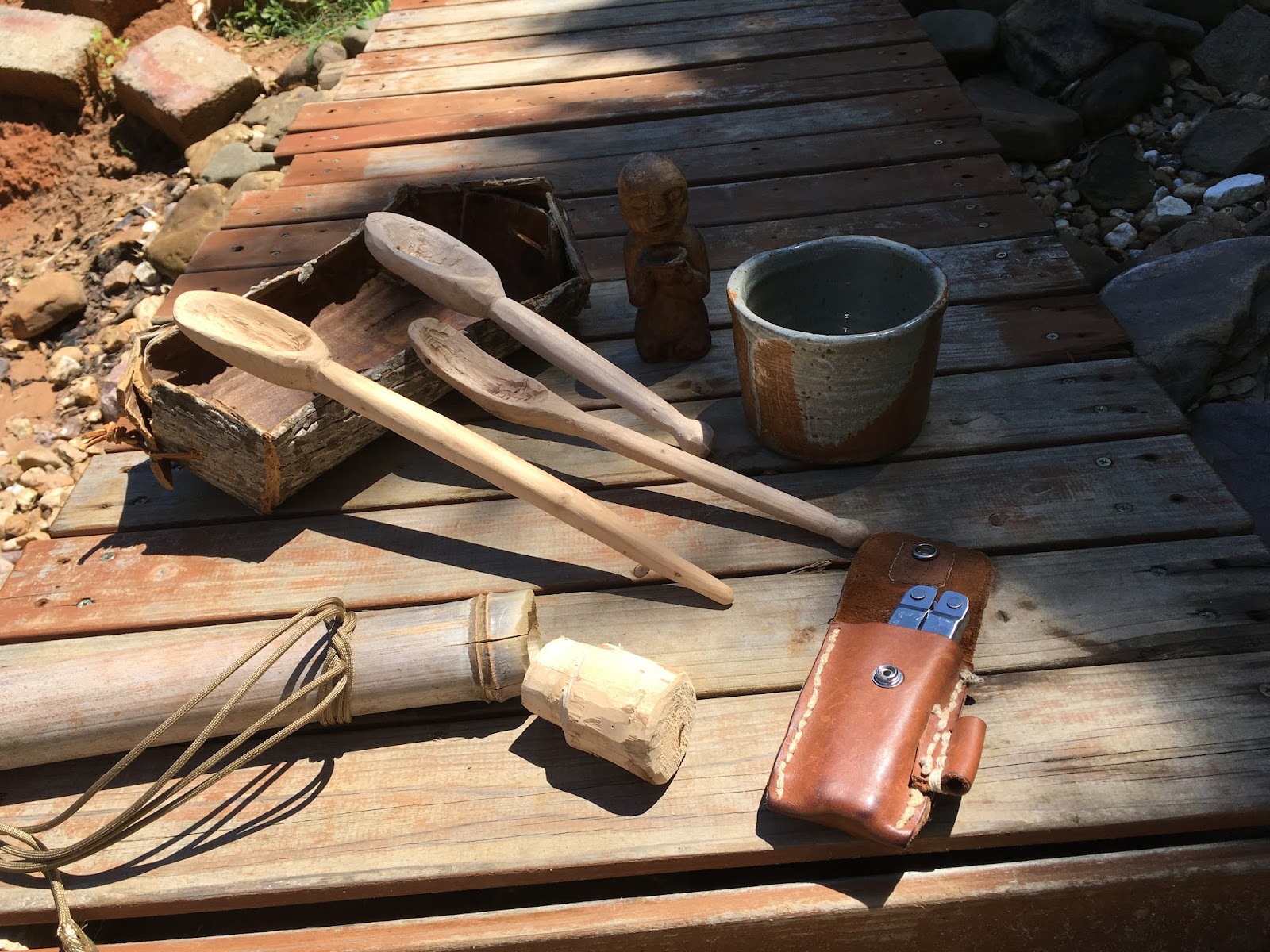
When I graduated high school I wanted to be an artist and began taking classes at a community college. I started in drawing and painting but soon found myself in sculpture. I started carving wood and researching primitive carvings and carving across cultures. I loved anthropology and incorporated many styles in my work. I have carved totem poles and small work alike.
Then my wife and I decided to move to Mississippi, where she was born. Whenever we visit her parent’s land I head off to the woods. They live in a small rural town that doesn’t even have a police station. I call my jaunts in nature, a bushcraft walk because when I go I always do some bushcrafty activities like, build a shelter, identify wild plants or make cordage from plants. I also gather materials and spot and identify them. It is a like a mini-adventure. When I was a kid I loved those shows about a jungle expedition where someone always got stuck in quicksand. Anyway, this is my little way of having an adventure. I have been doing that for over a decade and haven’t gotten caught in quicksand yet.
After doing some research I purchased VHS tapes from Ron Hood’s Woodmaster series. In them, he demonstrated all kinds of projects to make with wood and other natural and found materials. Watching those videos I realized that I could make that stuff while I was in the woods. What really grabbed my attention was the innovative, out of the box thinking, which I think is the hallmark of bushcrafting Ron displayed. In one, he magnetizes a small thin piece of metal and places it on a leaf in a cup of water to determine north, and in another, he sharpens both ends of two 12” long sticks and interlocks them to make a primitive weapon. There were tons of ideas that you can make from everyday items around you. From that moment on I was hooked and it became a life long hobby. It also paired well with my background in the arts and it made me feel more confident in nature.
To me ABMS is a daily mindset, I am always looking for a resource and seeing what I can make from it. I also try to make something everyday, even if it is a little feather stick and a small fire. Now these things are not pieces to sell at a crafts fair but they keep the juices flowing. The ABMS mindset puts me in creative mode, it builds body heat (during cold days), teaches me about the properties of different materials and finally it keeps my mind occupied. I don’t know if you are like me but my mind is constantly racing around, so this activity keeps me positive and focused.