Showing posts with label Hippies. Show all posts

Sunday, January 11, 2026

A Man Caught in a Cultural Shift ( how I now see my father's life and death)


In the early 1960s, my father was an adopter of two things that would later become mainstream and then commodified: marijuana and crafts. He made handmade leather goods to sell. Items like jackets, bags, belts, and one small item in particular stand out in my memory: a leather pouch he called a pot stash. Bushcraft people today would recognize it as a kind of possibles bag, but his was made for weed, not flint and steel.

He was a deeply curious and active thinker. His shelves held books on Hinduism, Daoism, shelter building, and design. He was immersed in graphic design and interior design, always thinking visually, structurally, philosophically. Craft for him was not just making things. It was his worldview, identity, and resistance all rolled into one package.

During the hippie era, handmade goods were a reaction against the industrial machine of the United States. Making something with your hands was a statement of integrity. It said, "I am not just a consumer. I belong to a lineage older than factories."

But cultures shift.

When John Lennon was killed, something changed. When yuppie culture emerged, money, status, and ambition were polished into a uniform; my father cut his hair and tried to follow along. He began chasing financial success instead of craftsmanship. He leased a Mercedes-Benz. He opened a business in Manhattan that combined antiques with modern design. His heart was not fully in it, and he did not truly understand the game he was playing.

The business failed. He lost our family home. That collapse sent me down a difficult path of my own.

After that, he drank hard. He smoked heavily. Somewhere along the way, he lost his center.

For a long time, I carried resentment toward him. But now I see his life differently. I see him as someone crushed by a cultural transition he could not metabolize.

I think about early human stone tool makers that had mastered flint knapping and who understood the language of stone. Then copper arrives. Some adapt. Some do not. Some love the stone too much. They do not disappear because they lack skill. They disappear because the world moves on without caring what they were good at.

My father lived through a similar shift. Handmade leather goods were once a countercultural strength. Later, it became nostalgia, and then fashion. Then mass-produced again. Some people rode those waves successfully. Others never recovered.

He had three kids. And maybe handmade leather jackets were not the safest way to support a family under that kind of pressure. I understand that now. I have compassion where I once had judgment.

What is tragic is that not long after, handmade leather jackets came back into fashion. And even today, the bushcraft and mountain man movements never really disappeared. There has always been a quiet current of people who value hand skills, wood, steel, fire, and shelter. He could have found a way to stay rooted in his strengths. He almost did. But he did not trust them enough to endure the lean years.

That is the part that still hurts.

When I graduated high school, I wanted to be a famous painter more than anything. If there had been a devil offering a deal, I would have signed it. Instead, I took a different risk. I hitchhiked across the United States and found Taos. That changed everything.

Taos gave me space to keep my hands busy and my spirit intact. I found wood carving. I found bushcraft. I found Tai Chi. Those practices became ways of staying honest. Ways of keeping my soul tethered to something real. I still carve wood today. I am not successful as a seller. But I am still carving away. Ironically, when I arrived in Taos, I found a strong culture of sheepskin and leather goods makers. 

My father didn't have the vision or faith to look elsewhere. That is where I feel the lineage split and also where it reconnects.

My father lost his way because he could not identify what truly mattered to him as a human being. He believed money would restore meaning. It did not. He died early as a result of his drinking and smoking.

I do not tell this story to judge him. I tell it because I understand him now. He was not weak. He was displaced.

And maybe what I am doing, carving wood, practicing tai chi, and walking instead of running, is my way of staying on the narrow ridge he fell from. Not chasing success at the expense of integrity. Not abandoning craft when culture devalues it. Learning, slowly, to measure life not by applause or profit, but by whether I can still recognize myself in the work of my hands.

Saturday, December 13, 2025

Karma, and Choosing The Path That Brings Growth


There is a real romance attached to special forces, especially when filtered through books and movies. Discipline, brotherhood, mastery under pressure, mythic testing of the self. But that romance usually edits out the moral residue. Carrying acts that do not align with your inner compass, wars that later reveal themselves as incoherent or unjust, and the long psychic aftermath. For someone wired like me, that dissonance would not have worked for where I needed to grow. It would have been a weight. This is not a critique of the warrior path, but a way of looking at paths and trends that society puts forth. 

The artist's path does not get the same cinematic glow, but it has its own rigor. Watching Mick Jagger or Iggy Pop is not about rebellion for its own sake. It is about pushing the limits of embodiment, expression, and presence. They are not escaping discipline. They are channeling it through a different nervous system. The same is true of great guitar players, dancers, and writers. They are testing how much truth a human body and mind can carry and still stay alive.

That is the parallel with special forces that does not get named often enough. Both are about capacity. One is romanticized because it serves power structures. The other is tolerated because it does not.

Karma matters here. Karma is not about what looks noble from the outside. It is about what pulls you and what will not leave you alone. It is about what you have to do in order to become whole. A soul does not choose the path society applauds. It selects the terrain where its work actually is.

I was born to hippie parents and exposed early to art, music, and Asian philosophy. That was both a gift and a destabilization. I was not handed a single narrative and told to stay inside it. That freedom came with existential vertigo. Other kids had rails, religion, culture, and certainty. I had openness, and openness without grounding can feel like falling.

Punk rock mattered because it gave me a reset. Not truth exactly, but a refusal of false certainty. A clearing of the table. From there, it made sense to look for something older than ideology. Primitive art, early human mark-making forms that emerged from survival and meaning-making rather than doctrine.

Wood carving held that truth. The material does not care what you believe. Grain runs where it runs. Cut against it, and you pay. Follow it, and the form emerges. Every carver anywhere in the world learns the same lessons. That is an embodied truth. That is also why Tai Chi found me. The body reveals what the mind endlessly argues about.

So when I chose art because it offered the most freedom, I would adjust that slightly. It provided the most honest constraints. Freedom inside reality, not fantasy. Wood. Breath. Movement. Health. Writing. None of these lets you delude yourself for long.

Seen from that angle, my life makes a quiet, but precise sense. Carving, health promotion, Tai Chi, writing, and community work in Taos help me translate ancient nonverbal truths into modern contexts where people are profoundly disconnected from their bodies and from meaning. I did not join the army, but I still serve. I did not go to war, but I work with suffering, discipline, and repair.

The question of where the best place for me is might not be geographic at all. It might be this. Standing at the intersection of art, movement, health, and meaning, doing the work that will not leave me alone. From a karma perspective, that is not indecision. That is alignment in motion.

It isn't romantic, but it is necessary.

Tuesday, June 13, 2017

The A.B.M.S. Mindest

IMG_2143.JPG

  • Always
  • Be
  • Making
  • Stuff

As I have mentioned in other posts, my parents were hippies that made hand-sewn leather goods and sheepskin coats for people in the 70's. As a young child to young parents I would play with the scraps while they were working-I have the scars to prove it. I specifically remember gluing together a leather bag with those scraps. My parents were very creative people and set me off on the road towards making stuff.

When I graduated high school I wanted to be an artist and began taking classes at a community college. I started in drawing and painting but soon found myself in sculpture. I started carving wood and researching primitive carvings and carving across cultures. I loved anthropology and incorporated many styles in my work. I have carved totem poles and small work alike.

Then my wife and I decided to move to Mississippi, where she was born. Whenever we visit her parent’s land I head off to the woods. They live in a small rural town that doesn’t even have a police station. I call my jaunts in nature, a bushcraft walk because when I go I always do some bushcrafty activities like, build a shelter, identify wild plants or make cordage from plants. I also gather materials and spot and identify them. It is a like a mini-adventure. When I was a kid I loved those shows about a jungle expedition where someone always got stuck in quicksand. Anyway, this is my little way of having an adventure. I have been doing that for over a decade and haven’t gotten caught in quicksand yet.

After doing some research I purchased VHS tapes from Ron Hood’s Woodmaster series. In them, he demonstrated all kinds of projects to make with wood and other natural and found materials. Watching those videos I realized that I could make that stuff while I was in the woods. What really grabbed my attention was the innovative, out of the box thinking, which I think is the hallmark of bushcrafting Ron displayed. In one, he magnetizes a small thin piece of metal and places it on a leaf in a cup of water to determine north, and in another, he sharpens both ends of two 12” long sticks and interlocks them to make a primitive weapon. There were tons of ideas that you can make from everyday items around you.  From that moment on I was hooked and it became a life long hobby. It also paired well with my background in the arts and it made me feel more confident in nature.

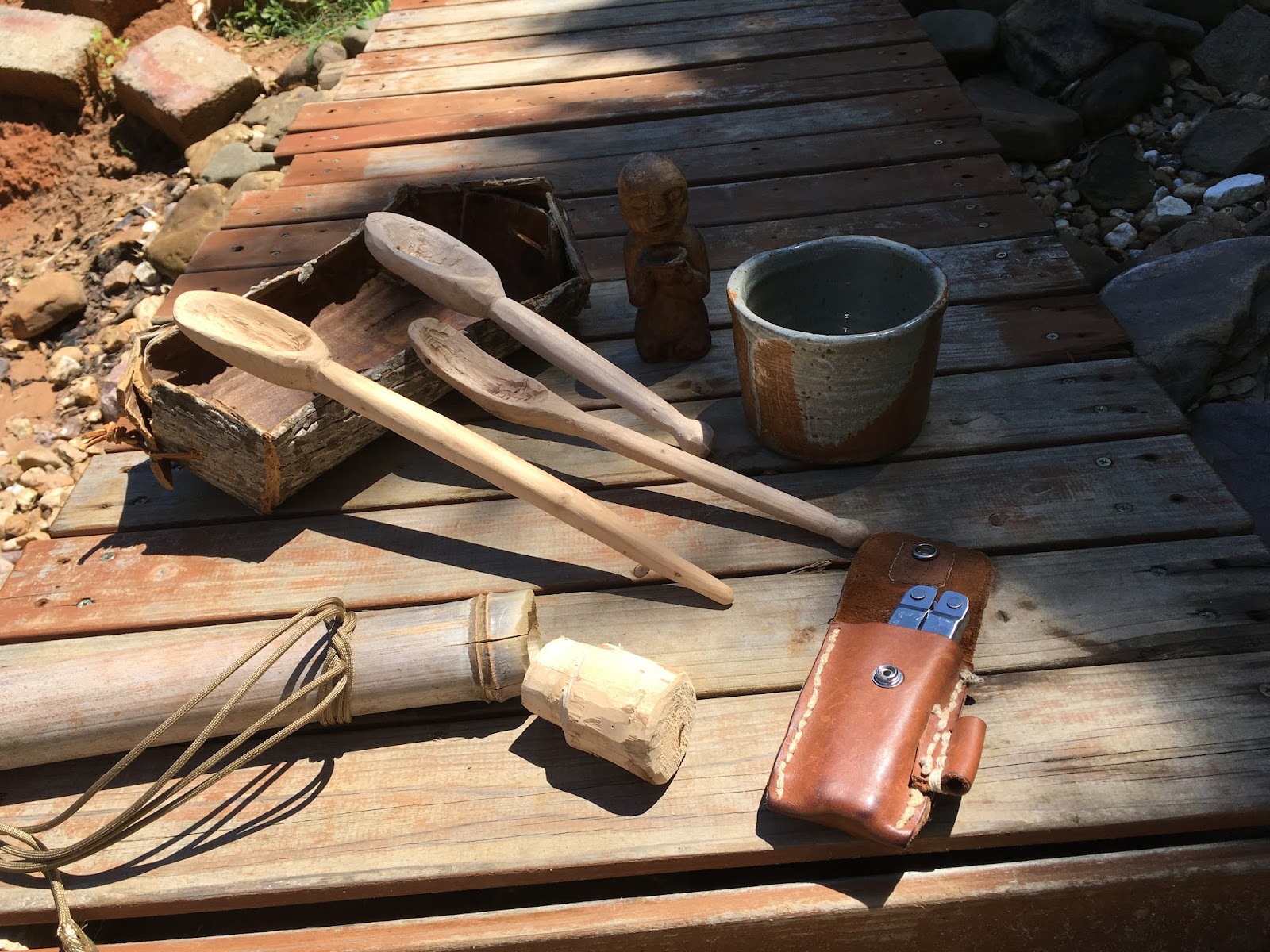
To me ABMS is a daily mindset, I am always looking for a resource and seeing what I can make from it. I also try to make something everyday, even if it is a little feather stick and a small fire. Now these things are not pieces to sell at a crafts fair but they keep the juices flowing. The ABMS mindset puts me in creative mode, it builds body heat (during cold days), teaches me about the properties of different materials and finally it keeps my mind occupied. I don’t know if you are like me but my mind is constantly racing around, so this activity keeps me positive and focused.

Monday, July 13, 2015

My First Step On The Martial Arts Path and The Fallen Idols

In the early 70s, my family of five moved to a suburb of NYC from Brooklyn, NY. It was a small town made up of mostly white working class people. I didn’t know it then but that town was a haven for white people fleeing school re-districting. My father had a long beard and long hair; he was a hippie. My parents made hand sewn leather jackets. My father, also did Tai chi, smoked marijuana and was into organic gardening. We clearly did not belong there. 

My parent’s were raised Catholic but never brought us to church. In Brooklyn I remember kids asking me what my religion was and I answered “public.” I guess I thought they were wondering what school I went to as some of the other Italian-American kids on our block went to Catholic school. Being hippies they made every effort to keep our mind’s open. They took us to the Museum of Natural History and MOMA often. My father had Salvador Dali books on the coffee table, along with a copy of the I-Ching and Mother Earth News was always visible. Not going to church or anything created an emptiness in me. I felt left out. I felt like I had no identity. 

As the 70s progressed the pressure to conform wore on my parents. In a few years, we went from no sugar cereals and no TV, to eventually having a TV, and occasionally getting a box of Fruity Pebbles. We were all really excited to own a TV.  I remember my father often practiced Tai chi in our living room. He tried to get me to stand in a Tai chi posture and he would test my balance by pushing on me. I would topple easily. Along with feeling identity-less I also felt physically unstable. I was an insecure kid. 

After dinner, we would all go and sit on my parent’s bed and watch a few shows on TV. In those days there was only one small TV in our house and it was in our parent’s room. My father would watch the show Kung Fu with David Carradine and explain some of the principles illustrated in the show. 

I became enthralled with Kwai Chang Caine. The intro to the show showed Caine dodging spears, fighting an old blind man who can listen to grasshoppers. It also showed him as a vulnerable boy struggling to learn the ways of the Shaolin Temple. The superheroes on TV seemed too ridiculous to take seriously but Caine was someone to look up to. My father loved the show, which only increased its awesomeness and the show also supported his Tai chi and eastern philosophical interests. Without a religion or any other thing to call myself Caine quickly filled a void as a role model. I still can see in my mind specific fighting scenes from episodes and I also tried to reenact them with my younger brother. In one scene Caine fights a man with a long handled ax but holds it closer to the head for better leverage, which my father took time out to explain (maybe that is why it is such a clear memory). During this period my father actually participated in the family. 

Things soon started to change. The times were changing. Every morning all the school kids walked to the bus stop, gathering together to talk about all kinds of stuff and see who would be made fun of and who would fight. Back then we all had to fight. One day some older boy brought an adult magazine to the stop. There was a series of photos of David Carradine, the actor who played Caine, having sex with a woman on the dirt in what appeared to be a teepee with candles all around them. It was a pretty freaky image for 9 or 10 year old to see. I was quite disturbed by it. He was a real hero to me. He was the one that saved people. He healed them when they were sick, counseled them when they were troubled and fought for them when they were being unjustly attacked. I needed Caine now more than ever. 

As we crept closer to the 80s, my father cut his hair shorter, quit Tai chi and tried to be a yuppy. My parents even stopped sewing jackets. The only thing left over from the hippy days was marijuana and solo albums by Lennon and McCartney. My father became quiet and withdrawn. Life changed. Our family changed. I never fit in at school and was always made fun of. The kids at school were quick to point out that my parents didn't look like all the other parents and one kid told me that my parents were witches. As I went on to middle and high school, people thought I was Puerto Rican or Jewish. No one ever considered me white, and many kids often used the words weird, fag, and gay to describe me. As the kids grew older verbal abuse turned into violence and since I was very gregarious I was often the one who they sought out to publicly humiliate. 

The football team made it their mission to beat me down any moment they could. When the teacher turned his back in class or when I went to the bathroom, or just walking down the hallway they would be there smacking me in the head, kicking me in the back or just choking me until I screamed. They just couldn't deal with me, they didn’t know who I was. I belonged to nothing. I tried running away from home a few times but that didn’t help. I pleaded to my parents to help me and take me out of school. They made an appointment with the principal to discuss the bullying. They tried but I knew things would get worse because of that and they did. 

When I began high school I was extremely nervous. I knew it was going to be hell. It was 1979 and I had already dreamed of revenge and would often cry alone in my room. I often thought of showing up at class with a gun and shooting them at their desks. One day, the biggest guy on the football team followed me into the bathroom with a group of about 5-7 other boys. I can only see his face all the rest were a group of blurry laughing faces. He commented on my new white sneakers and peed on them right in front of everyone. I was devastated that was worse than the actual beatings. I didn’t know what to do.

Not long after that horrible episode, I went to a movie with a few friends. Some older guy recommended we see this movie called Game of Death, starring Bruce Lee. I had never heard of Bruce Lee prior to that and I had totally forgotten about Caine. I remember sitting in the theater and being totally amazed at how the 5' 7" Bruce Lee knocked down the 7' 2 Kareem Abdul Jabbar with a flying side kick, and by the blinding speed of his nunchakus in his fight against Dan Inosanto, a filipino martial artist. To say that my mind was blown was an understatement. I went home and broke apart a wooden red chair in my bedroom to make the red nunchakus Bruce wielded. I began twirling them and knocking my head multiple times because of my poor understanding of the proper knots to make them fly smoothly. 

With a whole football team against me, my father withdrawn into a pot smoking zombie and nothing to belong to martial arts rescued me. Thinking back I have to say that making those red nunchakus was my first step onto the martial path. 

It is now 2015 and although it is technically true that I have never stopped practicing martial arts, I have to also admit that I wandered off the true path often and I still struggle to stay on the path. My father is a bitter old man who still smokes pot everyday. David Carradine died in 2009 from some weird sexual fetish and here I am struggling to keep true to the path. Still not belonging to anything but martial arts. Martial arts truly saved me multiple times from those stupid bullies in middle and high school, some angry people on the street and most of all from myself. My own self destructive behaviors often got the better of me. 

We are all fallen idols in some way. One by one from my father to Carradine to Bruce Lee they have all fallen. It is a difficult thing to grasp because we want something pure and unadulterated to give us hope. Unfortunately, time and time again we see our heroes fail and we see ourselves fail. I have failed so many times and I still fail but I have learned to accept that it is part of the process. 

The most important advice I can give to someone is that they will inevitably fail, and their idols will fail but despite that heartbreaking reality they must get back on the path.