Tuesday, July 21, 2020

Getting lost in infinity


Practicing martial arts forms on the deepest level manifests your cosmic kung fu training teachers. They train you. They are the cosmic ancient masters and their accumulated experiences are held in two different places, one in suspended animation in your DNA and second in the specific martial patterns. Once these are linked, the secrets can be unlocked through a deep visceral training of the ancient forms. 


After I was done with fighting highschool bullies, I realized fighting is not healthy. I ran to the Yin side to pursue the arts. I had grown up in an artistic household and thought this path would offer me the most out of life. It seemed an exciting choice and coincidentally not much different than martial arts with its physicality of moving the brush, charcoal, or chisel.


 Again, I heard those ancient voices but there were also voices of temptation like Lorelei whispering to travellers in the woods. I was soon coaxed into territories deeper than I could fathom, listening to the whisperings of lost souls whose threads were not connected to the ancient voices, my tether was cut and I was free floating in infinite space.

Floating in limitless space you brush up against those who are also untethered and there you can experience extreme connection but it is only temporary. Everything seems to fall apart and nothing lasts. Although this is true for much of the things found in life, there are however, some things that are rock solid and indestructible. Religions speak of such structures but, words can only be of little help. 


In martial forms, we walk with the ancient masters without form and our souls touch their footsteps. Those footsteps lead us to the energetic cathedral which forms the structure of the universe. This is indestructible and always changing.This is the place to reside. 


Chris Aloia, July 21, 2020


Tuesday, May 19, 2020

A Small Epiphany about Animal Consciousness


Recently my wife mused aloud questioning what could be occupying our pet's minds. I quickly brushed it off saying that all they think about is food. Since it was a rainy weekend and I had time, I decided watch a few TED talks on animal consciousness. One talk was given by Carl Safina, a noted writer on animal ecology, who wrote a book entitled Beyond Words; What Animals Think and Feel. Here is a link to the video  Not too far into the video, he made me feel foolish about giving short shrift to my wife's question. I also watched a few others but for the sake of brevity and clarity I will just stick to the one video. So not only did I immediately feel foolish, I also decided to open my mind and that simple but difficult action was like the sun bursting through the clouds on a rainy day. This inspired me to take my dog, Chewie (Short for Chewbacca, my kids are Star Wars fans) out in the back yard and let him wander around, while I did some T'ai Chi. During the practice I felt a deeper level of awareness of my whole body, as I moved through the T'ai Chi form. I felt these physical epiphanies before but, this time I felt increased neural connectivity.

In addition to greater connectivity, I became poignantly aware of the tightrope walk between flight or fight responses and more graceful responses. This fertile place of true realization in the moment that doesn’t stick around too long is what T'ai Chi cultivates. T'ai chi in combination with some other more direct combative training is a great match for walking that tightrope. Some might and some have questioned why practice T'ai Chi at all. 

I still practice it for three reasons: one, it makes my mind and body feel connected and that feels great; two, the research says T'ai Chi is good for injury prevention and pain management; and thirdly, I believe T'ai Chi develops a deeper understanding of form and biomechanics and forces me to think about movement efficiency.

When my practice was done, I got a bow saw and cut a freshly downed branch of tulip poplar into smaller throwing size sticks, and threw one about 70 feet, so my dog could fetch it. He was in heaven, prancing about with that stick in his mouth. We just played and enjoyed the freedom of the moment. I am usually very critical, almost cynical about TED talks, but I have to admit watching that TED talk about animal consciousness really helped me become more aware of his sentience as well as my own.

Monday, November 18, 2019

Reminiscing About How I Found Martial Arts

I was lucky that I grew up in the 70s and 80s when Asian culture, particularly martial arts, was becoming popular in the US. With the popularity of Bruce Lee movies, and the TV series Kung Fu it almost became a prerequisite to have a martial arts fight in many TV shows. I remember waiting for those fight scenes with great anticipation.

Additionally, my father was practicing Tai Chi from Robert Chuckrow and he took me to one of his classes. I remember watching him and his friend practice the Tai Chi form in our yard. My father even tried to get me to stand in a Tai Chi posture and it was really uncomfortable.  I was so rambunctious I was definitely not ready for the slow practice of Tai Chi. Then in the 80s, the TV mini-series, Shogun came on and I made myself a bokken and practiced cuts with it. I was so excited by Asian culture and swords that I really wanted to learn more.

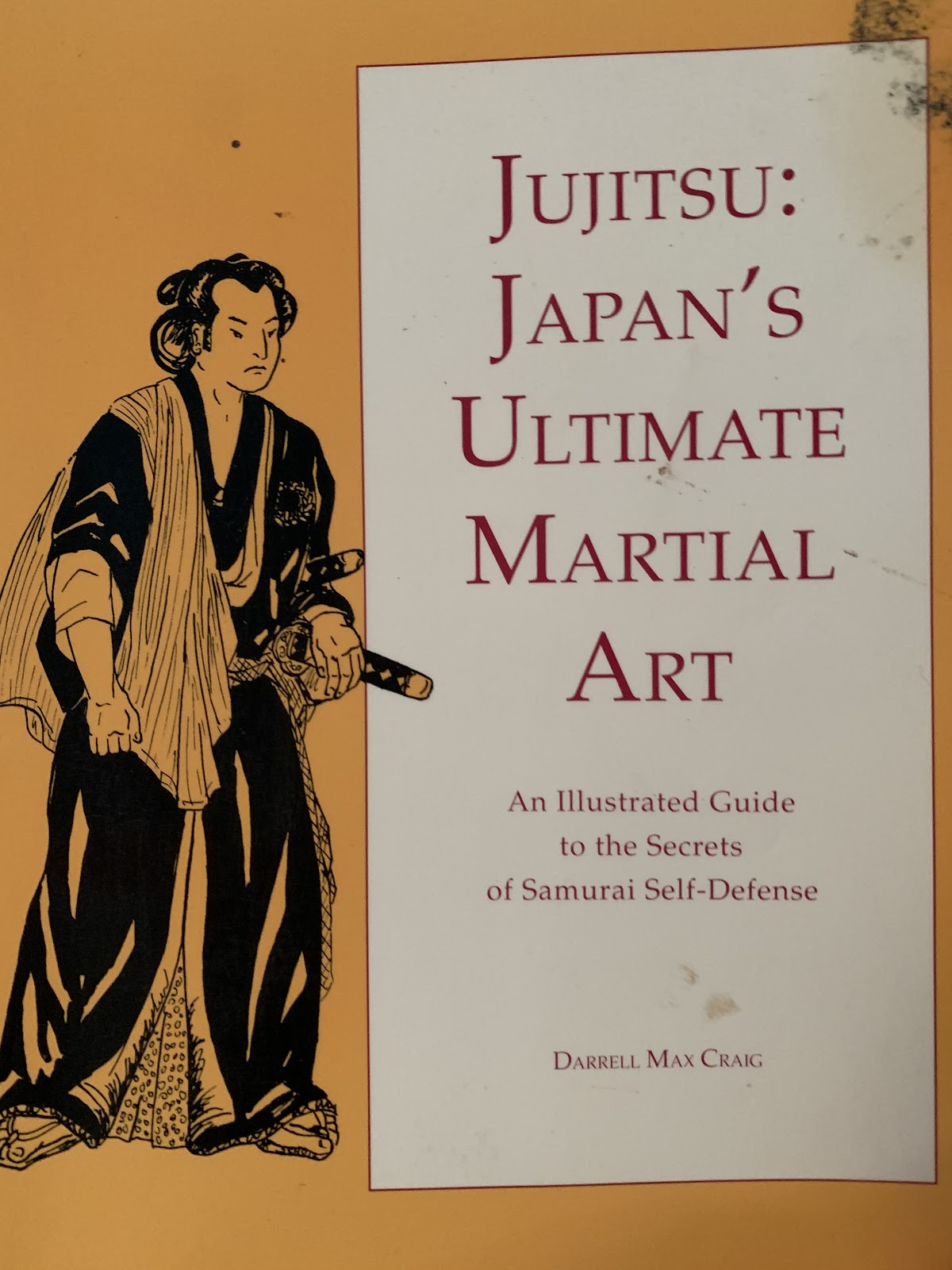
All that media exposure sparked me to explore further and I remember going to the local book store and checking out the martial arts section. It was only a few books and there was an orange book, much like this one pictured, that had historical illustrations of old time Jujitsu techniques. I bought it and became enthralled with those mysterious techniques. I tried to understand them but I couldn’t figure out the movements from the illustrations alone. 
Japanese Jiu-jitsu - Tuttle Publishing

I looked in the yellow pages and I remember seeing an advertisement for an Aikido class in a neighboring town. It seemed like it was a thousand miles away. Then I saw that our town had a Karate school so I did not have much choice. I ended up in Okinawan Goju ryu class and got my yellow belt. I remember the sensei telling us stories of the Okinawan masters he learned from, while in the military in Japan. Unfortunately, the school soon closed but luckily I found people who were into boxing. So I was still in the martial arts. However, in the back of my mind I still wanted to learn those traditional techniques found in Jujitsu and Aikido. After a couple of years of boxing I quit fighting all together. 

I had met some famous old boxing champs and realized that fighting and getting hit repeatedly in the head was not a healthy lifestyle choice. I forgot about the self development aspects of martial arts and boxing didn't teach those. So I thought I was done with the martial arts path. 


As I continued to explore other aspects of myself and grew as an adult, I once again saw a need to get back to martial arts.

This time I was in Seattle and there I had my pick of almost every imaginable martial arts style. I lived close to the International District and visited all kinds of schools offering Kung Fu, Brazilian Jujitsu, Hapkido and Aikido. I finally had my opportunity to study Aikido and learn those amazing mysterious techniques I dreamed about as a kid. So after many years I began learning everything I could and practiced intensely. Plus, there was a great group of people and we quickly became friends. The camaraderie at the school was a amazing.
 
Martial arts always came to my life in times when I needed guidance. In martial arts there is this important work being done that touches you on every level from the social to a deeply intimate and most personal. There is something compelling working out with people in a friendly but challenging manner that I have only found in martial arts.  I am very thankful that I grew up in a time when it was accessible to me. I honestly don’t know what I would have become had I not found the martial path.

Wednesday, September 18, 2019

Spiraling Patterns in Tai Chi (Notes from class on 9/17/19)


Yesterday in class, I discussed thigh rotation during Tai Chi movements. In the illustration from Chen Style Tai Chi, it depicts how your body should coil during most movements.


One exercise I use in my warm-ups is the reverse punch (Seen in the illustration below). Many people think the reverse punch is obsolete and a waste of time. However, they miss an important point, it is not directly for fighting but for training the body to coil, which is storing and releasing power. 


In fact, most of the reason why Tai Chi is performed slowly is to understand how this spiraling force is transmitted from one part of the body to the other without having gaps or hiccups, which can be exploited by an external force. This slow spiral movement also "ties" up the joints to protect them by keeping them aligned.
This is why Tai Chi is particularly good for balance, because it develops a counter spiral which "locks" the body into a stable structure. The lines in the Chen Style illustration show how force moves through the body, and of course, it is a spiraling motion, which follow patterns found in most organic structures because we live in a spiral universe and on a rotating planet.

When performing the reverse punch over time you will see every part of your body from your feet to your hands embodying a spiraling motion.  

Wednesday, July 17, 2019

Kayaking trip: father and son bonding in the computer age!


I have two sons, both of whom are ADDICTED to video games. My 14 year old has even cried when we have taken them away and said he hates everything else about life. Well, hearing that scared the crap out of me and my wife.

Additionally, my son has been doing typical teenage smart ass stuff, eye rolls and all. So it has been a little rough since he turned 13. It is not horrible but it is tough. Overall, he is a good kid and we love him to death. He does well in school, completes homework, and helps out with chores (but not without an argument about how stupid chores are).

So Easter 2018 weekend, I told my wife all I want for my upcoming birthday is to go Kayaking with her and the kids.

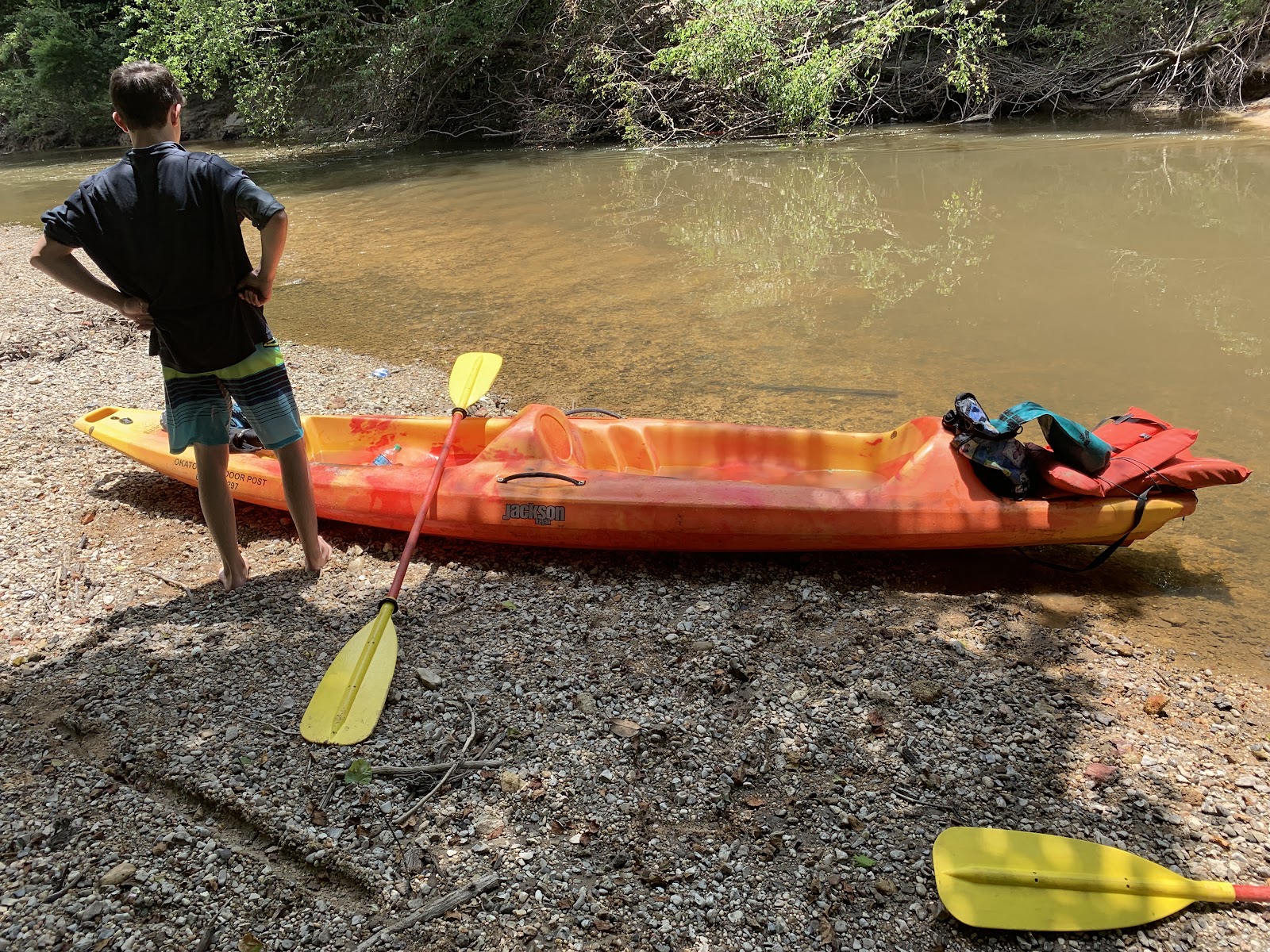
I was shocked when my 14 yo wanted to ride with me and surprisingly, we made great partners. I was so proud of him. He actually handled the turns and rapids really well for his first time. The whole trip he said, we have to come back and do this again. I felt so good and I felt like I got my son back. When he was younger we did everything together.  Needless to say this was the best birthday present ever!

When school got out in 2019, we found ourselves with the same battles and arguments. I saw an opportunity for just him and I to go kayaking again. And again it was really special. He really has a sense of adventure. It is so nice to share that with him. There are moments during any kayaking trip where there is a sense of danger, especially when seeing the on-coming rapids, rocks and debris. We work together to navigate it and shout out directives to each other. This is a great opportunity to bond but also to provide an example of how to deal with danger. I complimented him often and we teased each other some. There was a moment when he realized I am not such a bad guy. He joked back, saying that he has been doing the lion’s share of the rowing, with an obvious smile.

I could tell he needed to be in a real situation with me. So we can become accustomed to each other at a different stage in our lives. As adults, we take it for granted because we raised our kids from infants and we provide everything for them. Things that are obvious like meals but also things not so obvious like school applications, vaccinations and plane tickets etc, seem like magic to them; they just appear. What I am getting at here is that they don’t remember everything we have done for them and I think we have a tendency to demand respect and appreciation but they don’t remember all that little stuff. They need to rebuild the respect and connection, while we are placing more rigorous demands on them.

So being in semi-dangerous situations affords us the opportunity to build that connection and appreciate each other in a new context. I have found, just with these two trips, one was 3-4 hours and the other was over 6, that we came out of the river with much more love and respect for each other than before we went in. 


Another benefit of doing these trips is it is an opportunity to talk about other things and also share skills like survival skills that could potentially be needed. Whenever I go kayaking, I bring a couple of knives like, a Cold Steel Pro-lite folder or an Ontario Rat 1, which I keep on my person. I also bring other gear I keep in a dry bag as a backup. I also gave my son one of my knives to carry on him and gave him some simple instructions on how to use it and when he should use it. I discussed with him the potential of me getting hurt and what he would have to do. I made it fun to keep it from being another boring lecture. Kayaking also lends itself to a good life lesson, one of the things my son had trouble with was the importance of setting the right trajectory as you get to a bottle neck in the river. Since the water is moving fast and if you are on the wrong trajectory you could end up stuck on the rocks, flipped over, or eating a bunch of branches. 


I used this lesson to compare it to life and school work. While, schoolwork is boring and you want to wait until the last minute, sometimes that isn't enough and you could end up not getting into the college you want or missing an opportunity that you really wanted. I didn't drive in home hard but I did connect the dots.


Since kayaking is loved by everyone in the family, we  have decided that this is going to be one of our family activities and my wife and I discussed purchasing our own kayaks. We are also researching how to work out the transportation of them. 


Now, I feel like arguments and screaming matches are a cry for a new way of reconnecting and a new challenge rather than a downward spiral towards family disintegration.

Here’s to new hope!!!

6 reasons why the Mora Bushcraft Black is my number one favorite fixed blade.


1. Mora carbon steel takes a fine edge that can easily be brought back to shaving and I have found this to be reliable on all their knives I have owned. The other day I saw some rubber hanging below my car. So I grabbed my Bush Craft Black and started cutting the rubber. I kept trying to cut it but it wasn't budging. I looked at my knife in horror, and I realized the entire edge looked like a boxer's teeth, craggily AF. I checked the rubber and it had a steel core. I immediately went inside using only my ceramic rods and after a moderate amount of work, the edge was back to shaving sharp. Mora's carbon steel is one of the few knife companies I trust, so I keep coming back for more.

2. The handle is so comfortable. I can carve feather sticks for a long time with less fatigue than other knives. Plus the design of the grip really allows the knife to rest in a perfect position in my hand. Sometimes I just want to hold the knife because it feels so good.

3. The 90° spine is the sharpest of all my knives. I have used it countless times and it bites deep into the ferro rod giving me the most sparks of all my knives. It does have to be maintained with a stone every so often but it is still the sharpest out there.

4. It is lightweight. In a package that tics all the important boxes, like steel quality, comfort, usability, a good price, it is also lighter than other knives. Another benefit of it being lightweight is that when you have it on your belt you don't feel like it is dragging you down.

5. Another feature I like that is unique to Mora, is there is no ricasso, or choil, so you can get right up to the guard when cutting. Just to clarify, the ricasso on a knife is the space between the handle or guard, if the knife has one, and the cutting edge. The choil is a little (usually little) notch that allows you to sharpen the edge without the stone rubbing on the ricasso (see picture below). Sometimes people confuse the two and sometimes knifemakers enlarge the choil to allow for a finger to be placed there. It is really amazing how few knife companies do this. I find it makes sharpening easier and it provides more leverage for carving too. Also, the notch doesn't catch on things you are trying to cut. For a good article on choils click here .
Image result for fixed blade knife parts ricasso

6. Another great thing about Mora is they relatively low cost, which means you can get a great knife within your budget. That also means you can use it and not feel like you are destroying a family heirloom. They are a tool to be used not kept locked up for future generations. 

All of these great things about Mora also add up to making easier to having the knife on you when you need it. This week, there was a story of a 69 year old woman, who got separated from her husband while camping and was lost for 3 days in the wilderness without anything. Having a small fixed blade and a few other supplies on your belt, like a ferro rod and some cordage could have really helped her. She survived but was severely dehydrated and in need of hospitalization. It is a good reminder that having a few tools and a little knowledge on how to use them could make the world of difference. I would definitely recommend a Mora Bushcraft black for any hiker to carry into the woods, even for a day hike.


Thursday, June 20, 2019

Between Postures: Where the Gold in Tai Chi Is Mined!

 Every so often during practice I will have an epiphany about some aspect of the Tai Chi form or a particular movement within.  When it happens I feel like I have gotten closer to uncovering the mysteries of Tai Chi. As I continue to explore an epiphany I soon realize that it has already been thoroughly explained in Yang Cheng Fu’s 10 Important Points. This week was no different. In the past few classes, we had been working on the gap/transitions between Tai Chi postures, particularly from Single Whip to Wave Hands Like Clouds but it is in all transitions. Often someone learning Tai Chi will automatically go from one move to the other will little thought or activation put into the transition, thus creating a gap in their structure. Specifically, Yang Cheng Fu expounded upon my epiphany in number 8 and number 9 of his 10 Important Points. Number 8 discusses the importance of harmony between the internal and external parts and number 9 discusses the importance of continuity while going from one posture to the next.


Single Whip
What separates Tai Chi from other exercise routines is once the form has begun the training is the transition from one posture to the other seamlessly. I have found understanding the martial aspects helps focus your attention on those transitions because transitions or gaps are vulnerabilities. In analyzing transitions in the Tai Chi form there are two basic categories. Hand transitions (moving from one side to the other or raising one high and one low) and stepping transitions.


Hand Transitions

Two postures that make a great example are Single Whip to Wave Hands Like Clouds. When you strike with your left hand/forearm (at the 12:00 o’clock) position in Single Whip, your right hand is extended outwards perpendicular to your left, creating a right angle (at the 3:00 position). As soon as you have reached the apex of that left hand strike (12 o’clock position otherwise known as absolute yang), your energy should slowly dissipate from the left hand (and start moving toward yin), as you sense an attack coming at your 4:00 o’clock position. So you begin to rotate your body to face that attack. Your right hand becomes activated and dominant (now yang) while your left comes to support the right, which begins the Wave Hands Like Clouds sequence.

The beginning of Wave Hands Like Clouds


Stepping Transitions
When moving from one posture to another you are transferring weight from one leg to the other, as you propel forward. During most Tai Chi movements there is a point where you must place 100% of one’s weight on one leg as you step. In the form, we practice weight transfer extremely slow to develop strength and stability.

We analyzed our stability when changing hand positions, but how strong are we when taking a step? The answer to this requires a two-part response. First, you would ONLY enter when you see a gap in your opponent’s defenses, and secondly, when you do see that opening you must do it swiftly, like a hawk seizing a rabbit.

To discuss entering it is important to tie it in with my boxing days. Entering is a lesson learned the hard way and it was ingrained upon me in two ways. In that awkward period when you are first learning to fight and you try to get close enough to punch someone, you quickly realize that you are also able to get hit. A lot of fear is generated and leads to stopping you from moving. You want to end the encounter, but you have to enter to do it which exposes you to a counter attack and harm. Many boxers, myself included, were told to never cross legs when moving, because you may get hit when doing so and your base will collapse, resulting in a knock down at the very least.

The important aspect of Tai Chi that is often overlooked is timing, because many Tai Chi people have never had to fight. A good example to understand timing is jumping rope; to jump over the rope at the exact time the rope should be right in front of your toes. If you jump too soon, you will land before the rope passes and if you jump too late you will get hit by the rope. In a self defense situation, the movements are hyper dynamic and the attacker doesn’t follow the rhythms of the form. It is those rhythms of entering either to the outside or the inside and look for openings with a decreased chance of getting hit while doing so. It is that “beat” which needs to seamlessly change with weight transitions. A true self defense or combative training session will work more on the timing of entering than memorization of a choreographed routine.

Transitions are where the gold of Tai Chi is mined. With training, anyone can assume a posture or stance but to carry the mindful focus of the dan tian and using the kua to transfer energy from one part of your body to other takes real concentration and effort. This is why Yang Cheng Fu includes continuity in transitions in his ten important points. It is also why I included his 8th point, “harmony between the internal and external parts”. You can’t transition if you have no smooth energy flow from the right to the left side of your body, nor can it flow if internal and external parts are not in harmony. Working on that harmony is the gold of Tai Chi, it is the neija or internal work that needs to be worked on to grow.

In sum, the form is a great general training tool but it will not fully prepare you for a dynamic encounter either with an opponent or in life situations that could arise. If you include mindful transitions into your form it will help you understand the need to focus and place attention on weaknesses in your form. It will inspire you to incorporate transitions and timing drills into your practice.

Monday, June 17, 2019

Harmonizing Yin/Yang

Yesterday in my Tai Chi class we joked about aging and why Tai Chi is mainly for older people (I work mostly with older adults). I have a younger women in class, and she stated, "I am not old!" We all laughed. Then I talked about self-selection, explaining that Tai Chi is too slow for younger people, who are looking for quick results.

In that particular class, I decided to start with a little boxing drill.  As a change up to the typical Tai Chi posture drills, we practiced a jab and right cross for a bit and I showed how it is slightly similar to Brush Knee Push.

That boxing drill sparked some one to ask if it is better to punch someone with a closed fist than an open hand. I talked about the nuances of that for a bit, which led to palm strikes and I said that palm strikes, are in the following Tai Chi moves: Brush Knee, High Pat on Horse, Single Whip, Wave Hands Like Clouds, and Repulse the Monkey. Then I discussed how palm strikes can be strikes, grabs, or even blocks. Moreover, they can also include the forearm and even the elbow. When you find your inner structure, or in Tai Chi vernacular, "Steel Inside Cotton" the whole forearm, including the hand becomes a type of guard/shield or even a strike, as demonstrated by self defense expert Tony Blauer in the pictured above.

So when you are practicing Tai Chi and developing your inner structure you are also developing a guard that protects your vitals. The guard is present in almost every Tai Chi move from opening to close. Each arm smoothly transitions from attack (yang) to guard (yin) in a circular motion mirroring the yin/yang symbol or Tai Chi. When you are attacking you are also defending, part of you advances and part of you yields. At the highest levels, all movements in martial arts connect to this principle. Whenever you read online disses of a martial art they are only discussing the veneer of their perception. Aikido gets a tremendous amount of hate but there are no major difference between Jiu Jitsu and Aikido. Sure, many Aikidoka show certain moves like wrist grabs, but digging deep into the principles of both arts, you end up at the same place. Even Brazilian Jiu Jitsu uses the same principles but translated into ground fighting. I believe the biggest difference is in the training. Aikido and Tai Chi do not train for real combat, they instead work on self development.

Tai Chi literally means "the grand ultimate point" where yin/yang are perfectly balanced; and to accomplish that harmony between polar opposites takes time, and this is where we usually lose younger people. You have to become committed to unifying these opposites in your body and mind. Learning self defense is important. Many younger people are looking to learn a self defense skill but what they miss is working on that harmonization might have a greater impact on them and actually move them into a higher level of awareness that can be of more practical use to them than merely being able to stop an attack. 

Tuesday, May 14, 2019

Spyderco Tenacious Review


As I have written in the past, I have carried a pocket knife everyday for well over two decades. I love having a pocket knife handy for many of life's chores. Much of those two decades have seen a Spyderco in my pocket.

Last time, I wrote about the Spyderco Stretch, a knife I have I carried everyday for a 7 year period. Since that writing, I have found that the lock back has loosened creating too much vertical blade play. That discovery has set about a search for a new EDC. One great thing about being in many knife groups on Facebook is you get to see a ton of knives that are out there. In the past two years or so, I have carried an Ontario Rat 1, a Cold Steel Pro-lite, and a Spyderco Tenacious. If you sense a theme here it would be cheaper level knives.  A few years ago, My wife and I have bought a house and there are some repairs so I haven't had money to purchase more expensive knives.

After about almost two years of having those three in my carry rotation, the Tenacious found its way in my pocket more than the others. Just a quick note, both of the others knives are excellent for the money and they still have a place for me in specific activities, such as the Rat is great for yard work and hiking; but a little too large for daily carry and typical knife chores; the Pro-lite is my designated kayaking and travel knife because it is cheap but very strong. It is a great choice for that and that Tri-ad lock is one of the toughest locks on the market.

Left to right: Ontario Rat 1, Spyderco Tenacious, Spyderco Endura, Spyderco Stretch, Cold Steel Pro-Lite, Kabar Kharon
One of the main reasons why I like the Tenacious is the ease of opening. Especially compared to the Pro-lite, which is a bear to open. It made the Tenacious feel like a slippy-slide. I was also surprised by 8cr13mov steel. At first I was really disappointed in this cheaper steel, mostly because of haters in knife groups, but after months and months of hard use, doing tasks like carving feathersticks in all types of wood, cutting boxes, opening packages, I have not had to do any kind of extensive sharpening to it; just a few swipes on a ceramic rod or a honing steel and it was back to hair popping sharp. Now, I prefer it to AUS8 for sure and I think it is comparable to Ontario's D2.

Another thing that added to my liking of the Tenacious was when I just started carrying it, we had a plumbing incident and when our plumber got out from under the house to fix our pipes, I noticed he had a knife in his pocket. We started chatting about knives and he took his out and it was a Tenacious. So we compared stories and he said he has been EDC-ing his on his job for over a year (See Pic below) and it has held up really well for him.

At $50 dollars, the Tenacious is hard to beat. Usually in knife groups, the Ontario Rat 1 is one of the highest rated knifes for under $50. I agree, the Rat is tough and cheap. If I can only have one folding knife, under $50, it would be the Rat 1. That said, for an everyday carry knife I often recommend the Tenacious. Both are great knives.

Any knife review would be remiss if I didn't give some of my criticisms. So here goes!

My biggest issue with the Tenacious is blade play. Mine doesn't have the vertical blade play my Delica, Stretch, and Endura have, but it does have side-to-side play. The blade is wobbly, so wobbly that I had to put Loctite to prevent the pivot from coming loose and the blade is still wobbly. 
This is where this review has to go into Spyderco's Customer Service Policy.

NOTE: Loctite on the pivot pin has stopped the lateral blade play on the Tenacious. 

I am really disappointed in the amount of blade play my Tenacious has and I considered sending to Spyderco, but their customer service policy is extremely limited, which is still true! It is so limited that I have decided to move my loyalty to Benchmade because they have a life-time warranty policy. Even though, I prefer Spyderco's opening mechanism and some of their designs more than many of Benchmade's, their policy sucks. Benchmade's policy makes it a much better deal. I will still carry my Tenacious but it is not going to be my main carry anymore. I recently bought a Benchmade Bugout and it is now my main carry. For the record it has ZERO blade play. 

Another issue to discuss is the type of locking mechanisms. The Tenacious has a liner lock, which are great for closing with one hand and the liner protects against vertical blade play, which is the worst kind in my opinion. Vertical blade play means that when you are cutting an apple and pressing down there will be a slight give to pivot. Lateral blade play isn't as bad but it makes the knife feel cheap and means that the machining tolerances are low. Many of my knives have no play at all, like the Ontario Rat 1, or the Cold Steel Pro-lite, it can be done affordably. Unfortunately, all my Spydercos have unacceptable levels of blade play. Since the posting of this article, I have purchased a Manix, with a ball bearing lock and I have to say that is a very good lock with less blade play than Benchmade's axis lock. I have to admitt that Spyderco makes knives that I am really excited about and I will continue to carry them more than any other brand. With that said, I will not purchase any knife of theirs with a lockback.  

In sum, I still carry my Tenacious and it is a great knife for the money. I still recommend it for a cheaper level knife that can be used hard for tasks you might not do with more expensive knives. My plumber would agree too! 

This article has been updated on 9/2/2020 to reflect my continued experience with the Tenacious and other knives I have owned since May of last year. I carry my Tenacious more than any other folder. The Bugout is a great knife but it is too small for my hand to be carried regularly. It does make a great back up knife in a mini-survival kit (MSK).

Wednesday, November 28, 2018

What does it mean that T'ai Chi is an Internal Practice?


Recently,  a systematic review was published attempting to ascertain the different types of emphasis by T'ai Chi modalities. A lot of research on T'ai Chi is published, but usually the research doesn’t distinguish the approach a teacher chooses. In my experience, I have observed some T'ai Chi instructors focus on performing the form in competitions, some train to win medals in push hands, some focus strictly on health, and some focus on neijia, or internal martial arts.  

While all methods of teaching T'ai Chi share considerable overlap and most would be recognizable to the lay person as T'ai Chi, it is only when you delve deeper into T'ai Chi that you will be able to see the subtle differences between these general approaches. I have encountered T'ai Chi schools that focus on the performance of forms, and I have found them to be less substantive although more athletic, less internal and sometimes even rigid. For them, T'ai Chi is a more of an athletic dance than a martial art. There are many examples of this on youtube (click here). You can usually spot them when you see the practitioner raise their leg straight over their head. There is a ballet like aura to the movements, with a hushed silence as they slowly demonstrate their athletic prowess, albeit it in slow motion. I have also been to classes where it is purely a therapeutic movement with little or no demands on the body. Even though I enjoy T'ai Chi and love to see it performed in many ways, it is when I feel that internal body subtly moving do I completely become engrossed in the class. 

So what is Neijia?

Wikipedia’s definition is “Neijia is a term in Chinese martial arts, grouping those styles that practice neijing, usually translated as internal martial arts, occupied with spiritual, mental or qi-related aspects, as opposed to an ‘external’ approach focused on physiological aspects.” 

I disagree with parts of Wikipedia’s definition. While I would agree that neijia is classified as internal martial arts, I would not equate the external with physiological. It makes neijia seem elusive and mysterious. Neijia is, in fact, physiological but in a deeper way than just using large muscle groups. I would characterize external martial arts as using force and tension rather than relaxation or song (attentive relaxation).

I have trained with a few teachers that have emphasized the internal over the athletic dance style. In a blog post I wrote last year called “The Importance of Naturalness in T'ai Chi,” I discussed my experience with Gao Fu at a workshop, where she illuminated the path of neijia for me through zhan zhuang (standing meditation) and chan ssu jin (Silk Reeling Energy/Spiral Exercises). After that 5-day workshop, I became totally enthralled with neijia and rigorously searched for a teacher until I found Fong Ha, in Berkeley CA. The main part of Fong Ha’s teaching is zhan zhuang, and what blew my mind was that I am decades younger and many inches taller than he is, but I could not even budge him. He would stand on one leg and allow me to push him as hard as I could, and I failed to move him even an inch. Then when he was finished playing with me, he would shift a little and I would stumble off balance like an infant. Fong Ha and his teachings were elaborated on in the three-book series Warriors of Stillness by Jan Diepersloot. Those books introduced me to Fong Ha’s teachers, who have developed amazing internal abilities, like Master Cai and a few Yi Quan Masters, who were taught by Wang Xiang Zhai. Wang Xiang Zhai is an important figure in the resurgence of neijia because he developed an internal system of boxing that relied on standing meditation (zhan zhuang), which allowed him to push over an opponent with little external movement. While no videos exist of Wang Xiang Zhai, I have found one of a Tai Chi master doing push hands using neijia. (To see the video clip click here) Here is another more recent video clip of someone I have studied with here.

Neijia, the phenomenon

Something happens in T'ai Chi when you perform it ever so slowly and also while you are thoroughly engaged in standing meditation, which I believe is unique to T'ai Chi. For sure, there are many types of bodily awarenesses like being “in the zone” or feeling things happen in slow motion, but I have not experienced in other types of exercises what happens in T'ai Chi. In T'ai Chi, there seems to be a special focus on balance, specifically proprioception, that I believe is unique. Proprioception is defined as “is the sense of the relative position of one's own parts of the body and strength of effort being employed in movement. It is sometimes described as the "sixth sense." So, for the T'ai Chi practitioner, proprioception is not an afterthought like it might be in some other exercises, where your focus could be on jumping over a hurdle or swinging a racket at a ball. Of course, those exercises would facilitate proprioception, but what sets T'ai Chi apart is that the main focus is on proprioception. You turn your focus inward and work on using the mind to direct your center and its relationship to the ground and to other people, as in the case of push hands. Then something interesting happens: you start to see your body in a different way, not simply like outstretched arms reaching for something while keeping yourself upright but like a network of cables and fibers that are stretching and calibrating from your toes to your fingertips and everything in between. You feel whole. You feel connected but separate simultaneously.

What I have found is that the dance-like approach is closer to an external form and doesn’t feel like my whole body is fully engaged. I have to add that there are no studies I know of that research the benefits of one modality over another. It would be an interesting study but difficult to gather that many participants. So I can’t say which one is better with any credibility; however, what I can say is that being fully engaged is deeply fulfilling to me on a quality of life scale. I do think the athletic dance approach is more aesthetically pleasing, and I believe that makes people feel like it is the better approach. What I think gets lost following that path is the resistance you get from an outside force like push hands, which allows you to sense another’s intent. Then your body develops an ability to calibrate to external forces because you are directing and dispersing the force throughout your body using your intention via the network of fibers called the fascia. Having that force applied to your structure allows you to listen to it  and is what I believe makes it an “internal” approach. Simply stretching your body and assuming an athletic, albeit slow or static position, doesn’t necessarily mean you are directing it with your intention. When you use your intention, it deepens the quality of the movement and thus improves your mind-body connection.

I haven’t done much yoga, but I know many people draw a distinction between true yoga and gym yoga, criticizing gym yoga as being merely external and athletic, while true yoga is more internal and contemplative. I think the same distinction is drawn between internal T'ai Chi and the more external athletic dance approach. I would like to see a study using functional balance as a means of evaluating which of the different approaches is more efficacious. I know which one I would wager on. 


Wednesday, January 31, 2018

Survival Knife! Learning the hard way

On a plane heading to some islands off the Western coast of Canada, I met some guys who worked for a moving company. They had a large office move contract and offered me some work. I agreed, and when the job was completed, they asked me to come work with them in Vancouver, BC. I ended up working for them for 6 months. After a few months of working with them, I did not meet many people, so I was excited when my boss at the moving company asked me to go hunting with him and a few of his friends.

We drove many hours to a place called “Hundred Mile House.” During the drive, we were drinking beer and listening to Metallica's Black Album and being rowdy. On our drive, we were pulled over by a policeman. As the policeman approached our vehicle, the driver (my boss), who had previously rolled his large pickup truck over a few months ago, totally cracking the windshield, greeted the police officer. I distinctly remember the policeman telling him that it was illegal to drive with a windshield that had a crack longer than 12.” My boss, said, “sir, I don’t think there is one crack longer than 12” on the whole windshield.” We all burst out laughing. The whole windshield was like a spiderweb of tiny cracks. He let us go with a warning to fix the windshield. We began drinking beer again. Someone in the car said they left their flask in the back bed. I volunteered to climb out of the moving vehicle and retrieve it. Driving at night in the woods, I climbed out of the window and jumped into the back bed, grabbed the flask in his bag, and climbed back in. We finally and uneventfully pulled up to our motel. We were all pretty drunk. Next thing, I remember we were up at 4 am getting dressed and heading out into the woods.

It was a very cold, rainy November morning. My boss gave me a shotgun, pointed in a particular direction, and told me go out there and if I see a deer, shoot it. I had never been hunting before. I had been walking for a hour or so when I heard a shot. I walked over and my boss had just killed a deer. As I approached, I could tell the deer was still moving so I took out my knife and stabbed it in the throat. He was so impressed by that, he cut the deer open and removed its heart, and said I had to take a bite because it was my first kill. I balked, but he was insistent, so I reluctantly bit a chunk of the warm muscle. I immediately felt an adrenaline rush deep in my body. I now wanted to get my own true kill. Like a bloodhound in search of a fugitive, I charged off following deer tracks without taking my eye off the ground. I really do not remember how long I was searching, but when I looked up, the sun was just about to set.

An eerie chill went through my spine as the trees looked black and gnarled against the smoky pink sky. I simply didn’t notice where I was or what was happening weather-wise. My cotton jacket had a shell of ice from the rain, and the snow turned to sleet. The winds picked up, and I started screaming for help. Realizing I was totally screwed, I frantically yelled, but no one could hear me. I yelled till my voice was hoarse, and then I cried hard. The winds were so loud that it was useless even trying.

After a good bit of crying, A great fear hit me, I realized that wolves and bears could be out there stalking me. I searched for a clearing in the dark, and I took a long hard look around and realized I needed some protection from the elements. I started to get cold, really cold, and I remembered I had some power bars on me. I knew if I ate them, it would generate some body heat. I think I ate three. I felt around in the dark for a tree and cut off some cedar boughs with my Cold Steel SRK knife. It had a 6” blade and barely enough to cut through the boughs. I really had to use force. I remember the impact of those cuts on my wrist. As I started to make a crude shelter from the freezing rain, I found a piece of corrugated metal that was just lying a few feet away, and I surrounded myself by it and the boughs. I was still cold, so I would periodically get up and do some jumping jacks, and martial arts strikes. Those martial arts strikes really felt empowering in that dark, icy forest.

The thought of making a fire never entered my head. I think back then, I knew so little that the fact it was raining, with snow everywhere, meant it was impossible to make a fire. I am not even sure I had matches on me. I seriously doubt I would have made it through the night without becoming hypothermic. Luckily, after 6 hours or so, the winds died down, and I figured it would be a good time to fire the shotgun into the air as a signal device. After a short pause, I heard a shot. We continued to communicate with each other through gunshots, and I was finally able to find my way to them in the pitch dark. It was about 11 p.m., and they said they were just about to leave and notify someone. I can’t express how happy I was when I finally burst through that dense icy forest into an opening where my boss and his friends were.


Lessons Learned


Obviously, an experience like this is life-changing. I couldn’t help but think of how naive I was going into the woods and all the thoughtless decisions I made that led me into a life-threatening situation. There was a temptation to beat myself up; there was also a temptation to eschew ever going into the wilderness again. But as I thought it through, I realized who I was, and I used it as a way to improve myself.

So I set out to take my outdoor skills to a deeper level. After much reflection, three major areas can get you into and out of a survival situation: Decisions, Knowledge and Skills, and Tools.


Decisions


After being a father of two young boys, I realized just how stupid it was to get into a car that was already damaged from a previous drinking and driving accident. There was also the fact that I chose to walk out into a very unfamiliar forest in poor weather conditions without any training whatsoever. I am not beating myself up here, but I am examining some of the decisions I made leading up to my survival situation. Prior to that experience, I hadn’t spent too much time in the woods. Being a city boy, I didn’t grow up learning how to survive in the woods. This is why we can’t always make the right decision. I had always desired to go hunting but never knew anyone that did it. So I overlooked the bad cues because I really wanted to get out there and hunt. Still today, many people go for a hike and don’t even bring a water bottle or even carry a swiss army knife.


Knowledge and Skills


In short, I had none of either. Although I had never heard of hypothermia, I did know enough to keep my wits about me. I was fit; my martial arts background had given me a way to keep my body heated up. Eating something really helped me with increasing body heat, comfort, and keeping a positive outlook. Also, I intuitively knew I should cut some cedar boughs down to protect me from the icy rain. I had zero knowledge of shelter building, but somehow, I made a crude shelter in the night without a flashlight. I also didn’t know anything about navigation, and I lost contact with my hunting party. I am not sure I would have survived the night. I have not dressed appropriately for the weather. Back then, I knew nothing about gore-tex and the difference between waterproofing and water resistance. Most wilderness survival sites and instructors will tell you that knowledge and training are the two most important things to keep you from becoming a tragic news story, and I also endorse that thinking here. There is a wise saying in the survival world, “the more you know, the less you carry.“


Tools


If you search "survival situation preparedness”, you will find a ton of survival kits that talk about the gear you need. There is certainly a bunch of things I lacked in that situation. However, I did get four things right: I had a shotgun and shells, a decent-sized fixed-blade knife, really good boots, and those power bars. I lacked a proper jacket, a fire-starting kit, a whistle, a flashlight, and an emergency blanket. If I had all of those, I could have easily spent the night out there in the woods. I neglected to include a cell phone since this occurred way before the days' cell phones were carried regularly. If I had one, I would have called my boss, and we would have found each other in probably 20 or so minutes. But it is important to remember that a cell phone doesn’t not obviate the need for solid skills and training; batteries run out, and signals can be hard to come by in remote areas.


Going Forward


I should also mention that my experience was, typical of most survival experiences, a lost hunter, which is similar to getting lost hiking or fishing. It is important to acknowledge that while my experience was very challenging, it wasn’t as hardcore as Robinson Crusoe or plain crash survivors in the Andes. So I never would equate my 6-hour or so experience with people who were lost for days on end. But it does bring modest insights into the harshness of nature and what it takes to survive. I hope reading about my experience, you learn from my mistake and get inspired to learn a few skills and ensure that you have at least a few items in your bag to prevent you from getting into a survival situation. And if you are an experienced outdoorsman, look to my experience as a person who did not have many opportunities to get out in the woods and jumped at the first opportunity to get out there way too early and reflect on possibilities to share your skills with people who do not have opportunities to get out there.

Tuesday, October 24, 2017

The Importance of Naturalness in Tai Chi


Tao Te Ching - Lao Tzu - chapter 53

If I have even just a little sense,
I will walk on the main road and my only fear will be of straying from it.
Keeping to the main road is easy,
But people love to be sidetracked.

When the court is arrayed in splendor,
The fields are full of weeds,
And the granaries are bare.
Some wear are gorgeous clothes,
Carry sharp swords,
And indulge themselves with food and drink;
They have more possessions than they can use.
They are robber barons.
This is certainly not the way of Tao.


When first studying Tai Chi, a common question usually arises about coordinating breath with the movements. That one question needs a little background before it can be answered. Let's start with a seminar, I attended in 1999 with Madame Gao Fu. She was 82 at the time. It was a seminar in which you could choose who you want to workout with. I was new to Tai Chi and did not know who was famous and who was not. There were other teachers there who offered exotic styles with even more exotic names.

But all this 82 year old Chinese woman taught was zhan zhuang (standing meditation), and chan ssu jin (standing and doing spiral movements) for 3 hours per day. I thought there must be something to this because her practice is so simple while the others at the workshop presented more complicated esoteric forms. I ended up practicing with her for the rest of the 5 days. Towards the end of each practice we got a chance to ask questions. Someone in the crowd asked about matching the breathing with the movements. Madame Gao Fu said it was not necessary to try to match them up. Adding that after continued practice they would come together naturally. During one of those question sessions I asked, "my connection to my Qi comes and goes; sometimes I feel really in tune and then it goes away." "Is that how it is supposed to be?" She said that the more you practice the deeper the connection until you are never disconnected.

What Madame Gao Fu espoused was a type of natural unforced but committed practice, while standing in place or moving. Now in 2017, 18 years later, I still remember that seminar and I am still deeply committed to the wisdom she passed on.

Often when simply being natural you are perceived as lazy and in America laziness is the enemy. To just be natural in America is difficult because so many experts want you to DO STUFF, ACCOMPLISH GOALS and ACHIEVE RESULTS. I have found a lot of conflicting messages being promoted by health experts in America, "you should diet," "go jogging," "think positive," "have social networks," "sleep 8 hours per night,""set goals," "be successful," "challenge yourself," "meditate daily" and "reduce stress." The problem is that people are lost and the experts are lost. The Tao just is. All you have to do is follow the current. Where is the current? It is everywhere but the best place to start is in your body.

Many years ago when I visited Mississippi. My wife wanted to take me to her family summer vacation spot, the Buffalo River in Arkansas. There my wife and I went in a canoe and her father and mother went in a separate canoe. My father-in-law is a very devout Christian in Mississippi and I was this Tai Chi practitioner who KNEW the Tao, After all I have been studying the Tao Te Ching since the 80s. But this very 'square,' in the 60’s sense, school district superintendent, put his canoe in the water as I did. As he entered the river he effortlessly glided towards the part of the river where the current was strongest, whereas I battled the water and huffed and puffed and shouldered my way to that same current then it changed, as currents tend to do, and I lost it. So I again struggled to get into the right path. I would look up and there was this old guy blissfully gleaming along. Granted it was my first and really only time canoeing in a river but it is a good example of how to find the Tao.The Tao is not exclusively found in China, it is not owned by Taoists it simply is. You don’t even have to do Tai Chi to find it, although, I find that the pace of Tai Chi and the movements themselves reveal a deep understanding of the spiral energy that is part of the universe and doing them assists in finding the current within yourself.

There are two parts to this naturalness, one is the release to the Tao, the state of which is wu wei. I have explained wu wei before. It is a type of thoughtful non-action. It is not simply doing nothing, which many interpret it as and it is not using force to make something happen either. The second part of naturalness is song. Song is a state of being, like being relaxed but with a slight level of attentiveness. So it is not standing at attention like a soldier nor is relaxing at a beach in Cabo. It is somewhere in between.

Song is also applied to parts of the body and it involves conscious releasing of control of the waist, neck etc. The hardest part of Tai Chi is to release these parts of the body where most people store their tension. You find when working on this release that you are more able to find your center of balance because many of us are living in a shell like body that is not even aware of our true place on earth.

So to attain song is the first important but hardest step because it allows for the energy to settle in your dan tian and then it can start is transformation process.

Tao Te Ching - Lao Tzu - chapter 15

Who can wait quietly while the mud settles?
Who can remain still until the moment of action?
Observers of the Tao do not seek fulfilment.
Not seeking fulfillment, they are not swayed by desire for change.


There are a lot of hours, maybe a lifetime of work that goes into what was just described above. In fact that is the main practice, whether you chose to just sit and meditate or do the most esoteric ancient qi gong, song is the main activity to find the Tao. You can not find your center without song, you cannot do Tai Chi without song, and you can not attain wu wei if you do not song.

Note: Tai Chi could mean the series of postures most people think when Tai Chi is mentioned or it could be the balancing of yin/yang energies to canoe a river more adeptly or live to a ripe old age of 88 and still be teaching a physical activity.

"Madame Gao Fu died in Beijing January 17, 2005 at 88 years of age, following a brief illness."
http://seattletaiji.oo.net/bio.htm

Monday, September 25, 2017

The Holy Grail: A Literal Cup or Metaphorical Chalice of the Divine?

Finishing my undergrad in Psychology after years of Tai Chi, Qigong practice and other Asian practices, I asked my neuroscience instructor if there was a pathway between the perineum and the spine. He gave me the strangest look and that was the first time I realized that much of my knowledge from Tai Chi wasn’t going to hold up to anatomical scrutiny.


That said, there are still many important contributions to be gained from many ancient practices.


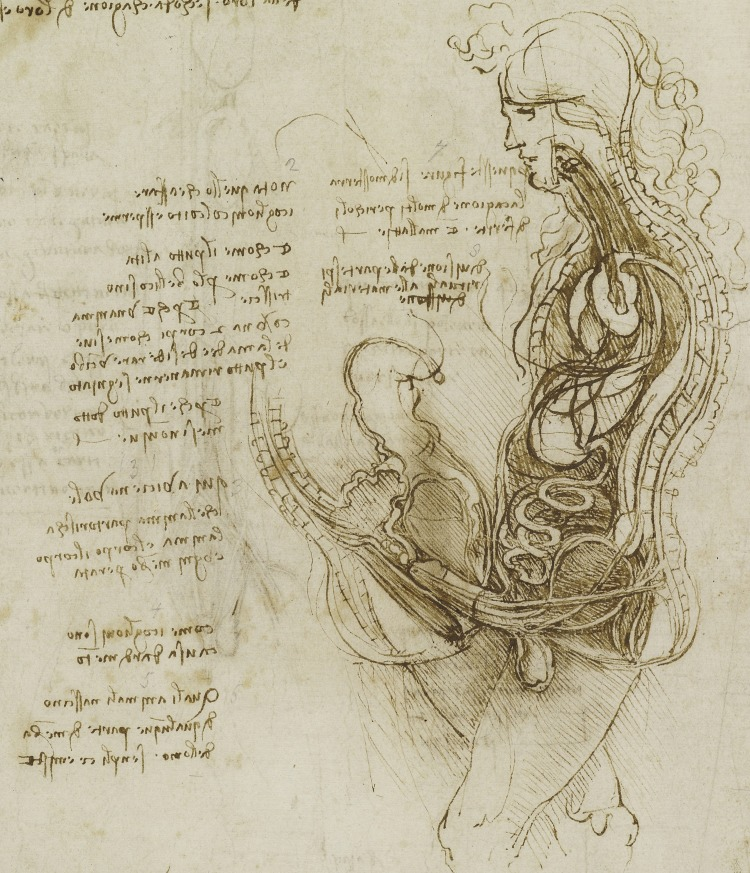
Anyway, I wasn’t a total idiot for asking about that pathway, here is a medical study that discusses Davinci’s thoughts on the subject and one of his drawings pictured.
Moreover, that pathway is ubiquitous throughout ancient texts from India to China and even in Catholicism, which is what captivated me. It is such a part of world knowledge and especially religious knowledge but it is rarely discussed. So I had to investigate it further. Experiential knowledge from my own practice with Tai Chi and internal alchemy led me to believe that the search for the Holy Grail was more about the dan tian and the kua than it was about a cup. I always found those stories about the search for the Holy Grail kind of dumb, although people are that dumb, ever watch antique road show? I mean seriously, what would be so significant about a cup that Christ drank from? Magical powers? It all just sounds so silly. Even the Davinci Code adds a spin on the theory of the Grail as a bloodline from Jesus that is still alive today. I find that hypothesis equally ridiculous. However, I would not put it past the multitudes of non-initiates who think they can attain religious growth or supernatural power from these comic book stories.


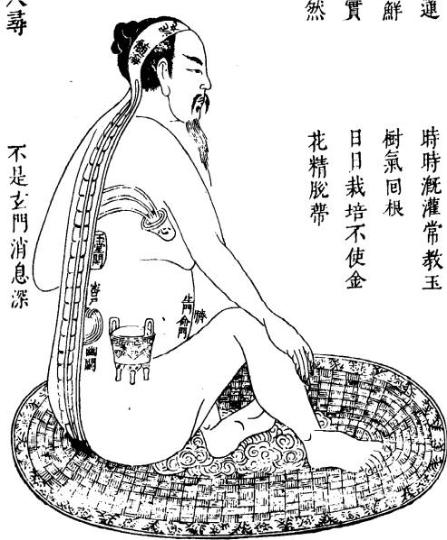
What I do find compelling and more believable is what if these ancient seekers of the Grail actually thought that Christ was a yogi or something similar, and that the Holy Grail was actually inside one’s body and spiritual development was attained through cultivation of the body? After all people are born from a woman’s womb which is located in that exact region that happens to look like a cup (see picture below).


To me the idea of self cultivation to bring about spiritual development is central to many Asian religious traditions to name just two, Indian yogic practices and Taoist bodily practices both of which were present during the time of Christ. However, it is not explicitly linked to Christianity but there is evidence that religious initiates did travel to India from Jerusalem. But you have to dig a little deeper and take into account that some how there is no documentation about Christ’s life between him at 12 and 33, early Christian symbolism has some evidence and some of Davinci’s drawings and writings do as well. Then maybe it is hidden in Christianity as well? This topic is interesting to me because as a Westerner, and the trend in the West for some reason is/was to separate the mind and body into two distinct halves, whereas the East chose to keep them unified. I am really not sure why but I think this is why so many Westerners pursue Eastern martial arts, and other mind body practices like Yoga. For a paper on the Cartesian mind body-duality and its role in medicine read here.


I believe that early Christian teachers actively sought to suppress body cultivation methods, like Yoga and Tai chi, and the idea that Christ may have practiced them, which is why we do not have any accounts of Christ’s missing years even though Christian writers have every last detail of his life documented except those 18 years. This might not be so outlandish when you include how secretive the church is and the mysticism of many of its sculptures,symbols, and texts for example, there is a pine cone in the courtyard of the vatican. Pine cones have long symbolized human enlightenment through the third eye or pineal gland and carvings of them are also found on staff of the Pope, the Egyptian God Osiris and in many religious motifs around the world (I will tie in the pineal gland to the dan tian in my next essay). Adding to this that St.Thomas began a church in Kerala, India, in 52 AD adds some credence that there was a connection between India and Jerusalem during Christ’s life and that the church knows more about internal alchemy than it shares.


Let’s not forget that the church actively sought control over people and knowledge and there are even accounts of people being killed for printing and translating the bible. It also shows that the West had access to this knowledge but sought to keep it from public view while in Asia it was more available.


Connecting it back to Taoism


In Taoism, there are what are called the 3 treasures, Jing, Qi, and Shen.
  • Jing "nutritive essence, essence; refined, perfected; extract; spirit, demon; sperm, seed"
  • Qi "vitality, energy, force; air, vapor; breath; spirit, vigor; attitude"
  • Shen "spirit; soul, mind; god, deity; supernatural being"
These need to be stewed in the cauldron to refine the elixir of life which is held in the dan tian along with the three treasures. Is it possible that the “caldron” referred to in Taoist texts is what the people in the West called the Holy Grail.

From Wikipedia: "The (late 16th century) Journey to the West novel provides a more recent example when an enlightened Taoist patriarch instructs Sun Wukong "Monkey" with a poem that begins:

Know well this secret formula wondrous and true: Spare and nurse the vital forces, this and nothing else. All power resides in the semen [jing], the breath [qi], and the spirit [shen]; Guard these with care, securely, lest there be a leak. Lest there be a leak!

Keep within the body! (tr. Yu 1977:88" 

Storing seminal fluid is also vital to Christian thought and Leonardo Da Vinci adds some credibility to this thinking as does the coitus interruptus views of the Catholic church. I think the reason is that to ancient peoples sperm was sacred and I can’t speak for the Catholics but beyond a shadow of doubt the Chinese thought that storing it was the only way for your spirit to leave your body and become immortal.


So if you are a spiritual person and believe that this earth is the place where you train to attain higher levels of consciousness then many religions point directly to your dan tian and my belief that it is also the Holy Grail as to where you cultivate your bodily essence and lead a spiritual life. Having said that, I have explored many aspects of these practices of self cultivation and I am certain there is some benefit to your health and longevity but I am uncertain as to whether bodily fluids are supposed to be kept internally and heated through mind-bodily cultivation which purportedly leads to immortality.  Next I will write more specifically on the whole process of attaining immortality.

For more information on this topic you can read:
Eva Wong's Cultivating Stillness
Stuart Alve Olson's The Jade Emperor's Mind Seal Classic