Showing posts with label qi. Show all posts

Saturday, November 29, 2025

Karma, the Five Bodies, and What Rock Art Taught Me Today (part two)


Standing in Sego Canyon today, looking at these ancient pictographs that once inspired me back in art school, something clicked. Some people like to describe these figures as “aliens,” but what if they’re early depictions of the energetic body — the subtle forms that ancient people sensed, felt, and lived with every day? When you see them in person, that possibility feels real. It’s like staring at an imprint of internal experience painted on stone.

That reflection tied directly back to what I’ve been learning about karma.

One of the most powerful lessons I’ve taken from Sadhguru is that karma doesn’t disappear through escape, not even through suicide. Ending this life only carries your unresolved patterns forward, with even more weight. In other words, the pain we avoid becomes the debt we carry. That understanding alone is a massive incentive to stay, to endure, and to grow.

I’ve felt that in my own life this year.
People have yelled at me more than they have in decades, and at times, I have resisted the lessons beneath it. I feared change. I feared losing parts of myself I had grown attached to. And when people sensed that fear, some tried to take control or twist the dynamic, especially when I stepped into the role of “teacher.”

But I now see that as karma, too.
When someone glimpses a path that could change them, and they’re not ready, they often retreat deeper into their own maze. They choose the comfort of familiar suffering instead of the vulnerability of transformation. That’s the “bartering” of karma: trading future freedom for present safety.

I’ve done it.
I’ve watched others do it.
And it’s always sad, because the maze only grows thicker.

Distractions as Karma Avoidance

Another trap: distractions.
Football games, Super Bowls, politics, endless entertainment, even worthwhile things, become escape routes when they pull us away from the deeper work. Nothing wrong with them by themselves, but if they become a substitute for introspection, then they feed karma instead of dissolving it.

Tai Chi showed me this clearly.
Once I stepped into real internal practice, I realized how many things I had used to avoid my own evolution.

Practicing Tai Chi in Sacred Places

One thing I’ve committed to is practicing Tai Chi in sacred places.
It feels like a way of accelerating the shedding of karma, like sweeping my past patterns out into the open air, allowing them to burn away under the sky and on the stone. Today, moving under the canyon walls, those pictographs watching over me, I felt a kind of alignment inside that I haven’t felt in years.

I felt unconstricted.
And that’s rare, society squeezes people into certain shapes, certain behaviors, certain expectations. I’ve long believed that this compression is one reason our country struggles with obesity: we lose our natural connection to the body. We store fear of our true selves as weight. We let norms dictate posture, breath, movement, appetite, everything.

But Sadhguru talks about something deeper, something I’m just starting to explore.

The Five Bodies: A Map for Karma and Growth

According to Sadhguru, each person has five bodies:

  1. Physical Body (Annamaya Kosha)
    The flesh-and-blood shell, shaped by food, habit, movement, and environment.

  2. Energy Body (Pranamaya Kosha)
    This is the field Tai Chi directly works with breath, flow, vitality, circulation, Jing/Qi.

  3. Mental Body (Manomaya Kosha)
    Thoughts, memories, interpretations, a major container of karma.

  4. Intellect / Discriminatory Body (Vijnanamaya Kosha)
    The part that can discern truth from illusion, the tool that cuts through the maze.

  5. Bliss Body (Anandamaya Kosha)
    The quiet, inner core untouched by karma, the destination of all spiritual work.

When these bodies fall out of harmony, life becomes heavier.
When they align, transformation begins.

Tai Chi, practiced deeply and sincerely, works on all five.
And I think that’s why I felt the pull to practice here, because places like Sego Canyon remind me that humans have always known the depth of the inner world. They carved and painted what they sensed. They documented the invisible.

Seeing these pictographs today, truly seeing them, made me realize that what I’m working through isn’t new. People thousands of years ago were wrestling with the same internal bodies, the same energetic movements, the same karmic patterns.

Change is hard.
Growth is uncomfortable.
Karma demands participation.

But standing there today under the canyon walls, feeling the wind move through the gap where ancient hands once painted their inner world onto stone, I felt something like gratitude.

This trip is shedding something.
A layer, a weight, a pattern,  and more importantly, I see a way out of the maze instead of deeper into it.

Karma, Change, and the Light I Finally See (part 1)


2025 has been a year of extremes for me — highs, lows, and more confrontations than I’ve had since high school. Some of that was on me. I’ve been resisting the next stage of my own growth, standing in denial because change is uncomfortable, and fear can be a quiet anchor.

In Karma by Sadhguru, he writes that many people “barter their karma.” They accept negative experiences as a kind of payment for not changing. I saw myself in that. I kept choosing the pain I knew over the transformation I needed. And that resistance had consequences — tension with others, fear, hesitation. But it also gave me clarity. A light at the end of the tunnel finally appeared because I stopped running from the lesson.

I’m starting to understand that adversaries aren’t obstacles; they’re catalysts. They push you to places you wouldn’t choose, but often need. Whether someone tries to take advantage of your fear or simply reflects it back at you, the direction you turn — negative or positive — is always your own responsibility. That, to me, is the essence of karma.

Today I’m wandering through Moab with the red rock breathing around me. I practiced Tai Chi on the arches this morning, feeling every movement reconnect me to that deeper current inside. And for the first time in a long time, I feel grateful. Grateful for the lessons, the discomfort, the people who challenged me, and the clarity that followed.

Karma isn’t punishment. It’s an invitation. And I’m finally saying yes.


Tuesday, October 24, 2017

The Importance of Naturalness in Tai Chi


Tao Te Ching - Lao Tzu - chapter 53

If I have even just a little sense,
I will walk on the main road and my only fear will be of straying from it.
Keeping to the main road is easy,
But people love to be sidetracked.

When the court is arrayed in splendor,
The fields are full of weeds,
And the granaries are bare.
Some wear are gorgeous clothes,
Carry sharp swords,
And indulge themselves with food and drink;
They have more possessions than they can use.
They are robber barons.
This is certainly not the way of Tao.


When first studying Tai Chi, a common question usually arises about coordinating breath with the movements. That one question needs a little background before it can be answered. Let's start with a seminar, I attended in 1999 with Madame Gao Fu. She was 82 at the time. It was a seminar in which you could choose who you want to workout with. I was new to Tai Chi and did not know who was famous and who was not. There were other teachers there who offered exotic styles with even more exotic names.

But all this 82 year old Chinese woman taught was zhan zhuang (standing meditation), and chan ssu jin (standing and doing spiral movements) for 3 hours per day. I thought there must be something to this because her practice is so simple while the others at the workshop presented more complicated esoteric forms. I ended up practicing with her for the rest of the 5 days. Towards the end of each practice we got a chance to ask questions. Someone in the crowd asked about matching the breathing with the movements. Madame Gao Fu said it was not necessary to try to match them up. Adding that after continued practice they would come together naturally. During one of those question sessions I asked, "my connection to my Qi comes and goes; sometimes I feel really in tune and then it goes away." "Is that how it is supposed to be?" She said that the more you practice the deeper the connection until you are never disconnected.

What Madame Gao Fu espoused was a type of natural unforced but committed practice, while standing in place or moving. Now in 2017, 18 years later, I still remember that seminar and I am still deeply committed to the wisdom she passed on.

Often when simply being natural you are perceived as lazy and in America laziness is the enemy. To just be natural in America is difficult because so many experts want you to DO STUFF, ACCOMPLISH GOALS and ACHIEVE RESULTS. I have found a lot of conflicting messages being promoted by health experts in America, "you should diet," "go jogging," "think positive," "have social networks," "sleep 8 hours per night,""set goals," "be successful," "challenge yourself," "meditate daily" and "reduce stress." The problem is that people are lost and the experts are lost. The Tao just is. All you have to do is follow the current. Where is the current? It is everywhere but the best place to start is in your body.

Many years ago when I visited Mississippi. My wife wanted to take me to her family summer vacation spot, the Buffalo River in Arkansas. There my wife and I went in a canoe and her father and mother went in a separate canoe. My father-in-law is a very devout Christian in Mississippi and I was this Tai Chi practitioner who KNEW the Tao, After all I have been studying the Tao Te Ching since the 80s. But this very 'square,' in the 60’s sense, school district superintendent, put his canoe in the water as I did. As he entered the river he effortlessly glided towards the part of the river where the current was strongest, whereas I battled the water and huffed and puffed and shouldered my way to that same current then it changed, as currents tend to do, and I lost it. So I again struggled to get into the right path. I would look up and there was this old guy blissfully gleaming along. Granted it was my first and really only time canoeing in a river but it is a good example of how to find the Tao.The Tao is not exclusively found in China, it is not owned by Taoists it simply is. You don’t even have to do Tai Chi to find it, although, I find that the pace of Tai Chi and the movements themselves reveal a deep understanding of the spiral energy that is part of the universe and doing them assists in finding the current within yourself.

There are two parts to this naturalness, one is the release to the Tao, the state of which is wu wei. I have explained wu wei before. It is a type of thoughtful non-action. It is not simply doing nothing, which many interpret it as and it is not using force to make something happen either. The second part of naturalness is song. Song is a state of being, like being relaxed but with a slight level of attentiveness. So it is not standing at attention like a soldier nor is relaxing at a beach in Cabo. It is somewhere in between.

Song is also applied to parts of the body and it involves conscious releasing of control of the waist, neck etc. The hardest part of Tai Chi is to release these parts of the body where most people store their tension. You find when working on this release that you are more able to find your center of balance because many of us are living in a shell like body that is not even aware of our true place on earth.

So to attain song is the first important but hardest step because it allows for the energy to settle in your dan tian and then it can start is transformation process.

Tao Te Ching - Lao Tzu - chapter 15

Who can wait quietly while the mud settles?
Who can remain still until the moment of action?
Observers of the Tao do not seek fulfilment.
Not seeking fulfillment, they are not swayed by desire for change.


There are a lot of hours, maybe a lifetime of work that goes into what was just described above. In fact that is the main practice, whether you chose to just sit and meditate or do the most esoteric ancient qi gong, song is the main activity to find the Tao. You can not find your center without song, you cannot do Tai Chi without song, and you can not attain wu wei if you do not song.

Note: Tai Chi could mean the series of postures most people think when Tai Chi is mentioned or it could be the balancing of yin/yang energies to canoe a river more adeptly or live to a ripe old age of 88 and still be teaching a physical activity.

"Madame Gao Fu died in Beijing January 17, 2005 at 88 years of age, following a brief illness."
http://seattletaiji.oo.net/bio.htm

Thursday, September 21, 2017

Opening your kua increases the benefits of Tai Chi


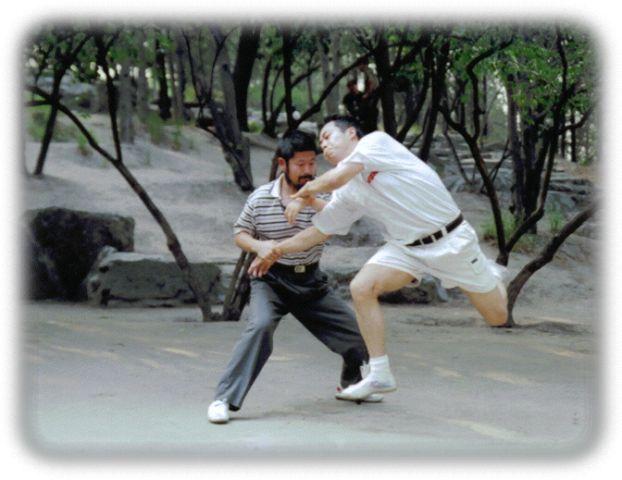
Image result for chen zhonghua kua
One of the joys of teaching Tai Chi to older adults is that you can see progress as they develop. The people who come into my class for the first time have very little balance or coordination so if they decide to stick with it you can clearly and profoundly see your impact as a teacher.


Knowing the impact of falls on that population and helping some people avoid some of those negative outcomes is quite rewarding.


The major challenges I see in people when they enter my class is not knowing the location of their center. This becomes increasingly evident when they are constantly overreaching, which places a heavy load on the vertebrae, and makes them top heavy. They also do not have their feet flush on the ground, which can again result in a fall. Overall, there is little coordination between the upper and lower half. I am always discussing the importance of the top half and lower half moving in agreement with each other and that discussion leads directly to the person responsible for the popularization of Tai Chi, Yang Cheng Fu. Yang Cheng Fu promoted the health benefits of Tai Chi, and created a list of 10 important points to do Tai Chi correctly (below). An excellent book on his teaching can be purchased here.

Yang Cheng Fu’s 10 important points:
1. Empty Neck, Raise Spirit  
2. Contain Chest, Raise Back   
3. Loosen Waist  
4. Differentiate Empty Full
5. Sink Shoulders, Drop Elbows
6. Use Intention not Exertion
7. Upper Lower Mutually Follow
8. Inner Outer Mutually Harmonize
9. Continue without Interruption
10. Move from Centre, Seek Calm


One of those important points is, "Upper Lower Mutually Follow" where I see most people have difficulty when they are learning Tai Chi. Most older adults I teach think that the Tai Chi form is a series of choreographed dance moves and want to memorize steps and hand positions. I guess being American and older they come to class with their prior experiences from square dancing and other American dance forms they grew up with. What they are missing is their whole structure is a shell with little or any understanding of the internal work that Tai Chi demands.The one exception to this is a woman who was married to a Spanish gentleman and they did a lot of Latin dancing. She had a very well cultivated understanding of her dan tian and could root quite well. Currently, she is 82 years old and still going strong.   


I often share with my students Yang Cheng Fu’s important principles because I think they are essential to truly practice Tai Chi. In fact, my teaching of Tai Chi focuses on cultivating these principles rather than rote memorization of the 24 form, because if you can attain some level of proficiency with these principles it will be more beneficial to your health and well-being.


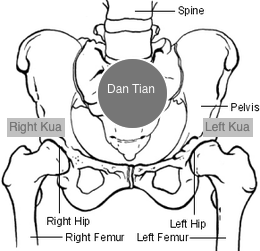
One of the things I continually notice in class as people age is they use their kua less and less, and those who have the most balance issues seem to be the most rigid in their kua (Pictured below). The kua is known anatomically as the inguinal crease or the grove where the femur meets the pelvis. In a quote from Zhang Xue Xin, a renowned Chen-style Tai Chi master, “Americans know how to use the hips and not the kua.” (this quote is from the hyper link to a paper on the kua above)


The kua and the dan tian work together to create a kinetic chain that:
  • Is the "glue" between the upper and lower halves of the body.
  • Keeps the center of balance aligned and sunk.
  • Provides better alignment of the body for smoother movement with less chance of sprains.
  • Creates a "mutable" joint that increases leverage and disperses force by tricking the opponent as to the actual location of your center.
  • Increases power output, i.e. force multiplier.


The dan tian is a Chinese term that means “Sea of Qi.” If you read ancient Taoist texts there is a lot of mystical abilities attached to this area. For an essay on that topic click here. Suffice to say, that the dan tian is the center of balance for people, it is located 1”- 2” below the navel and midway between the lower abdomen and the spine. Many people argue about exact locations but this is not meaningful to our purpose here.  There is no anatomical distinction for the dan tian. It is however your true center and that is the most important thing to remember. Every object has a center of balance because gravity makes it so.

One of the best explanations on opening the kua is by Chen style practitioner, Chen Zhonghua. He has a trailer for his video that can be purchased here. Unfortunately, I can not find anyone on youtube who explains it as clearly as he does. 

Training your body to move from the kua and its relation to the actual physical center of your body (dan tian) is a real game changer for your practice. If you were to go up to the average person on the street and ask them where their center was, they might point to their heart or to their stomach area but I will bet you most will not be close to knowing where it is. Imagine you have this body and every day you are walking around on this earth and you are completely clueless as its proper alignment with its true place in the universe? This awareness changes your life because for years you have walked, played and slept thinking it was way higher than it actually is and once you embody its placement your body is unlocked and you can experience so much more of life.

Wednesday, September 13, 2017

I Literally Walked into Sacred Geometry


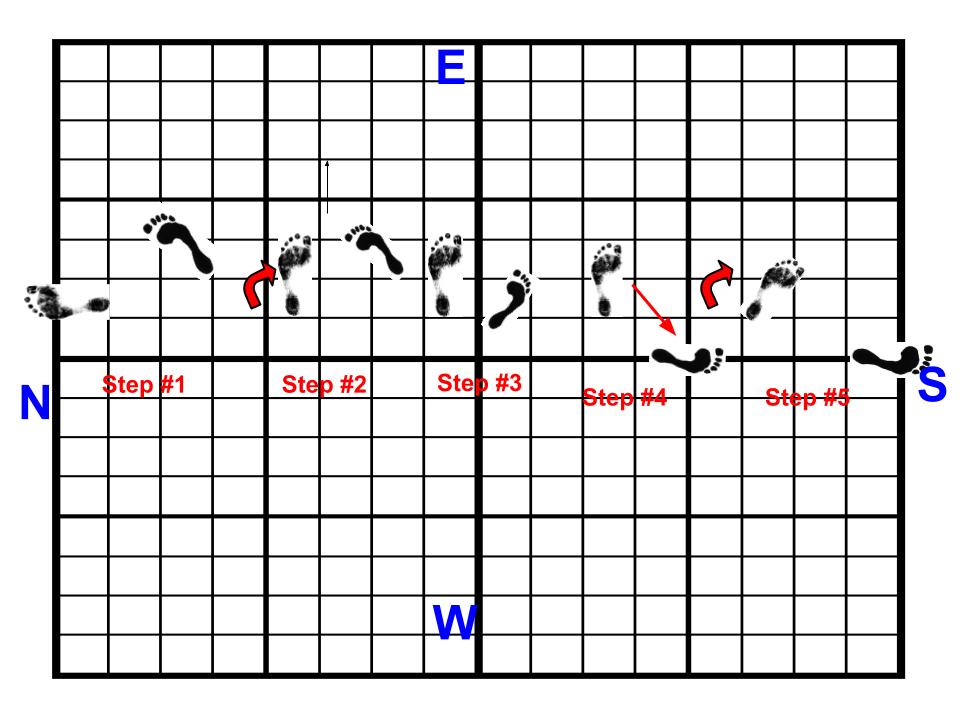
In teaching Tai Chi to older adults it is best to combine teaching the internal principles along with the form, which means you are basically reteaching people how to walk and move. After warm-ups, I have everyone pick a linoleum tile and place the feet heel to heel in a right angle on a corner on a tile. We stand like that for a moment and I have them take a step forward with their right foot, and about 4" over with their left foot, leaving their right on the square but turned at a 45 degree angle. As you are reading this you might be trying to visualize a bunch of older adults assembled in rows standing on a grid-like pattern.

taichi-wisdom.ppt (2).jpg

I have been teaching Tai Chi to older adults since 2001 and it took me awhile to catch on how to difficult it is for older adults to get into a bow stance and especially when turning 180 degrees with clear aligned movement. After so many students having difficulty I started using the tiles on the floor along with a cardinal directional sign on each of the four walls. As I started to create these methods of teaching people to do Tai Chi I realized that there was a geometric logic to how we align ourselves to the earth. When looking at the illustration (above) you can see one possible way sacred geometry developed. If you stay in one place facing north and turn around in a complete circle it will be 360 degrees. Then going back to basic geometry you can divide that up an infinite amount of ways but typically we divide it up first in quarters and then in eighths, hence the origin of the bagua (Pictured below).
Related image
That inspired me to seek out geometric relationships in Tai Chi, moreover, when I was exploring Tai Chi I became aware of Feng Shui and their usage of the bagua.  I also knew that the original 13 postures of Tai Chi are patterned off of the very same bagua symbol; eight main postures and five secondary ones (pictured below). These connections made me appreciate Tai Chi even more because the whole Taoist system worked in concordance with one another. There was not too many contradictions, although there are smaller discrepancies with certain assignments of what fits into which area, for instance, an animal and an emotion and actually everything in existence is prescribed to each cardinal direction.   


As the caption states in the 13 postures of Tai Chi, there are 8 energies and directions, which are also added to the elemental directions of the 5 elements, north, south, east, west, and center.


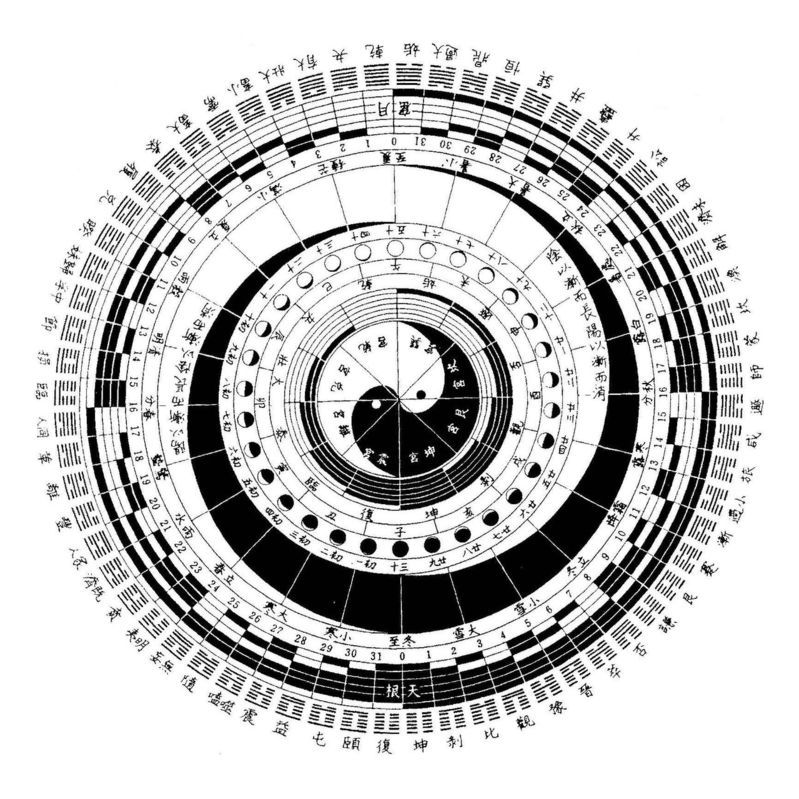
The early Chinese people created a compass (pictured below) that linked up the waxing and the waning of the moon with the 8 directions and this was used to predict floods and then more was added on to it. The I Ching or Book of Transformation was also created from there. The early Chinese people figured that significant events occur during the seasonal changes, i.e. floods, winter, harvest season etc. The idea is that by understanding the natural forces one could prepare ahead of time and avoid more acute emergencies.


Other cultures have discovered many of the same ideas; stonehenge follows the same circular formations as does the Kabbalah with its numerical structure. The phases of the moon are based in reality but the socially constructed aspect of attributing certain emotions, elements, animals to each phase is where there is not cross cultural corroboration. This doesn’t mean it is not worth studying. I view it more as an art form that deserves respect and consideration. An interesting fact is how deeply our psychology and physiology is tied to night and day. Circadian rhythms and seasonal patterns are strong determinants of hormonal secretions and


they play a major role in our psychological functioning as well of the well being of our vital organs.   


As you can see there are many connections with codified symbols found in Taoism that connect the heavens to man and to the earth. Another example of this intense connection is  the 64 hexagrams, 32 yin and 32 yang found in the I Ching, and their exact match with the 64 codons found in DNA.
Here is the conclusion of a paper on the connection between DNA and the I Ching:


“ —We defragged three I Ching representations of the genetic code while emphasizing Nirenberg's historical finding. The synthetic genetic code chromosomes obtained reflect the protective strategy of enzymes with a similar function, having both humans and mammals a biased G-C dominance of three H-bonds in the third nucleotide of their most used codons per amino acid, as seen in one chromosome of the i, M and M' genetic codes, while a two H-bond A-T dominance was found in their complementary chromosome, as seen in invertebrates and plants. The reverse engineering of chromosome I' into 2D rotating circles and squares was undertaken, yielding a 100% symmetrical 3D geometry which was coupled to a previously obtained genetic code tetrahedron in order to differentiate the start methionine from the methionine that is acting as a codifying non-start codon”


The depth of early Chinese people is astounding, even today this at least 4000 year old symbol still influences and explains phenomena in our lives. I think the reason why is that these early Taoist masters discovered a spiral network of energy vectors that determine all growth on this planet. They called these energy vectors “Chi” or “Qi.” Admittedly, the word Qi did not arrive until later years after the I Ching was created, nonetheless is it currently used in this manner to describe these energetic vectors and hence the 8 energies of the Tai Chi movement. So from a simple joint lock, to the structure of DNA to the Milky way solar system we are constrained by a spiral force that connects all life and all inanimate objects to the earth rotation and its evolution around the sun. Just to be clear, I am not a proponent of divination. I know this kind of thinking has led to over use to put it mildly. I am speaking from a physical science perspective. That said, this movement has an affect on us and it is hard to figure out just how much because there is no counterfactual ideal. We do not have another galaxy to measure its effect on the beings there. You may think I am starting to go off the deep end. There are people who I have run into who love sacred geometry but end up tying the origin of it to aliens. Believe me it gets even weirder with when the illuminati conspiracies start piling up.


As with many of the phenomena I write about, I am able to parse out the wheat from the chaff and where there is unknown I simply leave it at that. I don’t need to believe in aliens or a personal god either to substantiate the physical reality of certain things. I also don’t need to deny it all and be an atheist either.
Image result for flower of life


Another thing that happened when I was teaching the 180 degree turns was I saw how the foot positions fit within a box grid and if you draw diagonal lines and add circles it can become a flower of life. The flower of life (pictured above)is something in many cultures together, even Leonardo Da Vinci drew this in his Codex. Of course explaining the relationship between Davinci, stonehenge, the Kabbalah, and the I Ching could be an endless exploration that is not suited to the purpose of this blog post. If you are interested there are hundreds of videos and books on this topic but be forewarned that you will be hearing some crazy theories.


Anyway back to Tai Chi
I have always wondered why all the Tai Chi forms don't sync up with the bagua (8 directions), wu xing (5 elements) (pictured below) and ultimately the I Ching. Fortunately, I found Tai Chi According to the I Ching by Stuart Alve Olson who brilliantly tackled my dilemma. Per usual for Olson, he breaks everything down and backs it up with the ancient texts to support his reasoning. I have been searching for a truly symmetrical form for years and thanks to Mr. Olson I finally have that..   
Image result for wu xing


Conclusion
One of the reason why I love Tai Chi is because there is this internal logic that starts really small like with a step and then expands outwards to encompass the whole universe, the Chinese call it the microcosm and the macrocosm. Is it scientifically sound? I  am not sure but I think it is worth investigating. Moreover, humans love symmetry we seek it out whenever we can and I find discovering the underlying symmetry in Tai Chi increases my love of it and enhances my personal practice.

Thursday, June 12, 2008

A New Art

When I graduated high school in 1983, there was this sudden pressure to do something. One either had to get a job or go to school or something. I got a job at a grocery and thought for a while about what would be the best position in society for me.

Being 18, I wanted the "job" with the most freedom. My parents had a friend who was a struggling artist and he had this really open-minded perspective on life. So I chose to become an artist. My parents were not too happy with this decision but they knew I wasn’t going to change my mind that easily.

I started drawing everything I could. I eventually went to a college for art. I was as passionate about art as anyone had ever seen. I specialized in painting and sculpting. I had even carved totem poles for a motel in Taos, NM.

As I explored art, I was continually amazed at the artist’s calling for pushing limits of what art is. One of my artist role models is Joseph Beuys, a German performance artist who really broke new ground. He was an artist in the academy before WWII doing representational themes in paintings, drawings and sculptures. Then he was called to serve in Hitler’s army as an fighter pilot. He was shot down a few times. The last brought him closest to death. He was shot down and was found by a tribe of people who saved his life by putting him into a felt cocoon surrounded by fat. When the war was over he knew standard academy painting would never be able to externalize his past experiences. He began doing elaborate performances, which set his career off and changed the art world.

After 12 solid years in the art world, I had a profound experience during a martial arts class. We were asked to make 100 Japanese sword cuts with a wooden Katana called a Bokken. I can’t remember what number I was on but I got myself into a state. Then all of a sudden a black passageway opened up and I felt hyper-aware. That experience of an altered reality changed my perception of the world. Art itself seemed pale and utterly cheap from that moment on. I tried to paint that experience for the next few years with some feelings reminiscent of that first experience but it wasn’t until I started doing T’ai Chi and Qi Gong that I was able to get back to that place.

Once this new method of altering my consciousness began my art production slowed to a trickle. I found that Qi Gong and T’ai Chi could replace and surpass any internal feelings that my art was able to do.

My next step was to share that feeling with others. After becoming relatively proficient in some Tai Chi and Qi Gong forms, I felt comfortable enough to teach other people. But I seemed to keep bumping into some obstacles. Many people in society viewed these forms as either, stale and static or just for old people.

So my next challenge was how to change the way society viewed these activities. I went back to school and completed my bachelor's degree in psychology. Studying social psychology it becomes abundantly clear that people have many preconceived notions that are informed not from direct sensory experience but from socio-cultural norms they learn. Many people in society relegate art to a painting or a sculpture that is executed by “artists.”

T’ai Chi and Qi Gong are really not considered as anything more than an exercise for older adults who are in need of assistance. Even martial artists have been patronized by being Asian-philes who break boards and shout like cavemen. Our society has these narrow perceptions of what all these things are. Our whole society is compartmentalized so much that you would think nature is as well. Compartmentalization is a major flaw in our highly industrialized society. The problem is those of us in the West have to name everything, which seems harmless but limits the object once it is named.

Even fellow artists often ask if I still paint or make art. There is no possibility in their minds that the act of performing Tai Chi is the creation of art. Art to me has now become that amazing feeling when my body seems to open up and glide on the earth's crust weightless and painless and ready!