Showing posts with label Aikido. Show all posts

Friday, August 09, 2024

The Unforgiving Algorithm of The Universe

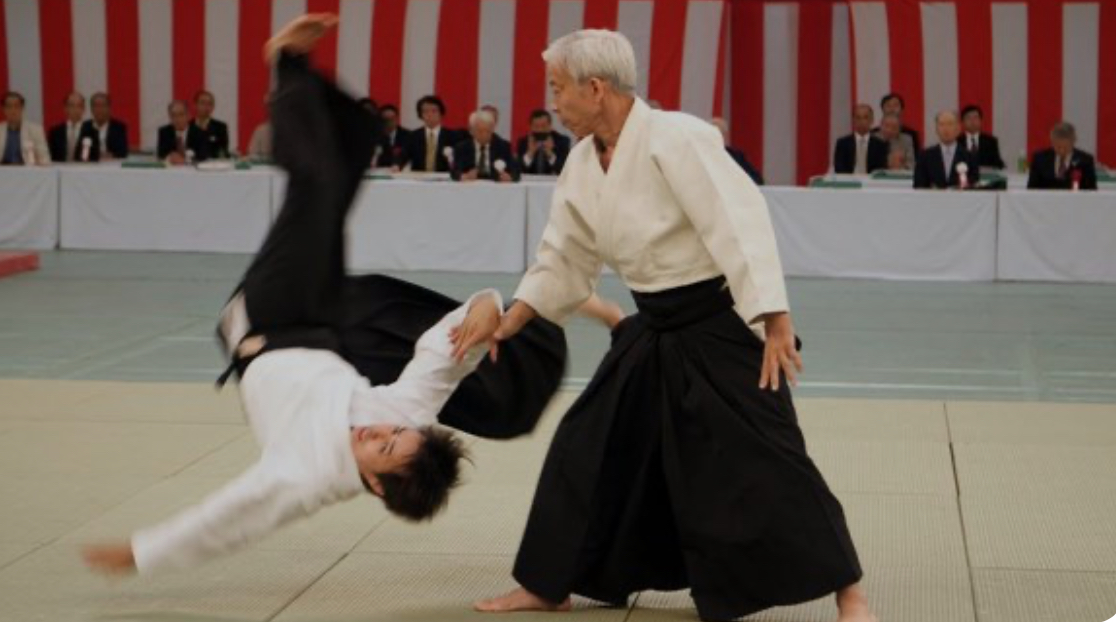
I have been experimenting with break falls in Aikido using Tai Chi for muscle repair and incorporating dietary protocols to repair muscle. Break falls are used when a throw is hard, and you land with your body directly onto a matted floor. Falling is tough and jolts your body, and many people get injured.  Many older students, who are, mind you, not much older than me, have cautioned me from doing too many break falls, and all of them have difficulty with parts of their body, such as shoulders and knees.


At 59, I feel really good. I do have a minor shoulder injury that I've been using acupuncture and massage to heal. Weirdly, for some unknown reason, in Aikido and other martial arts, many people do not take advantage of science-based methods of body restoration like nutrition, massage, acupuncture, and therapeutic movement.


This whole experiment is fun. I'm figuring out how to use quality protein intake, nutrient timing, Tai Chi, acupuncture, and massage therapy to heal my body and allow me to access my full potential. Specifically, going to regular acupuncture has afforded me quicker recovery, which allows me to work harder with fewer layoffs. So I can make exponential progress in skill development and body toughness. The injuries that used to make me take two or three days off heal faster, and I can return to training in a shorter period of time. 


During that time, I am not doing Aikido; I'm going for a hike, and I walk my dog, Ripley, at least two to three times a day. Sometimes, I get up to 14,000 steps per day, and I average about 10,000 steps per day. 

Another key ingredient in this is I am not stopping at all. For many years, I used to think oh, don’t push it and rest. Now, I just keep moving through it all. I have found this promotes faster healing. Rest is counterproductive and even detrimental. That said, I will go lighter on any area that feels strained, and I am careful not to reinjure those spots but I keep moving. It is important to note that overworking can backfire, so strategic rests are built into this.  


This exploration of body development has led me to an exciting discovery about nature and the universe. 

We all know the universal law of what goes up must come down, but few know the harder you work to improve, the greater you can handle tough shit and the more luck you have. Now, here is the unforgiving part: the less you work (even if it is a little bit), is a contagion because the more you let up on something, you atrophy, and then your overall capacity decreases. Your old injuries come back. The longer you sit, the greater the chance that those nagging injuries return.  

To understand it, you must understand how large data sets influence the mean. It is not about binging with a 6-mile hike on Saturday and sitting around all weekend. Consistent effort has a bigger impact on the average than one or two big activities. So, walking your dog 2 miles per day, EVERYDAY will have a great impact on your health than one 6-mile hike once per week. This is how you fool your body into doing more. You tweak the mileage little by little. Start off walking your dog 1 mile per day, every day, then increase it a little over time. The algorithm takes over because your body will tell you to do more; it will get bored with 1 mile. Then, you will have a consistent baseline to increase the mileage.   

The same algorithm can be applied to muscle building, school grades, and so much more. It is also how to improve in your career. Little improved changes over time are how the universe operates, so why wouldn't it work for you? especially knowing that the exact opposite momentum is true. That is not by making these little changes; you are declining gradually. Many people find themselves unhappy with their lives or seemingly all of a sudden with 30 pounds of extra weight. This only happens gradually. The cause is often found in the small details of one's habits, like extra snacking, extra beer or soda, or taking a rest too often. 

The tortoise knew this, and the hare did not. 


Sunday, June 02, 2024

Seasonal change and musical chairs


Transitioning from winter to spring, I felt like I was in a game of musical chairs, and there was an established groove from January to May. Then Memorial Day hit, and the music stopped. I was left without a seat and felt disconcerted and dumbfounded for a week. I realized that all life is changing; adapting when the music stops is what being a Tai Chi master is all about. School graduations, college kids returning home, and seasonal workers leaving are what we need to embrace. 


In Aikido, we practice Chiba Sensei’s 36 Jo basics and his choreographed two-person form, Sansho. I mention it because students (myself included) always complain that the parts do not align. It almost seems disjointed. 


This weekend, I realized that this disjointedness was intentional. From what I hear, Chiba Sensei was no slouch, and his intellect is well documented. For example, he makes you NOT step forward at the beginning of one of his 36 movements. This throws beginners off. It threw me off - it throws everyone off. My impulse was to step through, and while doing the form, I always felt awkward, like I tripped on a root. This is just one example of many traps that lie in wait for you.  


From multiple secondhand sources, I heard that Chiba Sensei abhorred rote movements. So what better way to protect your students from a lethal pitfall than to bake smaller trips and obstacles into your curriculum? The names of specific techniques don’t always match from one section to the other; the numbers of techniques and their placement in the form don’t match either. If they did you could easily coast through the whole 36, instead, you need to take a machete and cut your path through the jungle, in other words you need to earn it.  


Dunn Sensei has planted a few boobytraps of his own. On one of the walls of the Dojo, there are three paintings by a deceased and well-known painter that are easily within reach of being hit. Students beg Sensei to place plexiglass on them, but Sensei is vehemently against doing that. We need to be mindful of where we are in space and time. 


Approaching my 60s, I am embracing change and feel a little ashamed that I expected life to be consistent. 


Tuesday, July 21, 2020

Getting lost in infinity


Practicing martial arts forms on the deepest level manifests your cosmic kung fu training teachers. They train you. They are the cosmic ancient masters and their accumulated experiences are held in two different places, one in suspended animation in your DNA and second in the specific martial patterns. Once these are linked, the secrets can be unlocked through a deep visceral training of the ancient forms. 


After I was done with fighting highschool bullies, I realized fighting is not healthy. I ran to the Yin side to pursue the arts. I had grown up in an artistic household and thought this path would offer me the most out of life. It seemed an exciting choice and coincidentally not much different than martial arts with its physicality of moving the brush, charcoal, or chisel.


 Again, I heard those ancient voices but there were also voices of temptation like Lorelei whispering to travellers in the woods. I was soon coaxed into territories deeper than I could fathom, listening to the whisperings of lost souls whose threads were not connected to the ancient voices, my tether was cut and I was free floating in infinite space.

Floating in limitless space you brush up against those who are also untethered and there you can experience extreme connection but it is only temporary. Everything seems to fall apart and nothing lasts. Although this is true for much of the things found in life, there are however, some things that are rock solid and indestructible. Religions speak of such structures but, words can only be of little help. 


In martial forms, we walk with the ancient masters without form and our souls touch their footsteps. Those footsteps lead us to the energetic cathedral which forms the structure of the universe. This is indestructible and always changing.This is the place to reside. 


Chris Aloia, July 21, 2020


Monday, November 18, 2019

Reminiscing About How I Found Martial Arts

I was lucky that I grew up in the 70s and 80s when Asian culture, particularly martial arts, was becoming popular in the US. With the popularity of Bruce Lee movies, and the TV series Kung Fu it almost became a prerequisite to have a martial arts fight in many TV shows. I remember waiting for those fight scenes with great anticipation.

Additionally, my father was practicing Tai Chi from Robert Chuckrow and he took me to one of his classes. I remember watching him and his friend practice the Tai Chi form in our yard. My father even tried to get me to stand in a Tai Chi posture and it was really uncomfortable.  I was so rambunctious I was definitely not ready for the slow practice of Tai Chi. Then in the 80s, the TV mini-series, Shogun came on and I made myself a bokken and practiced cuts with it. I was so excited by Asian culture and swords that I really wanted to learn more.

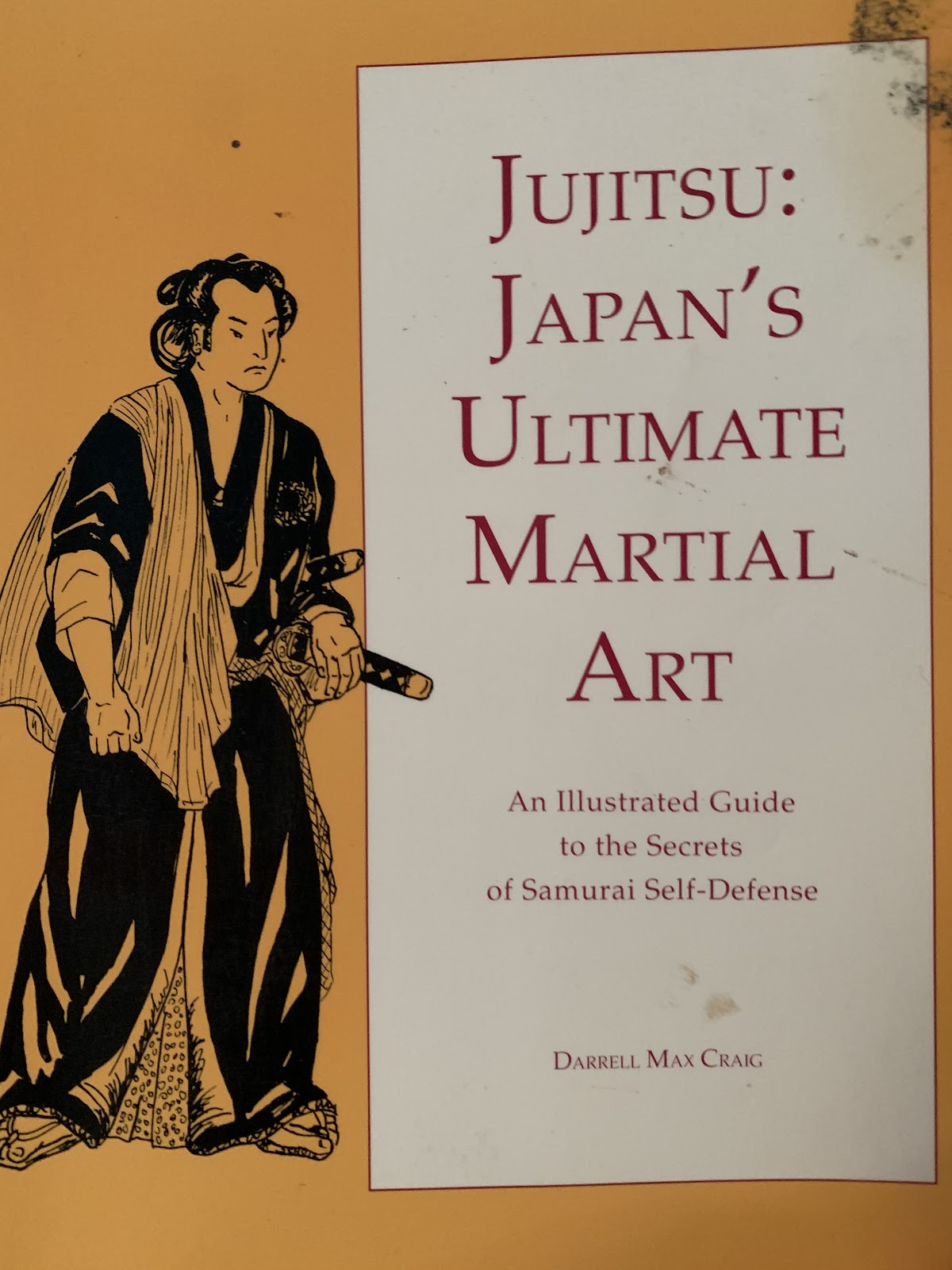
All that media exposure sparked me to explore further and I remember going to the local book store and checking out the martial arts section. It was only a few books and there was an orange book, much like this one pictured, that had historical illustrations of old time Jujitsu techniques. I bought it and became enthralled with those mysterious techniques. I tried to understand them but I couldn’t figure out the movements from the illustrations alone. 
Japanese Jiu-jitsu - Tuttle Publishing

I looked in the yellow pages and I remember seeing an advertisement for an Aikido class in a neighboring town. It seemed like it was a thousand miles away. Then I saw that our town had a Karate school so I did not have much choice. I ended up in Okinawan Goju ryu class and got my yellow belt. I remember the sensei telling us stories of the Okinawan masters he learned from, while in the military in Japan. Unfortunately, the school soon closed but luckily I found people who were into boxing. So I was still in the martial arts. However, in the back of my mind I still wanted to learn those traditional techniques found in Jujitsu and Aikido. After a couple of years of boxing I quit fighting all together. 

I had met some famous old boxing champs and realized that fighting and getting hit repeatedly in the head was not a healthy lifestyle choice. I forgot about the self development aspects of martial arts and boxing didn't teach those. So I thought I was done with the martial arts path. 


As I continued to explore other aspects of myself and grew as an adult, I once again saw a need to get back to martial arts.

This time I was in Seattle and there I had my pick of almost every imaginable martial arts style. I lived close to the International District and visited all kinds of schools offering Kung Fu, Brazilian Jujitsu, Hapkido and Aikido. I finally had my opportunity to study Aikido and learn those amazing mysterious techniques I dreamed about as a kid. So after many years I began learning everything I could and practiced intensely. Plus, there was a great group of people and we quickly became friends. The camaraderie at the school was a amazing.
 
Martial arts always came to my life in times when I needed guidance. In martial arts there is this important work being done that touches you on every level from the social to a deeply intimate and most personal. There is something compelling working out with people in a friendly but challenging manner that I have only found in martial arts.  I am very thankful that I grew up in a time when it was accessible to me. I honestly don’t know what I would have become had I not found the martial path.

Monday, June 17, 2019

Harmonizing Yin/Yang

Yesterday in my Tai Chi class we joked about aging and why Tai Chi is mainly for older people (I work mostly with older adults). I have a younger women in class, and she stated, "I am not old!" We all laughed. Then I talked about self-selection, explaining that Tai Chi is too slow for younger people, who are looking for quick results.

In that particular class, I decided to start with a little boxing drill.  As a change up to the typical Tai Chi posture drills, we practiced a jab and right cross for a bit and I showed how it is slightly similar to Brush Knee Push.

That boxing drill sparked some one to ask if it is better to punch someone with a closed fist than an open hand. I talked about the nuances of that for a bit, which led to palm strikes and I said that palm strikes, are in the following Tai Chi moves: Brush Knee, High Pat on Horse, Single Whip, Wave Hands Like Clouds, and Repulse the Monkey. Then I discussed how palm strikes can be strikes, grabs, or even blocks. Moreover, they can also include the forearm and even the elbow. When you find your inner structure, or in Tai Chi vernacular, "Steel Inside Cotton" the whole forearm, including the hand becomes a type of guard/shield or even a strike, as demonstrated by self defense expert Tony Blauer in the pictured above.

So when you are practicing Tai Chi and developing your inner structure you are also developing a guard that protects your vitals. The guard is present in almost every Tai Chi move from opening to close. Each arm smoothly transitions from attack (yang) to guard (yin) in a circular motion mirroring the yin/yang symbol or Tai Chi. When you are attacking you are also defending, part of you advances and part of you yields. At the highest levels, all movements in martial arts connect to this principle. Whenever you read online disses of a martial art they are only discussing the veneer of their perception. Aikido gets a tremendous amount of hate but there are no major difference between Jiu Jitsu and Aikido. Sure, many Aikidoka show certain moves like wrist grabs, but digging deep into the principles of both arts, you end up at the same place. Even Brazilian Jiu Jitsu uses the same principles but translated into ground fighting. I believe the biggest difference is in the training. Aikido and Tai Chi do not train for real combat, they instead work on self development.

Tai Chi literally means "the grand ultimate point" where yin/yang are perfectly balanced; and to accomplish that harmony between polar opposites takes time, and this is where we usually lose younger people. You have to become committed to unifying these opposites in your body and mind. Learning self defense is important. Many younger people are looking to learn a self defense skill but what they miss is working on that harmonization might have a greater impact on them and actually move them into a higher level of awareness that can be of more practical use to them than merely being able to stop an attack. 

Friday, May 26, 2017

Five Reasons Why Martial Arts Forms Don’t Suck!

“Those who are enlightened never stop forging themselves. The realizations of such masters cannot be expressed well in words or theories. The most perfect actions echo the patterns found in nature. “ ~ Morihei Ueshiba


The martial arts forms suck argument has been going around the martial arts world for a long time. It states that traditional martial arts are rigid and spend too much time mindlessly following the choreographed forms passed down from antiquity, while a fight in real life is dynamic, unpredictable and spontaneous. The purpose in me writing this is not to totally lay to rest that argument because there are valid points to both.

That said, I do believe that there are good reasons to continue to practice forms. For starters, forms have combat tested moves within them BUT it is up to the motivation of the practitioner to unlock them. It is hard to balance keeping the knowledge alive for future generations, and then letting that commitment go to follow the current trends in fighting. Whether or not the two sides of the argument are right or wrong depends on the context in which we are living. So if you were a police officer I would recommend focusing more on the dynamic fighting part and less on forms. On the other hand, if you are looking for a healthy alternative to gym exercise and want a just little understanding of martial arts then forms are perfect for you. I think the problem comes in when you get confused as to what are your main objectives.
Currently, at this point in the US, violent crime has been decreasing since the 70’s. Sure, there are places where it is bad and it is up to you to understand that in your environment.  Moreover, your context can change for a number of reasons and if it does we have adapt our training accordingly. Currently, chronic disease and accidents top the list of causes of death, with murder not even making the top 10.  When I assess my environment I look at national trends and local ones. In my context, I just don’t see a danger by other humans. Does that mean I turn a blind eye and go on my merry way? Absolutely not, I think it is important to prepare for a possible violent encounter. I just do not think it is necessary to focus everything I do on it. So this is where forms come into play. Like I mentioned previously, the moves are there. So why not practice them to develop your body as a weapon, and in the age of steep cuts to Medicaid, use it to prevent chronic disease?  

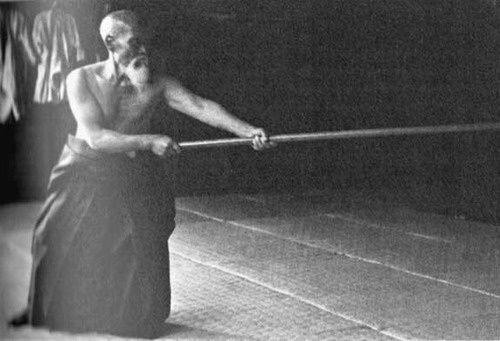
Without a doubt, one of my favorite forms is the Aikido 31 Jo Kata. A “jo” is a Japanese term for a 55” long wooden staff. O’Sensei, who is pictured above holding a jo, created Aikido, a Japanese martial art that uses the flow of spiral energy and joint locks to redirect an opponent’s momentum. O’Sensei used the jo often and created some small sets, consisting of a few moves together. It is said that he developed his love of the jo from bayonet training he did during his service in the Russo-Japanese war.  He continued using the jo until he was a very healthy elderly man. His student Morihiro Saito created the 31 Jo Kata from the different sets O’Sensei passed to him. Here is a video of Morihio Saito performing the 31 Jo Kata.
 
I did Aikido intensely for two years starting 1995 until I got a wrist injury that interfered with my progress in Aikido. I moved to Tai Chi because of the healing benefits, but I really missed Aikido and kept the form in my practice. Despite my love of the 31 Jo Kata, I eventually forgot the moves after a few years. I always wanted to bring it back. I did keep a smaller set memorized and then one day I decided to study Morihiro Saito’s video and regain the form for my training. Now it is a major part of my practice.

I wanted to bring it back because I find that the jo form is beneficial in 5 ways: 
  1. Power 
  2. Fitness
  3. Riai 
  4. Self defense
  5. Fun

Power Doing forms, especially weapons forms, helps you develop proper body mechanics to build power. When you repeatedly strike and move from one posture to another you can work on your body mechanics, which helps you understand the rhythm of releasing power. A great example is let's say you had to break a down a door with a stick or shovel. There are postures in the jo form that follow the same kinetic chain needed to muster the power to accomplish that action. It is not the form that teaches you how to apply the moves, it is your imagination. I figured that one out and now when I practice the form my intent is totally different. Can you practice that move without the form? Absolutely, yes, but the question I would ask is will you. Hell, you might even forget it. The form keeps the postures alive for as long as people practice them, even if they are taught by someone who doesn’t understand them and is a terrible teacher.

Fitness Doing the form over and over again for an hour is a great workout and gets my heart rate beating really hard. I haven’t measured the VO2 Max of it but but I would say that is definitely qualifies as a high intensity cardiovascular exercise, which the CDC recommends you do 75 minutes per week, along with some whole body muscle strengthening exercise. Since the staff weighs about 1-2 lbs and you are swinging it at pretty good speeds, you are definitely strengthening your muscles. Just take a good long look at that picture of O’Sensei (above). He is around 80 years old in that picture. Additionally, there was a study done comparing middle-aged martial arts practitioners with sedentary people of the same age, and it found that the martial artists were healthier on a wide variety of measures.

Riai is a Japanese martial art term that means understanding of the core principles behind the mechanics of punching, joint locks, and throws in relation to weapons training. For example, if you practice yokomenuchi, an overhead strike to the side of an opponent's head, you can see that the mechanics of that strike can be done without a weapon, such as using a hammer fist strike. That same motion can be used in grappling and in a forearm block. The idea of forms is to use your imagination and partner practice to unlock these relationships and innovate other uses. To me this is the main reason to keep forms alive. The danger comes when we mindlessly practice these forms and then think mindless practice alone will help us overcome an attack, or worse when we think we are invincible simply because we practice them. This is why I think the argument against forms is important. It keeps us honest.


Self defense
chris-kid-martialarts_0009.jpg
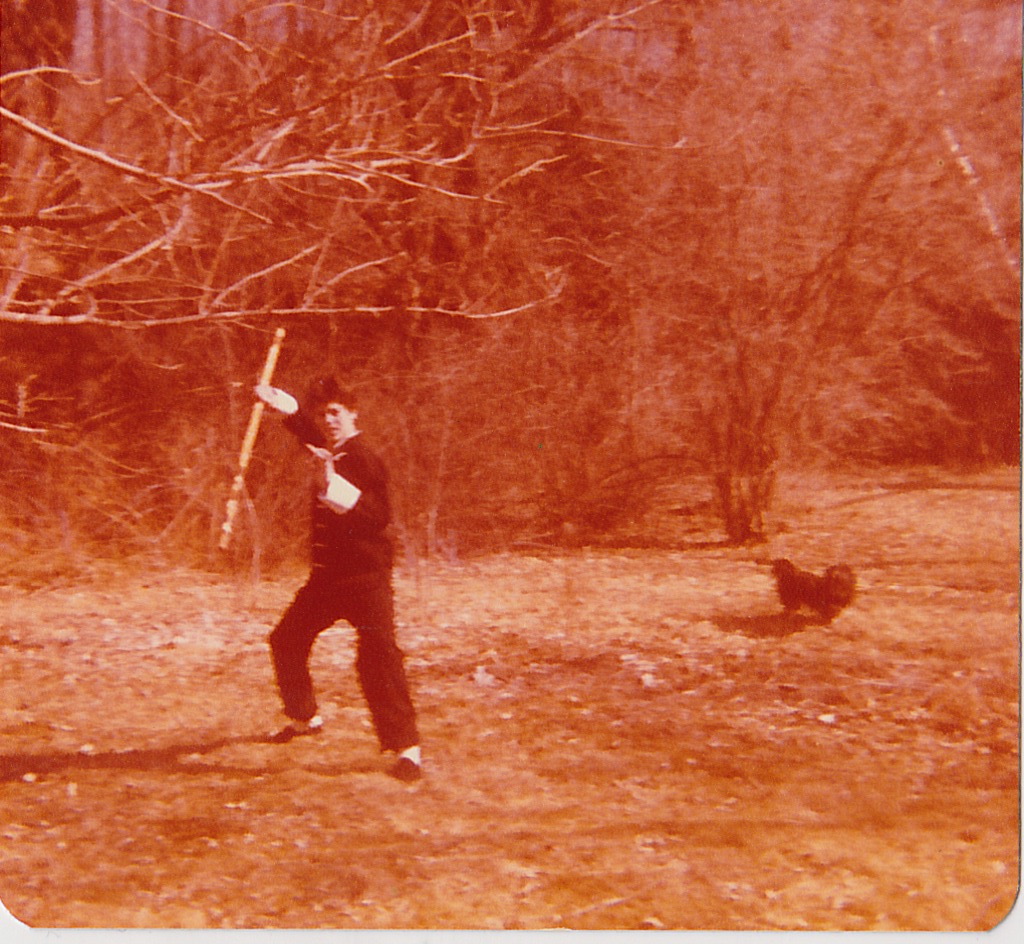
The author in his teens
First, check out this news story. It depicts a woman, who most likely had little to no self defense training, and probably less training with a weapon, fending off an attacker with a baseball bat. She got in some good hits, but she could have used some training to increase her effectiveness. The fact is a little training goes a long way. One could do forms with a little self defense application and in a dire situation be effective in deploying a weapon similar to the training weapon. There is no way that someone with little to no combative training can pick up a baseball bat and beat a competitive stick fighter, but if you have been working out with a staff for a while and a dog attacks you you would definitely have a better chance than someone with no training. I have been working out with weapons since the early 80s, and I can tell you honestly that I would not be able to compete in a stick fighting competition. But in the very rare possibility that I had to wield my staff to defend my family, I believe I am confident enough to dissuade any would-be assailant from continuing. In addition, a jo is first and foremost a common stick, which is ubiquitous in many environments from urban to rural. Sticks, pipes, and baseball bats can be readily found throughout the world, from India to Southern California. A stick is a feature of most environments.

Fun
Lastly, it is fun to move with a stick and develop your body at the same time. O’Sensei saw his jo practice as a sacred connection to the universe. I feel that same connection--it is kind of like a pantheistic dance partner! We all know that the more you see an activity as fun, the more likely you are to continue it. So I am counting on my love of the jo to increase my health, to decrease my health bills, and, if need be, to protect me in a dire situation.
chris-n-chewy.jpg
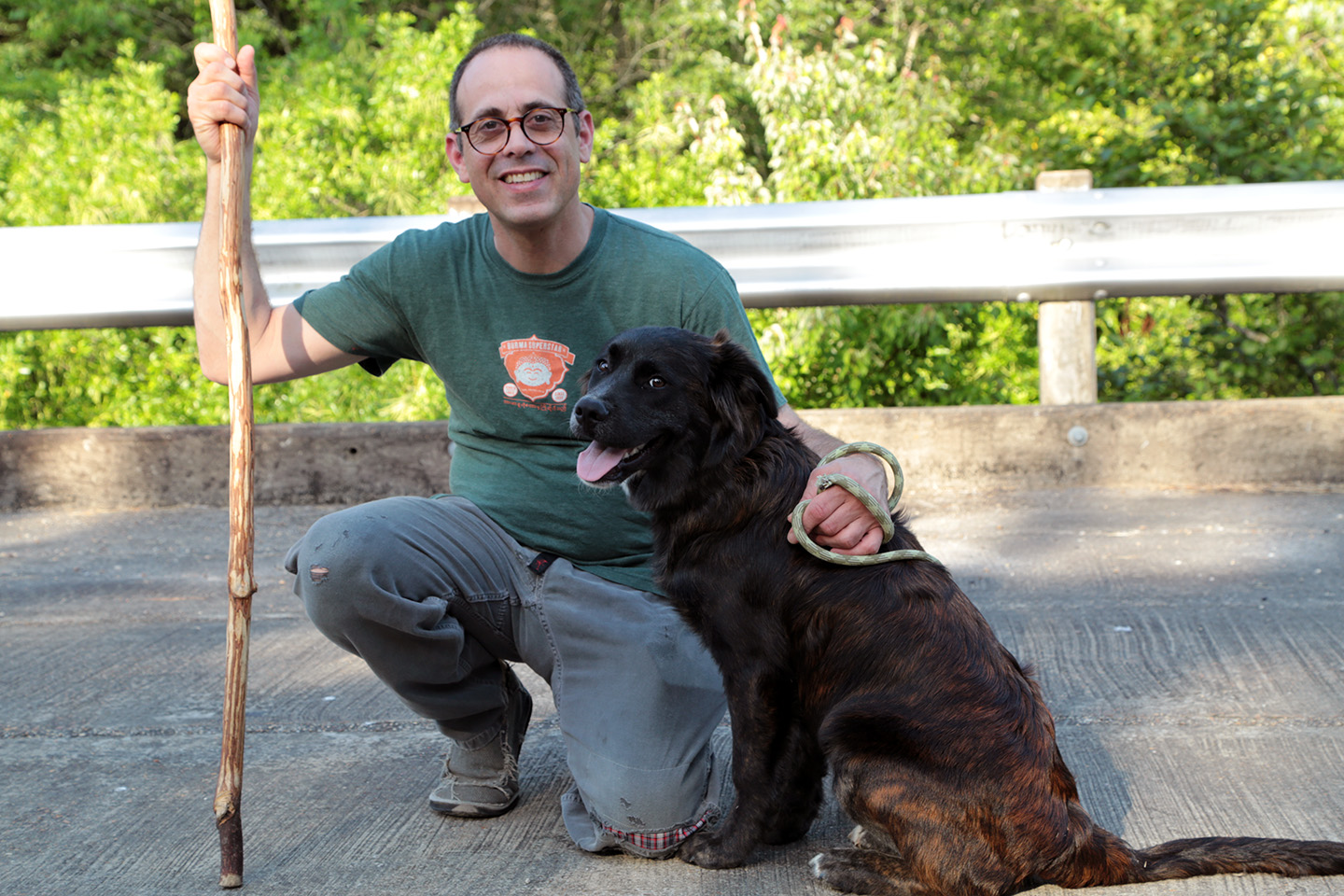
The author pictured with his dog and walking stick

As the quote at the beginning of this post says, the most perfect actions echo patterns found in nature, and I believe that the moves collected in the 31 Jo Kata do just that. They echo patterns that are found in nature, while intrinsically embedding them inside you. You are learning how to develop power and when to release power. These are not the only parts of the equation if you want to learn to become a skilled fighter. But in my context, where self defense is not a high priority, practicing these forms helps in the pursuit of health and provides a small amount of security. But most of all, I do it because it is fun. It genuinely brings a smile to my face when I practice.


Wednesday, September 23, 2015

Some People I Admire


Morihei Ueshiba 1883 - 1969
“Those who are enlightened never stop forging themselves. The realizations of such masters cannot be expressed well in words or theories. The most perfect action echo the patterns found in  nature.” 
To me, O'Sensei is the person I admire most. He is the epitome of never giving up. He persisted and developed himself until the end. 


Wang Zhang Zhai 1885 - 1963
Wang Xiang Zhai, brought standing meditation into the modern age. He was once asked to demonstrate his martial art in public; he just stood there and said this it it. 


Tuvia Bielski 1906 - 1987 
“Our revenge is to live. We may be hunted like animals but we will not become animals. We have all chosen this - to live free, like human beings, for as long as we can. Each day of freedom is a victory. And if we die trying to live, at least we die like human beings.”
Tuvia might seem like a weird choice but I can't think of anyone who fought against the Nazis and saved many people. After the war he came to NY started a moving company and taxi service. To think thousands of people got a ride by him never knowing he waged a serious resistance against the Nazi forces. You can see Daniel Craig play him a dramatization of his life called, Defiance


John Snow 1813 - 1858
Through his own intellectual desire about the 1854 cholera outbreak, he created epidemiology, John Snow tracked down all the cases of cholera in his neighborhood on his own time, he was an anesthesiologist at the time. He also created a dosage scale for the use of choloform and ether as an anesthetic. Pure genius!  You can read about him in the book Ghost Map


Leonardo Davinci 1452 - 1519
“It had long since come to my attention that people of accomplishment rarely sat back and let things happen to them. They went out and happened to things.” My grandfather told me about Davinci when I was a child. We often revere names like Gandalf and Merlin but truly if there real wizards Davinci would be one. 

Barak Obama 1961 - 
During the 2012 debate with Romney, Barak encouraged Romney to attack a point of that he made. After patiently waiting he totally did an intellectual Aikido move and turned it around on Romney.  I knew at that moment he would win the election. Some of Obama's best lines can be seen here. Republicans tried to tear this guy down, and time and time again they failed. He outclassed them.


“I am the son of a black man from Kenya and a white woman from Kansas.... I am married to a black American who carries within her the blood of slaves and slave owners-- an inheritance we pass on to our two precious daughters. I have brothers, sisters, nieces, nephews, uncles and cousins of every race and every hue scattered across three continents, and for as long as I live, I will never forget that in no other country on Earth is my story even possible.”


Charles Darwin 1809 - 1882
“Ignorance more frequently begets confidence than does knowledge: it is those who know little, and not those who know much, who so positively assert that  this or that problem will never be solved by science.” Darwin's persistence and drive to understand nature changed the world. 


Michelangelo di Lodovico Buonarroti Simon 1475- 1564
"If people knew how hard I worked to get my mastery, it wouldn't seem so wonderful at all." He is here because of his love of the human body. Looking at his work you can see he had an amazing view of humanity. He also hauled his own stones, made his own tools and hid in the caves when political fanatics went against his patrons.  


Constantine Brancusi  1876 - 1957
“They are imbeciles who call my work abstract. That which they call abstract is the most realistic, because what is real is not the exterior but the idea, the essence of things.” He made absolutely beautiful sculptures and taught me about universal beauty and the importance of relativism.  


Paul Cézanne 1839 - 1906 
“One had to immerse oneself in one's surroundings and intensely study nature or one's subject to understand how to recreate it,” and “With an apple I will astonish Paris.” Cezanne didn't have a show until he was in his late 50s. I love his paintings but most of all I admire his commitment to understanding nature. 


Monday, August 30, 2010

Vive L’amateur

In the mid 90’s I started taking an Aikido class in Seattle’s Chinatown. The crisp throws and graceful falls were all I needed to become hooked. The school advertised itself as “Aikido taught by professionals,” and was affiliated with a larger school north of the city. The instructor at the Chinatown dojo was a clean-cut young man, and as typical in martial arts school from Japan, he had a stern, militant voice.

I started the class because I needed to break a life pattern. The artist’s undisciplined lifestyle had been taking its toll, and I had had enough. Martial arts had saved me when I was a kid, and I knew it would do it again. As I began going to classes, first three days per week, then five, I became addicted, as did the other 20- and 30-somethings in the class. The class had a bunch of young men and women who bonded around Aikido’s unique philosophy of non-violence and non-aggression.

The students got along really well, and we thought we’d found the perfect school for us. Then, after about a year, these “professionals” started to make some changes to both the curriculum and, more significantly for me, to the payment plan. It was a time in the martial arts world when signing yearly contracts became popular, and the head instructors decided that was a good business model. In addition to requiring a contractual commitment with a lump sum up front, there were also tests fees, new uniforms, and other added expenses. It became a hefty sum of money, one that my wife and I could not comfortably afford.

When I balked at the new expenses, asking if there was a way to avoid some of them, the instructor railed into me, saying I wasn’t serious about Aikido and questioning my priorities. His response made my next move easy. I never returned. I soon found another martial art and dreamed of opening my own school. But after much reflection, I realized that to be a “professional” means making money and capitalizing on the role as a respected teacher to persuade students to purchase contracts, uniforms, and anything else that can bring in a profit. This is not illegal in any way, but it doesn’t sit right with me for one reason: trust. At the end of the day, a professional’s job is to make sure he or she is in the black. So they have to devise ways to excite, inspire, and persuade students to invest in the school’s future and purchase things, things they might not actually need.

Since then, I have decided not to open a school for profit or to formally attend one. Instead, I occasionally visit teachers whose primary income is not from their martial arts classes. That squarely makes them “amateurs,” which gives me a sense of trust and passion—after all, amateur means “lover of.” The amateur passes on knowledge because it provides meaning to their lives and, they believe, to the lives of others. Long live the amateur!