Showing posts with label Depression. Show all posts

Sunday, January 04, 2026

Humans Need Something to Do With Their Hands


Depression and anxiety are often talked about as personal failures or chemical imbalances that need to be corrected. But I think there’s another layer that rarely gets enough attention. For nearly all of human history, people were occupied for most of their waking hours with physical, tangible work. We grew food. We hunted. We built shelters. We made tools. We repaired what broke. Our survival depended on daily engagement with the physical world.

That reality has changed radically in a very short span of time. In the last fifty years, large portions of the population no longer need to do much with their bodies or their hands to survive. Yet paradoxically, we are more mentally overstimulated and stressed than ever.

I notice this very clearly in my own life. When I am the most anxious or depressed, it is almost always when I am sitting still, mentally spinning. My mind starts running endless scenarios, what-ifs, regrets, and imagined futures. None of it is productive. None of it is grounded. It’s just noise.

The moment I pick up a craft, something changes.

When I start carving wood, cooking, fixing something, or engaging in physical movement, the mental clutter quiets down. My attention narrows. The hands take over. The mind no longer has the bandwidth to spiral. It isn’t forced into silence; it is occupied.

Occupation as Regulation

This isn’t about productivity or hustle. It’s about regulation. Humans evolved to regulate their nervous systems through physical engagement with the world. Making, moving, lifting, shaping, walking, tending. These activities give the mind a place to rest because attention has somewhere to go.

I often think about autoimmune disease as a loose metaphor here. In overly sterile environments, the immune system sometimes loses its appropriate targets and begins attacking the body itself. I am not saying all autoimmune disease works this way, or that everyone with autoimmune illness is idle. But I do think the pervasiveness of sterile, low-engagement environments has consequences for biological systems that evolved in a very different context.

The mind may not be that different.

When it has nothing meaningful to do, it often turns inward and begins attacking itself. Rumination, self-criticism, catastrophic thinking. Not because the person is weak, but because the system is under-used in the way it evolved to function.

A World That Doesn’t Need You, But Still Stresses You

We now live in a strange contradiction. The world does not require much from our bodies, yet it demands constant mental vigilance. Emails. Deadlines. News cycles. Financial anxiety. Abstract stress with no physical outlet.

Unless you have Zen-level mental discipline, this is a brutal setup.

I wish my mind were strong enough to simply will its way through this. I do believe that kind of training is possible, and I work toward it. But I also think it’s important to be honest about what humans actually need. For most of history, we didn’t meditate our way out of stress. We worked it out through physical engagement.

We whittled. We cooked. We built. We repaired. I honestly don’t know if there has ever been a time when humans weren’t doing this, until now.

Keeping Your Head Together

This isn’t about the root cause of depression. It isn’t about dismissing therapy, medication, or deeper psychological work. It’s about something much more basic.

Keeping yourself occupied in a tangible way is a form of mental hygiene.

Using your hands calms the mind. Moving the body organizes attention. Making something creates feedback, satisfaction, and a sense of completion that abstract tasks rarely provide. Sometimes that turns into gifts. Sometimes it turns into skills. Occasionally, it even turns into a career. But that’s not the point.

The point is simpler.

Staying human in a world that increasingly asks you to be disembodied requires intention. Craft and physical activity are not hobbies in that context. They are stabilizers. They are ways of staying sane. They are ways of keeping your head together.

And for a species that evolved by doing, there might not be a better way to stay grounded.

Monday, December 22, 2025

Tai Chi is primarily about somatic transformation


Much of how we understand change is shaped by our beliefs, insights, intentions, and explanations, but a prerequisite for sustainable change begins in the body.

This is what I mean by somatic transformation: a lasting shift in how the body organizes itself in the world, how it breathes, balances, responds to stress, and moves through space. When this changes, thoughts and emotions follow naturally without force or self-management

For those who are not familiar with somatic, let’s break it down:

  • Somatic = of the body (muscles, breath, posture, nervous system, sensations)

  • Transformation = a durable shift, not a temporary technique or mood

So somatic transformation means:

Rewiring how your body experiences and responds to life, especially stress, emotion, and threat. Additionally, it is having your body open to deeper sensations that people who rush through life can’t feel. 

For me, Tai Chi is one of the most effective ways to cultivate this kind of transformation.

I believe that people who stick with Tai Chi don’t practice it as a hobby but as something that is fundamentally being addressed only at the level of the body.

In contrast, Buddhist meditation sharpens awareness and reveals how the mind creates suffering through clinging. These insights are valuable and necessary. Yet insight alone does not always change how the body reacts.

A person can understand non-clinging intellectually and still brace under stress. They can grasp emptiness conceptually and still live with chronic tension, shallow breathing, or a nervous system locked in fight or flight. This is not a failure of understanding. It is a limitation of cognition as the primary vehicle of change.

Tai Chi addresses this gap directly.

Rather than arguing with the mind, Tai Chi trains the body to experience stability without rigidity, power without force, and responsiveness without panic. Through slow, attentive movement, the nervous system learns, physically, what safety, balance, and adaptability feel like.

This learning does not require belief. It requires practice.

Movement as Embodied Wisdom

Tai Chi is often described as meditation in motion, but that description understates its depth. It is a method of reorganizing posture, weight transfer, and breath so that effort is distributed efficiently and excess tension is released.

Over time, practitioners stop forcing balance and begin allowing it. They stop bracing against gravity and begin working with it. The body learns to yield without collapsing and to issue power without aggression.

These are not metaphors. They are somatic facts.

This is why Tai Chi pairs so naturally with Buddhist principles. Where Buddhism clarifies the nature of the mind, Tai Chi trains the body to embody those insights. Non-attachment becomes the ability to let go of unnecessary muscular effort. Equanimity becomes a stable center under changing conditions. Presence becomes literally felt through the feet, the spine, and the breath.

Grounding Through Action

Somatic transformation deepens when movement is connected to activities that have grounded humans for millennia, walking long distances, working with the hands, preparing food, shaping materials, and spending time in natural environments.

These activities anchor awareness in necessity and consequence. They provide feedback that is immediate and honest. They prevent practice from drifting into abstraction or performance.

This is also where Tai Chi distinguishes itself from purely symbolic or ritualized systems. While any tradition can become decorative or performative, Tai Chi continually returns the practitioner to functional realities, balance, structure, timing, and adaptability. If these are absent, the practice simply does not work.

In this sense, Tai Chi is not about cultivating an identity or performing a role. It is about becoming more inhabitable, learning to live inside the body with less resistance and more coherence.

Somatic Transformation as the Point

Somatic transformation does not eliminate thought or philosophy. It integrates them. When the body changes, reflection becomes clearer and ethical action becomes less reactive. Decisions arise from grounded awareness rather than compulsion or avoidance.

This is why Tai Chi has endured not as a belief system but as a practice. It offers a way for the body to learn what the mind often understands too late, how to move through the world without unnecessary struggle.

In that sense, Tai Chi is not a supplement to insight. It is its embodiment. And for those drawn to it over a lifetime, the transformation it offers is no mere accident. It is the point.


Friday, February 10, 2017

Qi Gong and Depression


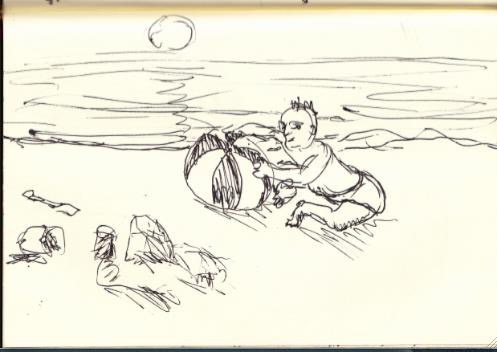
When moving to a new home, there are tons of boxes to open, inevitably you stumble across something from your past. This last move, I found an old sketch of a child playing on the beach from late 90s, quite a few years before my first son was born. I tried to remember why I kept that drawing as it is not the best drawing I have done.

During my early 30s I started to feel like I was stuck in a rut at work and I became quite unhappy for a long period. It lasted long enough for me to say to myself, I think I am depressed. I decided I needed to do something and as I was doing some Aikido at the time, I sought an alternative method of self-healing, I found this cassette tape called the Inner Smile Qi Gong set by Mantak Chia. I practiced every day and part of the set included visualization of something that makes you happy, whatever it is.

For the better part of six months of practicing, I could not fixate on anything in particular. Then after some more time, I was able to conjure children’s laughter in my mind, but only faintly. Then after more time, the sound became clearer and then I could actually see a blurry figure laughing and playing on the beach. I began to attempt to sketch it and during that process a boy playing and laughing on an ocean shore appeared in my mind’s eye. My wife and I had been married for about 5 years at that time and I never had a strong desire to have children and we hadn’t discussed it once until 3 years later. My depression soon passed and the Qigong succeeded in helping me focus on the things I wanted to spend my day thinking, doing, and feeling, and it kept me from falling back into a cycle of darkness.

I no longer practice the inner smile set anymore but I do practice the Tai chi 24 form most days of the week. I still do some 8 Brocades Qigong and a few others occasionally. Both Tai chi and Qigong help me on a daily basis with many of life’s challenges both physical and psychological. The odd thing about this story is that since finding this drawing my wife and I have two sons and I can’t help but wonder if the Qigong I did at that time provide me with a glimpse into the future. And did that glimpse abate my depression, or was it that I uncovered some lost part of myself from childhood, or was it something deeply felt but unknown within the caverns of my limbic system? I guess there is no way to answer those questions, but it does make me wonder.