Showing posts with label training. Show all posts

Wednesday, October 29, 2025

My Current Training Routine


Lately, my training has become a full-circle practice—rooted in martial arts, refined through nature, and expanded through inner awareness. I’m blending traditional disciplines with strength training and elemental work, tuning my body and mind to move as one system.

Tai Chi, Qi Gong, and Tai Chi Ruler
These arts are at the center of my practice. They slow me down just enough to feel the flow of energy—Qi—moving through every joint and tendon. The Tai Chi Ruler connects breath with spiral motion, helping me refine structure and intention. It’s meditative, but it’s also mechanical—retraining how I generate force and balance.

Microcosmic Orbit and Universal Alignment
I’ve been working on adjusting my mind to the universal consciousness—quieting the chatter of ego so I can sense the larger current. The Microcosmic Orbit is one of the ways I do that, circulating energy through the spine and the body’s meridians. It’s not only a meditation—it’s an expression of how the universe itself moves.

When I practice the Microcosmic Orbit, I’m not just visualizing energy; I’m participating in a cosmic pattern. The same underlying motion reveals itself in Tai Chi Ruler practice and even in chopping wood. The circular rhythm of breath, swing, and return mirrors the way galaxies spiral, seasons turn, and tides rise and fall. The Microcosmic Orbit is the structural pattern of the universe itself—the energetic blueprint that connects everything that moves. The goal of Tai Chi is to embody this pattern, to move in harmony with the greater design.

Developing Power and Durability
Alongside internal work, I’m increasing punch power and low-leg kicks through old-school conditioning—Iron Palm, impact training, and low-stance practice. I’m learning how to transfer energy from the ground up through relaxed, connected movement. My fingertip pushups and lifting sessions reinforce tendon strength and raw stability.

Training in Nature
I train outside as much as possible. The ground is uneven, the air changes, and that unpredictability keeps the senses sharp. Hiking long distances improves my cardio, but more importantly, it resets my rhythm. I swing tomahawks, throw them, and cut wood to build grip strength and coordination—all while staying connected to the land that teaches patience and resilience.

Mobility and Flow
Hip mobility training ties everything together. The hips are the gateway to rooted movement and powerful strikes. Every lift, kick, or turn of the waist depends on how well the hips can move without tension.

Each of these practices feeds the other. Whether I’m standing still, breathing through Qi Gong, or driving an axe through a log, I’m training for harmony—between body, mind, and the wider consciousness that holds them both.

Friday, August 22, 2025

Walking Through Back Pain: What My Latest Injury Taught Me


A few days ago, I tweaked my back trying to pull off a flashy weightlifting move I picked up from a Dagestani wrestler. I was training with one of my employees — who happens to be excellent at proper form — and she’d been giving me pointers all session. But during a break, I spotted a 45-pound plate and thought, “I’ve got to try that technique.” Instead of bracing properly and using what I know, I swung the weight around…and my back gave out.

At 60, this isn’t my first round with back problems. My history with back pain goes all the way back to the 1990s when I worked for a moving company. Years of heavy lifting led to my first real back injury. Later, I thought switching to desk jobs would help, but sitting all day only made things worse. The pain became so severe that surgery seemed like the only option.

Over the years, I’ve tried steroid injections, rest, and every pain-management method you can think of. But interestingly, once I found work that didn’t chain me to a desk, my back improved dramatically. That experience taught me something critical: our bodies aren’t designed to heal through avoidance — they heal through movement.

This latest injury reminded me of that lesson. I haven’t taken a single painkiller (though I did use Tiger Balm once). Instead, I’ve been walking, stretching, and staying as active as I can without pushing too far. I’ve scaled things back, but I haven’t stopped moving. Now, just a few days later, the pain is still there, but I can feel myself turning a corner.

The truth is, you can’t sidestep back pain — you have to walk through it. Too often, people rush into surgery or long-term treatments that may not be necessary. Our bodies are built to recover, as long as we give them the chance.


One story that inspires me is that of Willie Pep, the legendary boxer. After surviving a plane crash, he was back in the ring training within six months. Years later, doctors discovered he had actually fought with a broken back. His body healed because he demanded it to. That’s how the human body works — for millions of years, before modern medicine, survival depended on our ability to repair ourselves.

So that’s where I am today: moving through the pain, trusting the body’s design, and reminding myself that healing isn’t about babying an injury — it’s about giving your body the right conditions to do what it already knows how to do.

Sunday, July 27, 2025

Walking every day and the unforgivable algorithm of the universe


I walk slowly through trails many days per week, mainly along the Rio Grande gorge, and in minimal shoes on rocky trails with my dog, who is very much a taskmaster and not one who likes to sit around the house much. She forces me to get outside, and I comply because I understand the algorithm of the universe.  Video of a typical walk

Every time I walk on these uneven, shifting surfaces, I toughen my feet and activate my toes to prepare better for impact with the ground, thereby lessening the impact on my knees. This helps heal my knees, even though the uneven surfaces are challenging on them, but I know how the unforgiving algorithm universe impacts my body. When you understand the algorithm, you slow down your descent into bodily decay. 


We are all on a descent into bodily decay, and that is the algorithm of the universe. However, the speed at which one descends is key. When you engage in something consistently, your body adapts and repairs itself to meet the demands placed on it. Living on the planet requires a physiological organism to meet the demands of life; your mitochondria multiply to increase energetic output and thus consume more glucose. Your heart rate meets the demands, increasing blood flow, and your bones also remodel to accommodate those demands.


Not only does this benefit my physical health, but it also mentally prepares me. While I'm walking, I'm thinking about what needs to be done, but what is essential? What should I give my time to now? 


Conversely, sitting on a couch or playing video games all day, your mind and body scale down since the demand is minimal. Since there's very little demand, your body is like an energetic accountant. It decides it doesn't need to rebuild muscles. It doesn't need to grow more mitochondria, so it won't. Thus, your body decays faster. I wish we didn't talk so much about metabolic health and just focus on activities, especially demanding ones. 


I mean, that's really it. It's not rocket science, and I think that sometimes, especially among health influencers, it gets turned into rocket science. It really isn't rocket science; it's just a simple concept. I know I'm the one using terms like 'allocation resources' and 'unforgiving algorithm,' but it boils down to putting yourself in demanding situations that are slightly uncomfortable often. It doesn't have to be so painful that you want to die, but the key is REPETITION. Repetition is not a once-a-week thing; it should be at least three times a week, four times a week, five times a week, week after week. It might seem overwhelming at first, but take it one day at a time, and your body will have your back, literally.


Saturday, May 17, 2025

Kung fu is more than technique and form

The martial arts you typically see in movies, tournaments, and dojos are cosplay. They are theater, which lack the essence. 

The martial arts that I do, the kung fu that I do, are about spiritual growth and living the path of life. Often, we see martial arts portrayed through competition sports demonstrations, where you are dressed in some outfit from some weird era that most likely never even existed. While they can still be done with good intentions, all those things are not the martial arts I practice.


The martial arts I practice are a way of life. Before one gets triggered by the statement about martial arts being a way of life, usually the next thing said is, “We don’t train for fighting.” So let me state unequivocally that martial arts are for fighting, but only because life has fighting in it. The martial arts I practice don’t mean winning fights or having an excellent record. Records are of little concern to me. I would rather have more losses than wins if it meant I had profound wisdom. 


Moreover, people confuse the pursuit of perfect form with the path of wisdom, as if great form is the highest achievement. These people become obsessed with form and are limited spiritually. 


A good example of this I learned was a dojo where I practiced for a few years. They were all obsessed with technical proficiency, without even attempting to marry it to a practical application in self-defense. So it became an obsession with technical proficiency, which somehow was a proxy for spiritual development, and it wasn’t long before they proved that they were spiritually constrained.


While I went on my own and began training during my hikes on the mesas of New Mexico, I often didn't do much of the form, but the spiritual intention and emptying of my mind became the primary practice. So while I did little typical "martial arts" training, I was still heavily and deeply training my intention and working on my heart.


In Chinese martial arts, there is often a desire to write about these different types of concepts like Yi, Shen, and such through forms and practices ad nauseam, and when you read the books, there isn't much in there that applies to life or that discusses the true training of intention. 


Admittedly, it's a complex topic and not easily captured in words, but I do feel the need to try to do that. When I often see "martial artists” wielding a machete and trying to cut brush or a small tree, I see someone who doesn't understand true intention, yet they could win a Wushu competition with a sword or look furious while doing partner training. They don’t have death in their hands. You can see what I am describing in the commitment of the cut when there is resistance. When I watch these people cutting, there is less follow-through as the blade goes through the material. Intention is particularly relevant in handgun training. While handguns are not my focus, when I was training with them, there was this type of trigger pull that, if done without proper intention, the bullet doesn’t hit the target, or if it is feeble, the bullet can actually get jammed or stove-pipe in the port. 


The Tai Chi Classics speaks on this, stating that when you attack, you are to have the viciousness of an eagle grabbing its prey. This is good, but how many dojos do you enter where they take you to that abyss?  Also, can you even recognize what that looks like?


Luckily, I had a grandfather who was very physical and not abusive towards me, but he did get into fights, and his example of viciousness was excellent. He could see something with authority and command, and I often don't see that in training in many martial arts. I'm not picking on one martial art; ironically, Aikido people developed that, but because of a pseudo-moral philosophy, they cannot adapt it to modern applications.


That is why living life, cooking, hiking, playing with animals, and playing rough-and-tumble full-contact games, like football, and even bullies, are essential to developing this intention. How else can you learn this? If not, how to stop a bully when you're younger, as I said before, many, many times, even though I talk about it a lot because it was a trauma I experienced, it also pulled the best out of me. 


Working with young men is also part of martial arts training. When I switched to working in healthcare in 2003, I found this path to be rich in martial wisdom. Battling disease and preventing disease are also part of this path, but often, those things are not included in martial arts training.


The things I'm talking about don't require one specific teacher, per se, and I don't even know if there is one teacher who can teach you all those things. That's why martial arts teachers are overrated. 


Recently, while working in Indian country, I met a couple of wise Native American elders. They are not martial arts instructors, but they convey much of what I'm talking about now, and maybe martial arts is a small part of that, or vice versa. I don't know another name for a teacher on the path of wisdom. I always thought it was martial arts, and then there was also religion. So maybe there's another path without a name that I'm still learning about.


Reading Carlos Castaneda this year has been helpful because he captures much of what I'm talking about. Some things are universally included in martial arts, like wisdom, violence, and working with youth. But some things are exclusively outside the martial arts path, like the chaos of life itself. When training in martial arts, don’t fall for the stereotype we see on TV; explore the parts outside of the controlled arena. 


Thursday, August 08, 2024

What People Don't Get About Minimalist Shoes!

Conditioning is not abusive, but it is challenging and rough.


A major thing people don't understand about body conditioning is the principle of 1 mm at a time. It's not about binge and purge types of exercise. I remember an old friend who commented on a video of me banging my forearm against a wooden beam as an integral part of my martial arts training. Her statement alluded to me doing self-harm like I was an angry kid punching a wall.

That example sums up what people need help understanding about conditioning. Little by little, you mold your body over time.

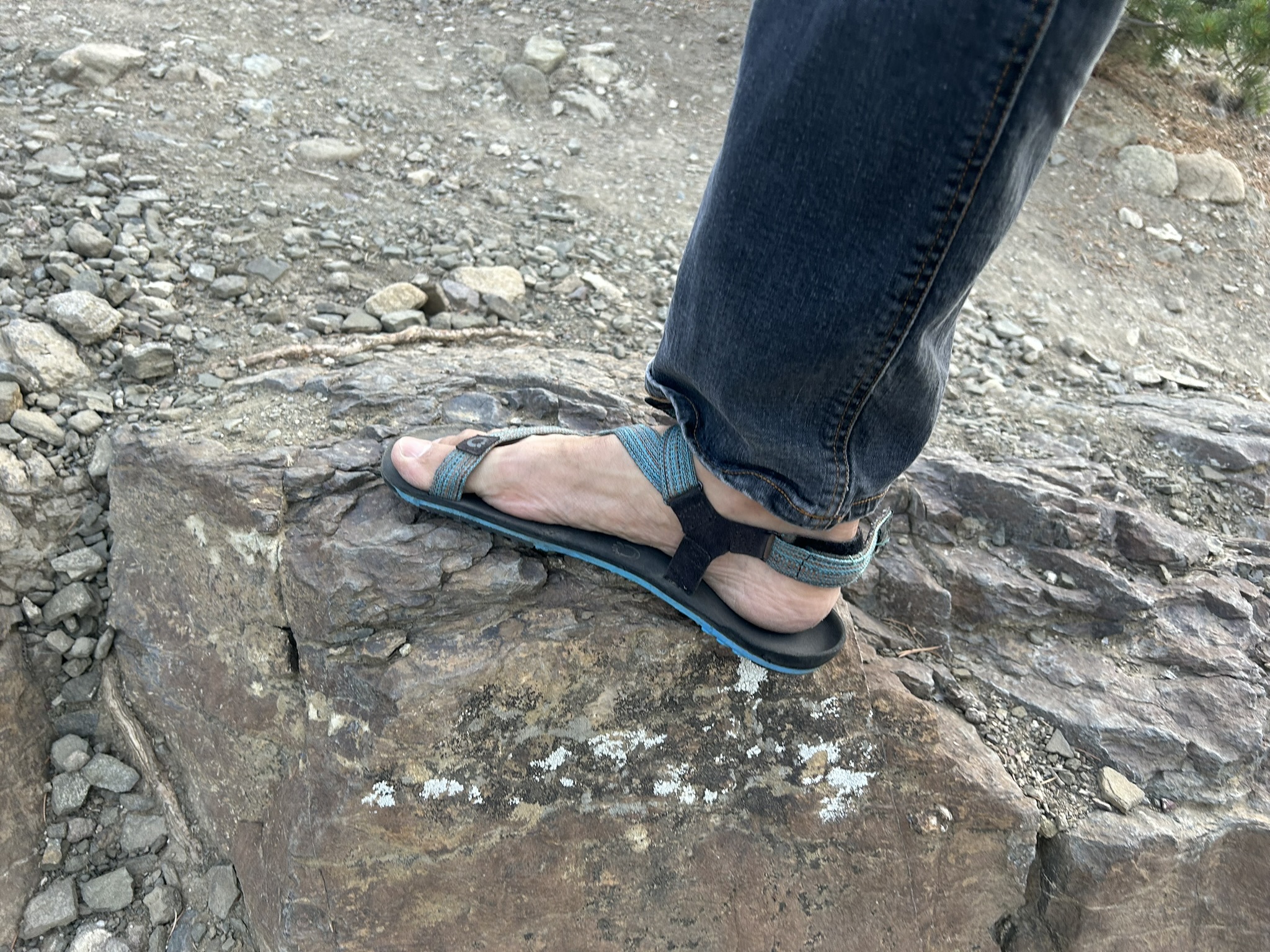
Take wearing minimal sandals on the trail in a rocky desert.
People think, “Oh my God, you're crazy!” “You are going to destroy your feet!”

They don't get that it's a skill you build up over time. Your feet get tougher and stronger, directly affecting your connection to the planet. The whole idea of putting your feet in some heavily “supported” shoe is counterproductive to conditioning your body for the long journey of life.
The more you condition your feet, the longer you can walk without discomfort. This extended walking time contributes to better overall fitness, making the journey of life more enjoyable and less painful. It's a long-term investment in your health and well-being.

Wearing minimal shoes is not just about the footwear; it's a skill. It involves strategic foot placement, which in turn reduces the risk of injuries. It's not a complex science, but for some reason, people tend to overprotect themselves. This modern trend of heavily 'supported' shoes deviates from the majority of human existence. All reactio