Showing posts with label Meditation. Show all posts

Monday, December 22, 2025

Tai Chi is primarily about somatic transformation


Much of how we understand change is shaped by our beliefs, insights, intentions, and explanations, but a prerequisite for sustainable change begins in the body.

This is what I mean by somatic transformation: a lasting shift in how the body organizes itself in the world, how it breathes, balances, responds to stress, and moves through space. When this changes, thoughts and emotions follow naturally without force or self-management

For those who are not familiar with somatic, let’s break it down:

  • Somatic = of the body (muscles, breath, posture, nervous system, sensations)

  • Transformation = a durable shift, not a temporary technique or mood

So somatic transformation means:

Rewiring how your body experiences and responds to life, especially stress, emotion, and threat. Additionally, it is having your body open to deeper sensations that people who rush through life can’t feel. 

For me, Tai Chi is one of the most effective ways to cultivate this kind of transformation.

I believe that people who stick with Tai Chi don’t practice it as a hobby but as something that is fundamentally being addressed only at the level of the body.

In contrast, Buddhist meditation sharpens awareness and reveals how the mind creates suffering through clinging. These insights are valuable and necessary. Yet insight alone does not always change how the body reacts.

A person can understand non-clinging intellectually and still brace under stress. They can grasp emptiness conceptually and still live with chronic tension, shallow breathing, or a nervous system locked in fight or flight. This is not a failure of understanding. It is a limitation of cognition as the primary vehicle of change.

Tai Chi addresses this gap directly.

Rather than arguing with the mind, Tai Chi trains the body to experience stability without rigidity, power without force, and responsiveness without panic. Through slow, attentive movement, the nervous system learns, physically, what safety, balance, and adaptability feel like.

This learning does not require belief. It requires practice.

Movement as Embodied Wisdom

Tai Chi is often described as meditation in motion, but that description understates its depth. It is a method of reorganizing posture, weight transfer, and breath so that effort is distributed efficiently and excess tension is released.

Over time, practitioners stop forcing balance and begin allowing it. They stop bracing against gravity and begin working with it. The body learns to yield without collapsing and to issue power without aggression.

These are not metaphors. They are somatic facts.

This is why Tai Chi pairs so naturally with Buddhist principles. Where Buddhism clarifies the nature of the mind, Tai Chi trains the body to embody those insights. Non-attachment becomes the ability to let go of unnecessary muscular effort. Equanimity becomes a stable center under changing conditions. Presence becomes literally felt through the feet, the spine, and the breath.

Grounding Through Action

Somatic transformation deepens when movement is connected to activities that have grounded humans for millennia, walking long distances, working with the hands, preparing food, shaping materials, and spending time in natural environments.

These activities anchor awareness in necessity and consequence. They provide feedback that is immediate and honest. They prevent practice from drifting into abstraction or performance.

This is also where Tai Chi distinguishes itself from purely symbolic or ritualized systems. While any tradition can become decorative or performative, Tai Chi continually returns the practitioner to functional realities, balance, structure, timing, and adaptability. If these are absent, the practice simply does not work.

In this sense, Tai Chi is not about cultivating an identity or performing a role. It is about becoming more inhabitable, learning to live inside the body with less resistance and more coherence.

Somatic Transformation as the Point

Somatic transformation does not eliminate thought or philosophy. It integrates them. When the body changes, reflection becomes clearer and ethical action becomes less reactive. Decisions arise from grounded awareness rather than compulsion or avoidance.

This is why Tai Chi has endured not as a belief system but as a practice. It offers a way for the body to learn what the mind often understands too late, how to move through the world without unnecessary struggle.

In that sense, Tai Chi is not a supplement to insight. It is its embodiment. And for those drawn to it over a lifetime, the transformation it offers is no mere accident. It is the point.


Wednesday, December 17, 2025

Your Body Is Not Broken It Is Stuck in Survival Mode

In my line of work, community health promotion, I occasionally see people who work out hard but then end up in the hospital. It took me a long time to understand why health is much more than lifting heavy weights and running marathons. It is also how your nervous system responds to a hectic environment.

Your nervous system runs on autopilot. This is the autonomic nervous system, and it is always working in the background, whether you are aware of it or not. It has two primary modes. One is sympathetic, which most people know as the fight-or-flight response. The other is parasympathetic, which is largely regulated through the vagus nerve. Neither system is bad. Both are necessary. The problem shows up when one dominates for too long.

Fight or flight is designed for short bursts. It raises heart rate, tightens muscles, sharpens focus, and redirects energy away from digestion and long-term repair. This is precisely what you want when danger is real. The body is doing its job.

The issue is that modern life keeps triggering this response without ever letting it shut off. Work pressure, trauma, poor sleep, constant stimulation, and unresolved stress all send the same message to the body. Stay alert. Stay ready. Over time, the autonomic system gets stuck in survival mode. The body never receives the signal that it is safe to stand down. Eventually, survival becomes the default state.

The vagus nerve represents the opposite side of this equation. It is the main pathway of the parasympathetic system, and it connects the brain to the heart, lungs, and gut. At its core, it is always asking a straightforward question. Are we safe enough to relax?

When the vagus nerve is engaged, heart rate slows, breathing deepens, digestion resumes, inflammation lowers, and the body can finally shift into repair mode. Stored stress and tension can begin to unwind. This transition cannot be forced through thought or willpower. The body has to feel safety before it will allow relaxation.

This is where Tai Chi becomes especially powerful. Tai Chi works because it speaks directly to the autonomic nervous system rather than trying to override it. Slow continuous movement reduces threat signals. Upright posture improves breathing and circulation. Rhythmic motion steadies the nervous system and supports healthy heart rate variability. Attention stays in the body instead of spiraling through anxious thought loops.

Unlike intense exercise, Tai Chi does not keep pushing the body deeper into fight or flight. Unlike passive relaxation, it does not lead to collapse or spacing out. It teaches the body how to move out of survival mode and into vagal regulation smoothly, repeatedly, and safely.

Healing does not happen while the body is braced for impact. Trauma, inflammation, digestive issues, and chronic pain tend to persist when the nervous system believes danger is ongoing. Tai Chi creates a controlled environment where the body can relearn safety through movement, not by forcing calm, but by restoring balance.

Fight or flight keeps you alive. The vagus nerve teaches you how to recover. Tai Chi is one of the most practical ways to retrain the autonomic nervous system by using slow, intentional movement to signal safety, restore rhythm, and allow healing to happen naturally.


Saturday, December 06, 2025

The Most Overlooked Wilderness Survival Skill: Tai Chi


Outdoor skills are usually framed around the same familiar categories: navigation, fire building, first aid, layering, risk management, and physical conditioning. We talk endlessly about gear, preparation, and the right tools to carry into the backcountry. But there is a missing category that rarely makes it into the conversation, even though it directly shapes how we move, think, and make decisions when the terrain changes or the unexpected happens. It has nothing to do with equipment and everything to do with the person carrying it.

That missing category is our internal skill set—our ability to regulate stress, stay composed under uncertainty, perceive subtle environmental cues, and move with stability even when tired or cold. These qualities often determine whether a situation remains manageable or begins sliding toward trouble. And one of the best ways to train them, though almost no one in the outdoor world talks about it, is Tai Chi.

Most people think of Tai Chi as a gentle meditative practice, something done slowly in a park or community center. But Tai Chi is also practical conditioning for the nervous system and the body’s mechanics. It teaches you to interrupt panic before it snowballs. It teaches your breath to stay long when adrenaline wants to shorten it. It teaches smooth, efficient movement that reduces unnecessary strain and lowers the risk of slips or missteps. And it sharpens awareness so that details in the landscape become clearer instead of fading under stress.

I was reminded of all this on a recent winter hike in the Rio Grande Gorge. It’s a trail I’ve done many times, a descent into the canyon and a climb out along a steep and rugged slope. But with a fresh layer of snow, the trail vanished. The familiar markers were gone, and the terrain suddenly felt foreign. Even though I had the right gear, water, a knife, fire starter, and layers, there was still a moment where my stomach tightened and that subtle, disorienting whisper crept in: “You might be lost.” It wasn’t a dangerous situation yet, but it was enough to trigger the early stages of poor decision-making—the very thing most survival incidents are built on.


Instead of pushing forward blindly, I stopped. I found a patch of sunlight, took a moment to warm my hands, and settled my breath. Then, almost instinctively, I began moving through a few Tai Chi patterns. Slow rotations. Shifting weight. Feeling the ground beneath me instead of fighting it. The more I moved, the more the anxiety dissolved. The land stopped feeling like an adversary. My senses widened. I began noticing small landmarks I had overlooked a few minutes earlier—the way a cluster of rocks opened in one direction, the faint rise of a ridge I recognized, the subtle indentation of the path beneath the snow. Within minutes, the terrain reorganized itself in my mind and the trail appeared again, almost effortlessly.

It struck me afterward how natural that sequence felt. Tai Chi wasn’t something extra I added to the hike; it was a built-in reset button. It prevented me from compounding a small problem into a real one. The practice didn’t “save me”—the situation wasn’t extreme enough for that—but it absolutely corrected the direction of my thinking before it slid into unnecessary risk. And that is the essence of internal survival skill.


When adrenaline hits outdoors, people tend to move faster, breathe shallower, and narrow their awareness. Tai Chi trains the opposite pattern. It teaches you to slow down just enough to see clearly again. It reminds the body how to generate warmth without burning energy, using rotation and breath to bring circulation back into your hands and feet. It keeps your joints soft instead of rigid, which dramatically reduces the likelihood of small but consequential injuries. And it cultivates a wide, open form of attention that lets you read terrain instead of fight it.

None of this requires mystical thinking. These are practical, testable qualities. They translate directly onto icy trails, steep scrambles, loose scree, snow-covered switchbacks, and long climbs. Anyone who spends time outdoors knows that panic, rushing, and missteps cause far more emergencies than rare dramatic events. Tai Chi is one of the few practices that directly conditions the internal mechanics behind those mistakes.

And perhaps most importantly, it’s accessible. You don’t need to be flexible or athletic. You don’t need equipment. You don’t need decades of training. A handful of simple motions can help you breathe deeper, move smarter, and reset your nervous system when the environment becomes challenging. You can practice it at a trailhead, during a rest break, or in the middle of a canyon when the snow makes the world look unfamiliar.

Outdoor participation is higher than ever, and so are preventable incidents caused by panic, poor footing, cold, and decision fatigue. At the same time, athletes across disciplines are embracing breathwork, somatic awareness, and mobility training. Tai Chi exists right at the intersection of these trends, yet it’s rarely discussed in the outdoor community.

It should be. Because ultimately, survival is not just about what you carry in your pack. It’s about the clarity, stability, and awareness you bring to the moment things don’t go as planned. Tai Chi strengthens those qualities. It makes the outdoors feel not just safer, but more alive. It changes how you read the land, how you move through it, and how you respond when the unexpected happens.

It’s not simply a practice—it’s a skill. And for anyone who spends time in wild places, it’s one worth learning.

Saturday, May 17, 2025

Kung fu is more than technique and form

The martial arts you typically see in movies, tournaments, and dojos are cosplay. They are theater, which lack the essence. 

The martial arts that I do, the kung fu that I do, are about spiritual growth and living the path of life. Often, we see martial arts portrayed through competition sports demonstrations, where you are dressed in some outfit from some weird era that most likely never even existed. While they can still be done with good intentions, all those things are not the martial arts I practice.


The martial arts I practice are a way of life. Before one gets triggered by the statement about martial arts being a way of life, usually the next thing said is, “We don’t train for fighting.” So let me state unequivocally that martial arts are for fighting, but only because life has fighting in it. The martial arts I practice don’t mean winning fights or having an excellent record. Records are of little concern to me. I would rather have more losses than wins if it meant I had profound wisdom. 


Moreover, people confuse the pursuit of perfect form with the path of wisdom, as if great form is the highest achievement. These people become obsessed with form and are limited spiritually. 


A good example of this I learned was a dojo where I practiced for a few years. They were all obsessed with technical proficiency, without even attempting to marry it to a practical application in self-defense. So it became an obsession with technical proficiency, which somehow was a proxy for spiritual development, and it wasn’t long before they proved that they were spiritually constrained.


While I went on my own and began training during my hikes on the mesas of New Mexico, I often didn't do much of the form, but the spiritual intention and emptying of my mind became the primary practice. So while I did little typical "martial arts" training, I was still heavily and deeply training my intention and working on my heart.


In Chinese martial arts, there is often a desire to write about these different types of concepts like Yi, Shen, and such through forms and practices ad nauseam, and when you read the books, there isn't much in there that applies to life or that discusses the true training of intention. 


Admittedly, it's a complex topic and not easily captured in words, but I do feel the need to try to do that. When I often see "martial artists” wielding a machete and trying to cut brush or a small tree, I see someone who doesn't understand true intention, yet they could win a Wushu competition with a sword or look furious while doing partner training. They don’t have death in their hands. You can see what I am describing in the commitment of the cut when there is resistance. When I watch these people cutting, there is less follow-through as the blade goes through the material. Intention is particularly relevant in handgun training. While handguns are not my focus, when I was training with them, there was this type of trigger pull that, if done without proper intention, the bullet doesn’t hit the target, or if it is feeble, the bullet can actually get jammed or stove-pipe in the port. 


The Tai Chi Classics speaks on this, stating that when you attack, you are to have the viciousness of an eagle grabbing its prey. This is good, but how many dojos do you enter where they take you to that abyss?  Also, can you even recognize what that looks like?


Luckily, I had a grandfather who was very physical and not abusive towards me, but he did get into fights, and his example of viciousness was excellent. He could see something with authority and command, and I often don't see that in training in many martial arts. I'm not picking on one martial art; ironically, Aikido people developed that, but because of a pseudo-moral philosophy, they cannot adapt it to modern applications.


That is why living life, cooking, hiking, playing with animals, and playing rough-and-tumble full-contact games, like football, and even bullies, are essential to developing this intention. How else can you learn this? If not, how to stop a bully when you're younger, as I said before, many, many times, even though I talk about it a lot because it was a trauma I experienced, it also pulled the best out of me. 


Working with young men is also part of martial arts training. When I switched to working in healthcare in 2003, I found this path to be rich in martial wisdom. Battling disease and preventing disease are also part of this path, but often, those things are not included in martial arts training.


The things I'm talking about don't require one specific teacher, per se, and I don't even know if there is one teacher who can teach you all those things. That's why martial arts teachers are overrated. 


Recently, while working in Indian country, I met a couple of wise Native American elders. They are not martial arts instructors, but they convey much of what I'm talking about now, and maybe martial arts is a small part of that, or vice versa. I don't know another name for a teacher on the path of wisdom. I always thought it was martial arts, and then there was also religion. So maybe there's another path without a name that I'm still learning about.


Reading Carlos Castaneda this year has been helpful because he captures much of what I'm talking about. Some things are universally included in martial arts, like wisdom, violence, and working with youth. But some things are exclusively outside the martial arts path, like the chaos of life itself. When training in martial arts, don’t fall for the stereotype we see on TV; explore the parts outside of the controlled arena. 


Friday, February 10, 2017

Qi Gong and Depression


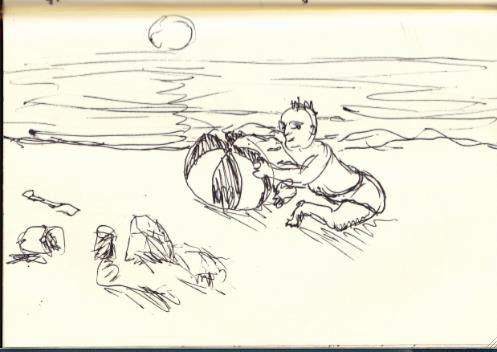
When moving to a new home, there are tons of boxes to open, inevitably you stumble across something from your past. This last move, I found an old sketch of a child playing on the beach from late 90s, quite a few years before my first son was born. I tried to remember why I kept that drawing as it is not the best drawing I have done.

During my early 30s I started to feel like I was stuck in a rut at work and I became quite unhappy for a long period. It lasted long enough for me to say to myself, I think I am depressed. I decided I needed to do something and as I was doing some Aikido at the time, I sought an alternative method of self-healing, I found this cassette tape called the Inner Smile Qi Gong set by Mantak Chia. I practiced every day and part of the set included visualization of something that makes you happy, whatever it is.

For the better part of six months of practicing, I could not fixate on anything in particular. Then after some more time, I was able to conjure children’s laughter in my mind, but only faintly. Then after more time, the sound became clearer and then I could actually see a blurry figure laughing and playing on the beach. I began to attempt to sketch it and during that process a boy playing and laughing on an ocean shore appeared in my mind’s eye. My wife and I had been married for about 5 years at that time and I never had a strong desire to have children and we hadn’t discussed it once until 3 years later. My depression soon passed and the Qigong succeeded in helping me focus on the things I wanted to spend my day thinking, doing, and feeling, and it kept me from falling back into a cycle of darkness.

I no longer practice the inner smile set anymore but I do practice the Tai chi 24 form most days of the week. I still do some 8 Brocades Qigong and a few others occasionally. Both Tai chi and Qigong help me on a daily basis with many of life’s challenges both physical and psychological. The odd thing about this story is that since finding this drawing my wife and I have two sons and I can’t help but wonder if the Qigong I did at that time provide me with a glimpse into the future. And did that glimpse abate my depression, or was it that I uncovered some lost part of myself from childhood, or was it something deeply felt but unknown within the caverns of my limbic system? I guess there is no way to answer those questions, but it does make me wonder.

Wednesday, July 29, 2015

Dreaming and Meditation

Upon entering the house after a night time meditation that invoked the yin power of the full moon into my body,  I realized that summer is fading fast. Then a quick blur of all the projects I had completed since turning 50 this spring spiked in my brain. I have accomplished a lot of projects that I had been wanting to do for years and I challenged myself more than ever.

But the twisty logic I received during my meditation is that my growth isn't from the things I have done it is more about the things I have not done. For years, I have been carrying projects and plans for things that have little chance of materializing due to a number of factors.

So I am not about to pontificate on how growing is about killing your dreams and I am not saying don't have any "pie in the sky" dreams. Dreaming is fun but it is important to focus more energy on the ones you truly want to pursue. You can spend a lot of time dreaming and not producing anything and more importantly not being present in your life. One of the reasons why I meditate often is because it helps inform me about which of my dreams are more doable and more importantly closer to my true self.

Meditation does that because it teaches you the preciousness of energy. Thus helping you clarify what feeds your energy and what depletes your energy. When I started meditating in 1998 in Seattle its effects were immediate. I became more drawn to nature and less drawn to frivolities. So dreaming about something that you truly do not want is more of a drag on your energy than a benefit.

Your friend in the Tao, 

Chris

Wednesday, July 23, 2008

What’s the Buzz about Mindfulness?


In America, mindfulness has been a buzz word since the 80’s and it is just as strong now as it was when it first appeared on the scene. Usually, a buzz word’s life span is pretty short. There is no doubt that mindfulness has staying power. Even though mindfulness has only been in the USA for a few decades, it has fascinated cultures around the world for thousands of years. Currently, there are a group of scientists who are trying to understand what exactly it is about mindfulness that makes people feel so good. The purpose of this essay is define and draw a distinction between mindfulness and meditation. 


Mindfulness is a good term because it implies that people can control their bodily drives by applying their mind in a particular way. It shares many qualities with self-regulation, and all people need that kind of reassurance. In fact, many human pursuits attempt to impose some type of regulatory principle over the body’s “evil” defaults of carelessness and selfishness. In Eastern mindfulness practices, there is a place for the mind to share in the internal regulation of bodily functions not just simply behavior modification. Unfortunately, many people confuse the terms mindfulness and meditation. They are often used synonymously but there are major differences. Mindfulness has been defined many ways. The most common definition is by Jon Kabat-Zinn, who defines mindfulness “as paying attention in a particular way on purpose, in the present moment, non-judgmentally.” Ellen Langer and Herbert Benson were some of the first people to explore this phenomenon. In her 1974 bestselling book “Mindfulness,” she gives us many related phrases like “being open to process.” Later in her 2000 paper on the construct of mindfulness, Langer states her definition this way: “The concept of mindfulness can be best understood as the process of drawing novel distinctions.” Herbert Benson went a different route. He looked at the physiological measures of meditation and found that meditation lowers the heart rate. He called this process the “relaxation response” (Benson & Wallace, 1972). Langer’s and Kabat-Zinn’s definitions make similar points. Langer’s “process of drawing novel distinctions” and Zinn’s “paying attention to things we ordinarily never give a moment’s notice to” propose that the mechanism of action within mindfulness is a cognitive one, while Benson relies more on physiological correlations. 


As you can see, there is still a lot of confusion surrounding the definition of mindfulness. It is a relatively new concept to the West and there are many components to mindfulness. In fact, mindfulness is such a broad term that it maybe impossible to truly define. One important point to bring up is that there are two meanings to mindfulness. First and foremost, it refers to a state of being in which one is being very careful and focusing attention on the task at hand while still keeping the mind open to new possibilities (my definition). Secondly, when many people use the term they actually mean meditation. Meditation is defined as a technique for self-induced manipulation of awareness. When the definition says, “technique,” it is referring to any activity such as, walking, sitting, moving, doing the dishes, and even lying down; really any action that requires intense focus with the intended purpose of altering consciousness.  So when athletes mention “being in the zone” they are talking about a special moment when then are deeply focused and all actions seem effortless and coordinated. My definition of meditation is a category of techniques that build self regulatory awareness over the mind and body, while maintaining a mind open to new possibilities.   


While teaching Tai Chi for the past 7 years, I became interested in how Tai Chi could develop a type of control over the body’s movements. One could control the distribution of weight from one part of their body to another. This more subtle level of control is a skill and it takes time to develop which is rather useful when one has an injury. If the front of one’s knee has a strain, that person could redistribute the weight towards the muscles in back of their knee and avoid re-injuring the front. The interesting element here is that people can intentionally regulate which part of the body received the majority of force or weight. Based on my experience and research in mindfulness meditation, it appears to me that meditation is the same technique of dispersion that is done with the body, only applied to the mind. It has been demonstrated in psychology that people often focus on a small portion of reality when speaking about it in the past tense. That theory is called, focalism. If mindfulness allows a person the ability to shift the attention to other aspects and broaden or enrich the person’s perception of reality in the present moment, then it is a similar tool as Tai Chi. 


I believe that shifting attention happens because of the sensory systems of the brain. Humans have five sensory systems, an optical, auditory, olfactory, gustatory and finally, somatosensory or touch. It is here in the very order that these senses are listed in every scientific text published, is also where our problem begins. Our culture is so visually and auditorily oriented that we suppress or ignore the other senses. When we have a problem we deal with it in our limited ways. This happens so many times we develop a repetitive motion injury of the mind. Our thinking becomes fixated on a narrow set of information and then we have trouble seeing beyond our problem or obstacle. We remain inside a small box. Mindfulness allows an opportunity for the other senses to contribute to our perception of the moment. We feel things emotionally and physically, we also hear things from outside this narrow margin of reality that our cognitive resources confine us to. Mindfulness opens up that door to other possibilities. It brings us outside that proverbial box. Also, we have to mention other possible senses that are not yet recognized scientifically. Although, this might make some scientists wince it is important to understand that things like, x-rays and wireless were science fiction, not too long ago. So that wince could slow the advancement of science. We must remain open to the possibility of other senses if we are to discover them. 


Finally, we could sum up that mindfulness is a large umbrella term that entails many components—for example, some type of “special awareness,” an internal sensory awareness with an external cognitive lens that allows out-of-the-box thinking. There is also a relaxation component and some physiological skills as well, such as posture and breathing; these components of mindfulness work together to assist in regulating these powerful biological determinants. Meditations have a different focus, referring to a specific means, where as mindfulness is a general state of being; a tactics vs. strategy kind of thing, meditation being the tactic and mindfulness being the overall strategy. With meditation, one could be more cognitive in nature while another is more physical. There are many components of a meditation practice, such as breathing, posture, relaxation, and usually a lecture giving instructions on how to deal with thoughts, especially emotionally-charged ones but they are focused. In mindfulness anything could be done mindfully from throwing out the garbage to painting a wall to sitting in a temple in front of a statue of the Buddha. The meditation would be called throwing out the garbage meditation, or painting wall meditation if of course they were performed mindfully. So here we are, meditation is the vehicle with the aim of achieving a state of being called mindfulness.